

Everyone was… shocked
The very next day after the 46% retaliatory tariff was announced, the price of raw shrimp in the Mekong Delta – the country's largest shrimp producing region – began to fall sharply, with a decrease of 10,000-20,000 VND/kg in some segments of large-sized shrimp. This is understandable, as this segment is the most consumed in the US market. Not only did prices plummet, but sales also became very difficult, with some shrimp farmers reporting being unable to contact traders to sell their shrimp, even those they had known for many years. Businesses were equally worried as US customers requested a temporary suspension of deliveries for April and May contracts pending negotiations between the two governments .
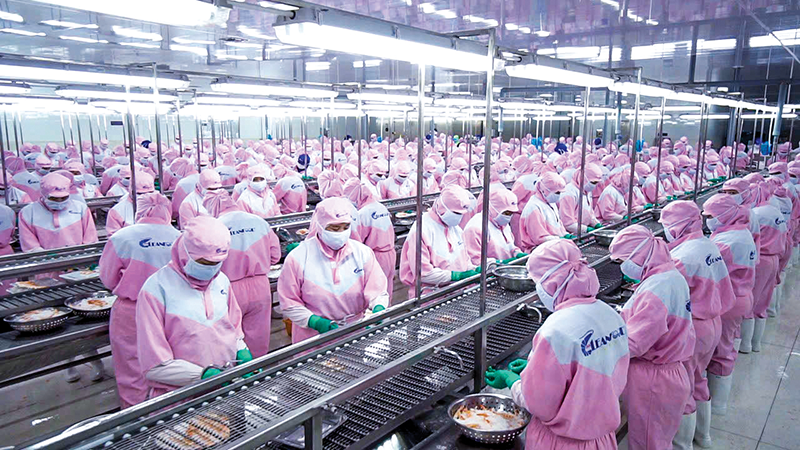
Businesses are taking advantage of the crucial 90-day period to boost exports and seek new markets to overcome the challenging phase.
Their concern stems from the fact that on the morning of April 3-4, right when news broke that the US was imposing a high 46% tariff, approximately 37,500 tons of various seafood were en route to the US, and about 31,500 tons were scheduled for export in April-May 2025. In addition, there were already signed orders for 2025, totaling approximately 38,500 tons. Of these, the most worrying are the 37,500 tons of seafood currently en route to the US and the 31,500 tons expected for export in April and May. The concern stems from the fact that, barring any changes, the 37,500 tons will be subject to a 46% retaliatory tariff upon arrival in the US, while the 31,500 tons expected for export in April and May will certainly be held up, with no buyers due to varying market requirements regarding product design, size, and processing methods.
Over the years, the US has consistently been Vietnam's largest traditional shrimp export market, accounting for approximately 20% of total shrimp export value, ranging from $800 million to $1 billion. Currently, more than 400 Vietnamese businesses are exporting or planning to export seafood to the US market with large, high-value orders. In the context of high competition and anti-dumping duties, the primary method of transporting seafood to the US is DDP (delivery to warehouse), meaning Vietnamese businesses must pay all costs (transportation, insurance, taxes) before delivery and await payment from their US partners. Furthermore, Vietnamese shrimp already faces fierce competition from cheaper Ecuadorian and Indian shrimp, and now, burdened with a 46% tariff – significantly higher than India's 26% and Ecuador's 10% – withdrawing from the US market is no longer a viable option.
Take advantage of the golden opportunity.
The recent decision by the US President to postpone the application of the 46% retaliatory tariff for 90 days has helped 37,500 tons of seafood en route to the US and 31,500 tons expected to be delivered in April and May avoid this high tariff, although they will still be subject to the 10% tariff like most other countries. The first hurdle has been overcome, easing some of the businesses' concerns, but the hectic pace has intensified as they must seize this crucial time to fulfill contracts. This is also why our calls to the directors of several close shrimp businesses were always difficult to connect with, even though the conversations were very brief, despite our close relationship with them.
The US President's decision to postpone the application of reciprocal tariffs is truly good news, giving businesses and shrimp farmers more opportunities and confidence in this shrimp season. This is reflected in the recent rebound in shrimp prices, improved sales, and increased stocking by shrimp farmers. The first objective that the Government and businesses hoped for has been achieved. The next challenge is how to bring the reciprocal tariffs down to a level where Vietnamese goods in general, and seafood in particular, can compete fairly with new competitors. This is the main objective and the greater expectation that both the Government and businesses hope to achieve. Upcoming negotiations on a reciprocal trade agreement and, further, a bilateral trade agreement between Vietnam and the US will undoubtedly be challenging and complex, but we have reason to believe that a better outcome will follow.
Besides the expectation that negotiations between the two governments will yield positive results, businesses are also proactively developing production and business plans to adapt to the new situation. Mr. Vo Van Phuc, General Director of VinaCleanfood Joint Stock Company, said that VinaCleanfood is striving to find and expand potential markets with high shrimp consumption demand, such as Japan, South Korea, Canada, and Europe, to compensate for orders in the US market if the reciprocal tariff is not changed in a way that the company can accept. Most seafood businesses said that adjusting sales and profit plans for 2025 is almost a necessity, but more importantly, they are looking for new directions and new markets, focusing on exploiting the advantages of markets that already have FTAs with Vietnam and also the promising Halal market.
Text and photos: HOANG NHA
Source: https://baocantho.com.vn/thach-thuc-tu-thue-doi-ung-a185426.html


![[Photo] General Secretary To Lam working with Ambassadors and Heads of Vietnamese representative offices abroad attending the 14th National Congress of the Party](/_next/image?url=https%3A%2F%2Fvphoto.vietnam.vn%2Fthumb%2F1200x675%2Fvietnam%2Fresource%2FIMAGE%2F2026%2F01%2F25%2F1769334314499_image.jpeg&w=3840&q=75)


Comment (0)