

Attracting foreign capital into the corporate bond market: Lack of both suitable products and mechanisms.
Liquidity in the corporate bond market is sluggish, with a sharp decline in individual investors, while institutional investors remain limited to banks and securities companies.
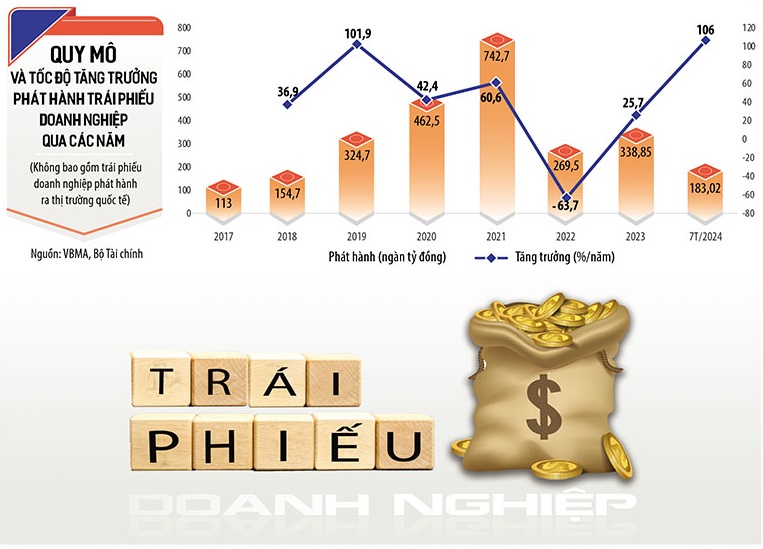 |
| Despite periods of impressive growth, the corporate bond market lacks the mechanisms and quality products to attract foreign investors. (Graphic: Dan Nguyen) |
Without rankings, even the "sharks" are helpless.
Experts believe that the corporate bond market lacks both the mechanisms and quality products to attract "sharks," especially foreign investment capital.
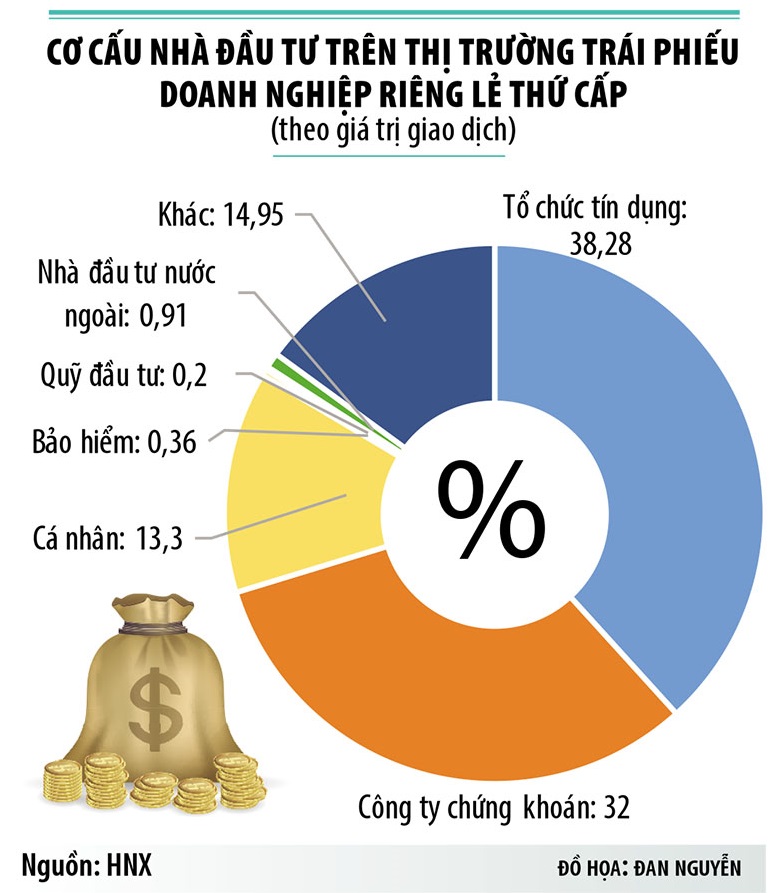
Currently, buyers in the private (secondary) corporate bond market are primarily banks and securities companies (accounting for approximately 80%). Other institutional investors such as investment funds account for only 0.2%, and insurance companies account for 0.36%. Notably, foreign investors account for a mere 0.91%.
According to bond market intermediaries, many financial institutions with tens of billions of USD in assets are interested in investing in the Vietnamese bond market, but are unable to do so due to a lack of both mechanisms and high-quality products.
"Many pension funds and mutual funds are interested in the Vietnamese bond market, but they cannot invest," said Nguyen Quang Thuan, General Director of FiinRatings.
According to Mr. Thuan, this situation arises because these foreign funds base their investments in each country's bonds on the bond's credit rating. This is an international practice, but issuers in Vietnam have not yet adopted this habit. According to the Vietnam Bond Market Association, in the first seven months of this year, only 7% of the value of bonds had credit ratings.
Ms. Duong Kim Anh, Investment Director of Vietcombank Securities Company Limited (VCBS), also stated that when foreign insurance companies want to invest in bonds in Vietnam, the first thing they are interested in is data about the bonds, especially data on the probability of default of the issuing company. This is mandatory for businesses to manage the risks of their investments.
"Almost every foreign fund that contacts VCBS asks if that data exists, and if there is an independent party that provides that data to carry out their risk management activities," said Ms. Duong Kim Anh.
Currently, licensed life and non-life insurance companies in Vietnam manage approximately $30 billion in investments, but only a very small fraction of these companies' investment assets are allocated to corporate bonds.
The Insurance Business Law, which came into effect at the beginning of 2023, prohibits investment in corporate bonds issued for debt restructuring purposes, thus limiting the participation of this group of investors in the corporate bond market.
 |
An opportunity to attract foreign investment right in our own backyard.
In recent times, many businesses have had to issue international bonds to raise capital at interest rates of 8-10% per year, not to mention the costs and risks of exchange rate fluctuations. Meanwhile, raising capital domestically would significantly reduce costs.
"However, in order to develop and attract investors, especially institutional investors, the main infrastructure (policies, legal framework, transparency) is important, but the soft infrastructure (trading on the listed exchange) must follow international practices, especially credit ratings," Mr. Nguyen Quang Thuan recommended.
Furthermore, to attract institutional and foreign investors, experts suggest that the government should consider several tax incentives and refinancing mechanisms. Solutions are needed to improve the quality and diversity of "goods" on the market, especially green bonds.
Mr. Vo Hoang Hai, Deputy General Director of Nam A Bank, recommended that one of the important solutions to attract foreign investors is for Vietnamese businesses to increase the issuance of green bonds.
Currently, the government has a policy to develop green bonds, and the State Securities Commission has also issued a green bond handbook. However, the relevant authorities have yet to issue a green classification list to serve as a basis for issuing green bonds.
In addition, many securities companies have suggested that Vietnam should consider establishing intermediary financial institutions for credit guarantees or bond guarantees. This would restore confidence and diversify the bond products offered to the market. These guaranteeing organizations could be established and operated by large Vietnamese financial and investment institutions and international organizations.
Source: https://baodautu.vn/thu-hut-von-ngoai-vao-thi-truong-trai-phieu-doanh-nghiep-thieu-ca-hang-hoa-lan-co-che-d222895.html
![[Photo] The courage of new recruits of Brigade 144 on the training ground.](https://vphoto.vietnam.vn/thumb/1200x675/vietnam/resource/IMAGE/2026/05/27/1779881651341_anh-man-hinh-2026-05-27-luc-18-32-52.png)

![[Photo] The heat at the fireworks display site on the opening night of the Da Nang International Fireworks Festival 2026](https://vphoto.vietnam.vn/thumb/1200x675/vietnam/resource/IMAGE/2026/05/27/1779889741485_ndo_br_z7872039145157-fecaba5112f39e8352544099d7ef4738-5140-jpg.webp)


































































![[Photo] The courage of new recruits of Brigade 144 on the training ground.](https://vphoto.vietnam.vn/thumb/402x226/vietnam/resource/IMAGE/2026/05/27/1779881651341_anh-man-hinh-2026-05-27-luc-18-32-52.png)





























Comment (0)