

In Ridley Scott's portrayal, Napoleon Bonaparte (played by Joaquin Phoenix) is a military genius who is also a lonely, dreamy, and vulnerable man in the presence of his wife, Joséphine (Vanessa Kirby).
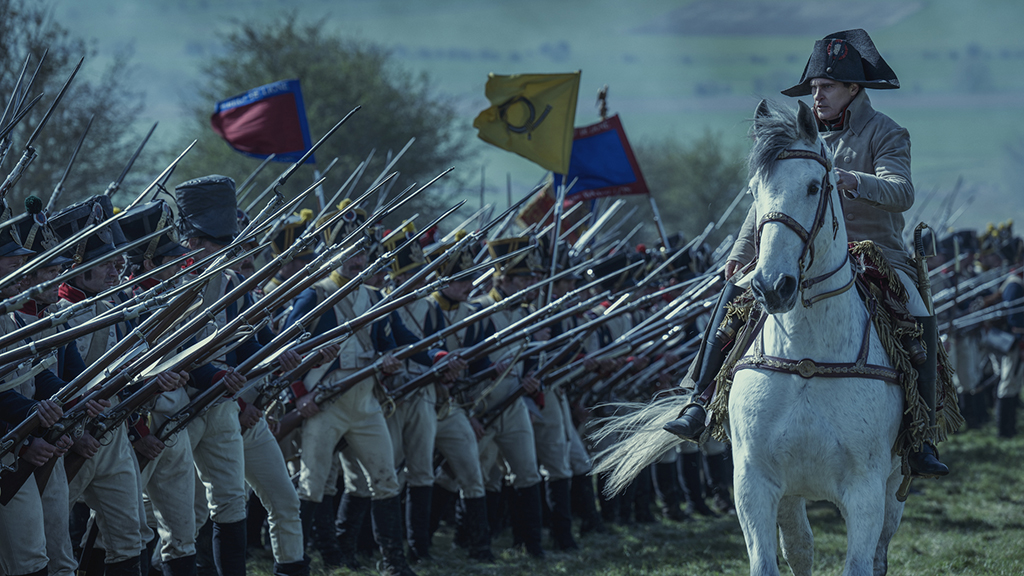
Scene from the movie Napoleon
Napoleon keeps viewers glued to the screen for over two and a half hours, following the unfolding events of the life of one of France's most brilliant emperors, with a full spectrum of emotions: glory and humiliation, jealousy and forgiveness, conquest and surrender… explaining why the French dictator was so warlike yet so insecure. Napoleon's unwillingness to admit defeat in any form, whether in marriage or military, is a key characteristic that makes everything both comical and tragic.
Before his death on May 5, 1821, Napoleon Bonaparte left behind only three words that encapsulated his entire life: France - Army - Joséphine.
The film sparked intense controversy upon its release.
Director Ridley Scott once had a heated argument with French historians over his decision to have the characters speak with an American accent in the film instead of French.
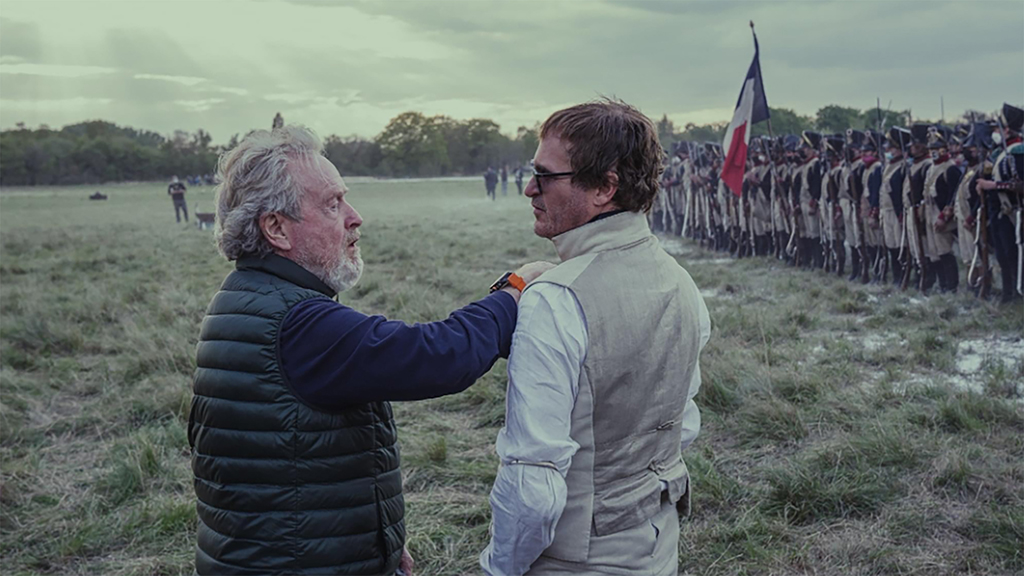
Director Ridley Scott (left) and Joaquin Phoenix on the set of Napoleon.
French historians argue that Napoleon began with a mistake: Napoleon Bonaparte witnessed the beheading of Marie Antoinette – an event that never actually occurred in history.
Historian Jean Tulard (90 years old), who has written dozens of books about Napoleon Bonaparte, stated: "I admire Ridley Scott, but as a history professor at the Sorbonne University, I advise you not to watch this film." Tulard also pointed out that Napoleon never carried a sword at the Battle of Waterloo.
Another historian, Patrice Gueniffey, pointed out even more inaccuracies in the magazine Le Point . The film depicts the dictator's presence during the beheading of Queen Marie Antoinette, while Napoleon was commanding the Battle of Toulon, 700 km from Paris. He also argued that Napoleon's bombardment of the pyramids in the film was purely fictional.
Military historian Dan Snow also pointed out inaccuracies in the production of the $200 million Napoleon film in The Guardian , stating: "Napoléon did not shoot at the pyramids in Egypt or witness Marie Antoinette being beheaded."
Writing in Le Figaro , journalist Romain Marsily, who teaches communications at Sciences Po Paris, commented: "Ridley Scott insults Napoleon, turning him into a mediocre, stupid, ridiculous, and tragic figure."
Ridley Scott launched a highly inflammatory counter-attack in The Times , stating that none of the current French historians lived during that era, so they can't confirm everything. Regarding the scene where Napoleon orders his troops to bombard the Egyptian pyramids, the director nonchalantly responded to The Sunday Times : "I don't know if Napoleon ever did that, but it's the quickest way through cinema to prove he... conquered Egypt!"
Historian Loris Chevalier, historical consultant for the film Napoleon , commented: "We have to accept fictional details, because every film, ultimately, is the artist's own unique work."
Actress Vanessa Kirby commented: "Any interpretation of Napoleon is just a lens, or a perspective. Just like every book you've ever read about the French emperor, there's a different point of view. This film is no different."
Ridley Scott began his film career in 1965 and gained global fame through films such as Alien, Thelma & Louise, Gladiator, Black Hawk Down, American Gangster, Robin Hood, and House of Gucci . He won Emmy, Golden Globe, and BAFTA awards, and received four Oscar nominations, including Best Picture for Gladiator .
Napoleon was released globally on November 22nd and in Vietnam from December 1st under the title Napoleonic Empire. The film has currently grossed approximately $137 million worldwide and 805 million VND in Vietnam.
Source link


![[Photo] The heat at the fireworks display site on the opening night of the Da Nang International Fireworks Festival 2026](https://vphoto.vietnam.vn/thumb/1200x675/vietnam/resource/IMAGE/2026/05/27/1779889741485_ndo_br_z7872039145157-fecaba5112f39e8352544099d7ef4738-5140-jpg.webp)
![[Photo] Life on both banks of the river returns to its bustling pace on the day the Long Bien Bridge opens to traffic.](https://vphoto.vietnam.vn/thumb/1200x675/vietnam/resource/IMAGE/2026/05/28/1779949763708_cau-long-bien-minh-duy-7-3610-jpg.webp)





















































































Comment (0)