


Under the leadership of the Party and the State, the Vietnamese health sector has achieved remarkable accomplishments over the past 70 years.
Under the leadership of the Party and the State, the Vietnamese health sector has achieved remarkable accomplishments over the past 70 years.
Paying tribute to Vietnamese doctors.
During the Covid-19 pandemic, the wrinkled hands of the anti-epidemic workers, constantly soaked in sweat while wearing medical gloves, will forever remain etched in the minds of the people.
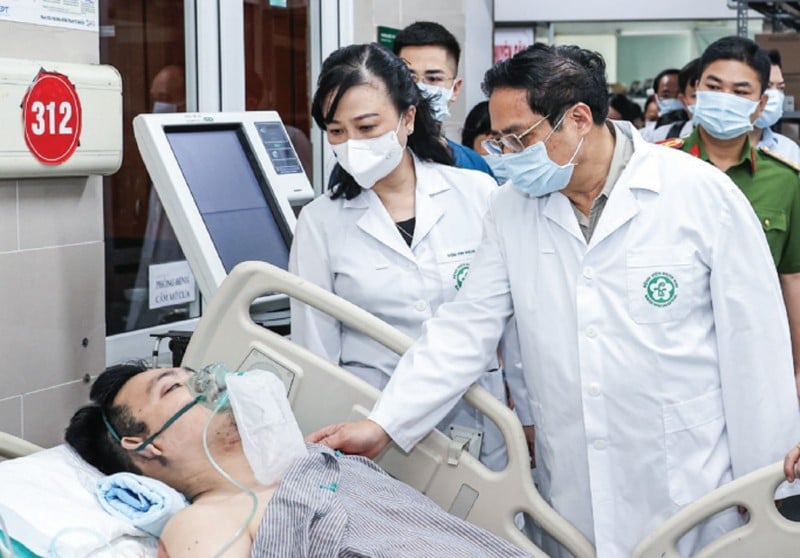 |
| Prime Minister Pham Minh Chinh visits patients. |
The image of exhausted doctors and nurses falling asleep on the ground from exhaustion in the fight against the Covid-19 pandemic will always be remembered. Their sacrifice and dedication are immeasurable, and that is why the Party, the State, and the people always place their full trust in the country's medical staff.
Under the leadership of the Party and the State, the health sector has achieved remarkable accomplishments. From a nationwide network of primary healthcare facilities to specialized medical centers, the Vietnamese healthcare system has become one of the important achievements in the country's reform and development.
In particular, over the years, many doctors and medical staff have demonstrated compassion, resilience, and dedication to the health of the people.
It was during these difficult times that they set aside personal gain, venturing into remote areas to help treat patients under harsh and challenging conditions. These images not only demonstrate sacrifice but also unwavering determination to fulfill the noble mission entrusted to them by the Party and the State.
On the occasion of the 70th anniversary of Vietnam Doctors' Day, Minister of Health Dao Hong Lan sent her gratitude and congratulations to nearly half a million doctors, medical staff, and healthcare workers nationwide on Vietnam Doctors' Day, February 27th. The Minister also wished the health sector continued strong and stable development, worthy of the trust and expectations of the Party, the State, and the people.
Speaking about 70 years of the medical profession, National Assembly Chairman Tran Thanh Man, on behalf of the Party and State leaders, extended sincere thanks to generations of doctors, medical staff, and healthcare workers nationwide. The Chairman emphasized that over the past 70 years, the medical sector has continuously developed and achieved great accomplishments, contributing to the building and development of the country.
The medical professionals were present on battlefields everywhere to care for and treat the wounded, sick, and suffering, as well as our compatriots and comrades. Thousands of doctors and medical staff, including the late Minister Pham Ngoc Thach, Professor Dang Van Ngu, and Doctor Dang Thuy Tram, bravely sacrificed their lives for the cause of national liberation.
In peacetime, the healthcare sector continues to play the role of a living shield, caring for and protecting the health of the people. Especially during the Covid-19 pandemic, doctors, nurses, and healthcare workers have not shied away from sacrifice and hardship, steadfastly fulfilling their mission of "treating the sick and saving lives."
Over the past 70 years, the health sector has built a solid grassroots healthcare network, covering remote areas, border regions, and islands, while also strongly developing specialized medical facilities with advanced technology, making Vietnam one of the leading countries in achieving the United Nations Millennium Development Goals on protecting people's health.
Health and life expectancy indicators for the population have improved; maternal and child mortality rates have decreased rapidly; many infectious diseases have been contained and eliminated; and non-communicable diseases are well controlled.
Vietnamese medical professionals have successfully implemented many advanced medical techniques, particularly in fields such as intervention for complex congenital defects from the fetal stage, pediatrics, cardiology, microsurgery, multi-organ transplantation, limb transplantation, endoscopic surgery, and many other medical achievements. These accomplishments have made a strong mark on the world medical map and have been highly appreciated by the international community.
We are very proud of the achievements that the Vietnamese health sector has made, and the demands placed on the sector in this new development phase will continue to create more motivation for the health sector to constantly strive and strongly develop its potential. This is a great responsibility to meet the expectations of the people and maintain the trust and affection of the entire society.
The Speaker of the National Assembly affirmed that protecting and improving the health of the people has always been a top priority of the Party and the State.
The health sector needs to continue implementing policies on protecting people's health effectively, while also focusing on improving the quality of medical examination and treatment, strengthening human resource training, and building a scientific, national, and accessible healthcare system.
The Speaker of the National Assembly also requested that all levels and sectors continue to pay attention to and care for the material and spiritual lives of doctors, nurses, and medical staff, creating favorable conditions for them to work with peace of mind and serve the people.
The 70th anniversary of Vietnam Doctors' Day is an occasion to look back on the arduous yet glorious journey of the Vietnamese healthcare sector. However, on this occasion, many major challenges still await the healthcare sector in the next phase.
The Chairman of the National Assembly emphasized that the entire healthcare system needs to continue to unite, uphold the glorious traditions of the ngành, innovate, and constantly improve the quality of healthcare for the people. Vietnamese doctors, officials, and medical staff will continue to strive and dedicate themselves to meeting the trust and expectations of the Party, the State, and the people.
In a world increasingly facing challenges such as climate change, environmental pollution, natural disasters, epidemics, and new threats to global health, the task of protecting, caring for, and improving people's health has become a top priority.
With Vietnam's population surpassing 100 million and a rapidly aging population, we need to develop a robust healthcare system and integrate internationally to best meet the health protection needs of our people.
To achieve these goals, the Speaker of the National Assembly requested the Ministry of Health to implement several measures, prioritizing the protection and care of people's health as a top priority.
The Party and the State need to fully institutionalize policies and guidelines on healthcare, ensuring the sustainable development of the healthcare sector. Building a scientific, national, and accessible healthcare system is essential, as taught by President Ho Chi Minh. Focus should be placed on improving the quality of healthcare services at the grassroots level, developing science and technology in healthcare, and strengthening international cooperation in the healthcare field.
Prioritizing healthcare for the elderly and addressing population issues is crucial to achieving the goal of increasing life expectancy and health for the Vietnamese people. Simultaneously, strengthening domestic production of medicines and vaccines, developing the biomedical industry, and ensuring self-sufficiency in the supply of medicines and medical supplies are essential.
Hanoi pays tribute to healthcare workers on the occasion of the 70th anniversary of Vietnamese Doctors' Day.
On the occasion of the 70th anniversary of Vietnam Doctors' Day (February 27, 1955 - February 27, 2025), on the afternoon of February 26, Mr. Nguyen Ngoc Tuan, Deputy Secretary of the Hanoi City Party Committee and Chairman of the Hanoi City People's Council, visited and extended his congratulations to the staff, doctors, and medical personnel at Viet Duc Friendship Hospital and Duc Giang General Hospital. Also present was Ms. Pham Thi Thanh Mai, Deputy Head of the Hanoi City National Assembly Delegation.
During the visit, Dr. Duong Duc Hung, Director of Viet Duc Friendship Hospital, stated that the hospital always receives cooperation and support from the local authorities to successfully fulfill its mission.
In 2024, the hospital successfully performed tens of thousands of complex surgeries, including many highly specialized organ transplants. Simultaneously, the hospital aggressively implemented digital transformation, organized telemedicine consultations via online conferences, and supported technology transfer to lower-level hospitals, including several in Hanoi.
In the coming period, Viet Duc Friendship Hospital will continue to research and apply robots in treatment, deploying advanced techniques to meet the needs of medical examination and treatment, especially serving the people of Hanoi. The hospital will also complete the electronic health record system this year, making it more convenient for people when going for medical examinations and treatment.
On behalf of the Hanoi City leadership, Chairman of the People's Council Nguyen Ngoc Tuan extended his best wishes for health and success to all the doctors, nurses, and medical staff of Viet Duc Friendship Hospital. He also emphasized that the city always prioritizes the healthcare of its people.
In his role as Head of the Steering Committee for Program No. 08-CTr/TU of the Hanoi City Party Committee on "Developing the social security system, improving social welfare and quality of life of the people of Hanoi in the period 2021-2025", he promptly directed efforts to improve the quality of life and healthcare for the people of Hanoi.
At Duc Giang General Hospital, Director Nguyen Van Thuong stated that in 2024, the hospital focused on comprehensive development, improving the quality of medical examination and treatment, and developing human resources. The hospital was particularly successful with its kidney transplant project using living donors and brain-dead donors, with 10 successful kidney transplants, helping to improve the quality of life for patients.
Duc Giang General Hospital has been recognized as a Grade I general hospital, with over 1,000 staff members and 45 departments, serving the medical needs of people in the northern area of Hanoi.
Chairman of the People's Council Nguyen Ngoc Tuan extended his congratulations to the staff and medical personnel of Duc Giang General Hospital, expressing his delight at the hospital's achievements in medical examination, treatment, and healthcare for the people. He also requested the hospital to continue strengthening the application of information technology, improving the capacity of its staff, and taking care of the material and spiritual well-being of its employees.
On the occasion of the 70th anniversary of Vietnam Doctors' Day, Chairman of the People's Council Nguyen Ngoc Tuan expressed his wish that each medical staff member of Duc Giang General Hospital would always uphold a sense of responsibility and follow President Ho Chi Minh's teaching: "A good doctor is like a loving mother," continuing to excellently fulfill the task of caring for the health of the people.
On behalf of the entire staff of Duc Giang General Hospital, Director Nguyen Van Thuong expressed gratitude for the attention of the city's leaders and stated that they would heed the directives to further develop the hospital and meet the healthcare needs of the people.
Artificial intelligence in healthcare: Opportunities and challenges in Vietnam.
Artificial intelligence (AI) is becoming an increasingly indispensable part of human life, especially in the healthcare sector. In Vietnam, the healthcare industry is actively applying AI to improve the quality of healthcare for its citizens, thereby creating significant opportunities for development.
With the support of AI, doctors can make more accurate diagnoses, and thus apply treatment methods that are appropriate for each patient.
This is especially important in the early detection of dangerous diseases such as cancer, cardiovascular diseases, or neurological disorders, where early intervention can save patients' lives. AI not only helps doctors improve accuracy but also helps them work more efficiently, minimize errors, and save time.
Virtual reality (VR) technology is being widely applied in medical training. Through VR, doctors and medical students can simulate and practice surgical procedures in a virtual environment, improving their skills without needing to perform procedures on real patients. This not only speeds up medical training but also helps doctors become more confident and reduces errors in actual surgeries.
One of the key applications of AI in healthcare is predictive analytics. AI can analyze data on patients' medical history and health indicators to detect early signs of serious diseases such as cancer, cardiovascular disease, diabetes, or stroke.
Furthermore, this technology helps hospitals manage resources more effectively, predict the number of patients needing examination each day, and schedule appointments efficiently, minimizing overcrowding and improving the quality of healthcare services.
AI not only helps reduce the manual workload of doctors but also minimizes errors in diagnosis.
One of the major challenges in the healthcare industry is inequality in access to healthcare services. Despite significant technological advancements, many people, especially in remote areas, still lack access to quality healthcare.
AI can address this problem through telemedicine, allowing people in remote areas to receive consultations and medical examinations remotely via mobile phones or tablets. This is an effective solution, especially in the context of a pandemic like Covid-19.
One of the notable achievements in AI application in Vietnam is the Blife device, which supports communication for ALS (amyotrophic lateral sclerosis) patients.
This device, developed by a research team at the University of Technology, Vietnam National University, Hanoi, helps ALS patients communicate more easily through eye movements. It's an application combining AI, virtual reality (VR), and augmented reality (AR), offering significant benefits to patients and improving their quality of life.
Although AI offers enormous potential for improving healthcare systems, its deployment in Vietnam still faces numerous challenges. Hospitals, especially in rural and remote areas, lack the necessary technical infrastructure and connectivity between data systems. Furthermore, the cost of investing in AI is also a major obstacle.
Furthermore, the issue of collecting and standardizing medical data is a significant challenge. Many hospitals currently lack synchronized data storage systems, hindering effective integration into AI systems. Patient security and privacy are also crucial factors to consider when applying AI to healthcare.
Despite facing numerous challenges, AI will undoubtedly play a crucial role in improving the quality of healthcare services in Vietnam. With technological advancements and the pioneering efforts of hospitals, AI will help alleviate the burden on healthcare staff and improve people's access to better healthcare services. The application of AI in healthcare will be a long but necessary step in building a modern and efficient healthcare system in the future.
Source: https://baodautu.vn/tin-moi-y-te-ngay-272-tri-an-cac-thay-thuoc-viet-nam-d249518.html



![[Image] Lunar New Year 2026 is celebrated with great fanfare around the world.](https://vphoto.vietnam.vn/thumb/1200x675/vietnam/resource/IMAGE/2026/02/17/1771339826059_155b0e14cbf624b0045-2993-jpg.webp)













































































![[E-Magazine] Springtime Conversation: Thanh Hoa - New Vision, New Aspirations](https://vphoto.vietnam.vn/thumb/402x226/vietnam/resource/IMAGE/2026/02/17/1771344033131_e-magazine-tro-w1200t0-di2607d272d1101804t11600l1-cover1.webp)
















Comment (0)