

Recirculating hydroponics is a method that uses a nutrient solution to nourish plants instead of soil. The unique feature of this system is that the solution is continuously pumped through the plant roots and then returned to the reservoir, creating a closed loop. The operating principle of this system is: a pump pushes the nutrient solution from the reservoir up through the pipes/troughs where the plants are placed. After flowing through the roots and providing nutrients, any excess solution flows back to the reservoir for reuse. Therefore, this system helps to save water and nutrients to the maximum extent. In addition, hydroponic cultivation avoids soil-borne diseases and allows for self-sufficiency in nutrient supply for the plants.
Mr. Nguyen Quoc Bao, owner of Tan Hiep Farm, said: “I thoroughly researched this method through a practical application. Then I further studied and improved some steps to create a complete process. In 2024, I invested in building four greenhouses for growing cantaloupe, with a total area of 1,200 m² . The average life cycle of cantaloupe is 85 days, and I harvest from day 75-90. Because I plant in rotation, harvesting every 25 days and then sowing seedlings, the farm always has cantaloupe for sale year-round. On average, I harvest about 14 crops per year, yielding 1-1.5 tons per crop. The retail price is 60,000-70,000 VND/kg. After deducting expenses, the profit is about 30%.”
The process of cultivating cantaloupe using a recirculating hydroponic system at Tan Hiep Farm involves many meticulous steps. First, the seeds are germinated for 10 days in a treated coconut fiber substrate. When the seeds sprout and develop roots (from day 10 to day 20), they are transferred to the hydroponic water troughs. Providing nutrients is crucial for the plants' healthy growth because improperly mixed fertilizers can cause precipitation and nutrient loss. Therefore, Mr. Bao has researched and precisely blended various fertilizers to create a compound with the appropriate and balanced nutrient levels, ensuring optimal plant growth at each stage while preventing common diseases.
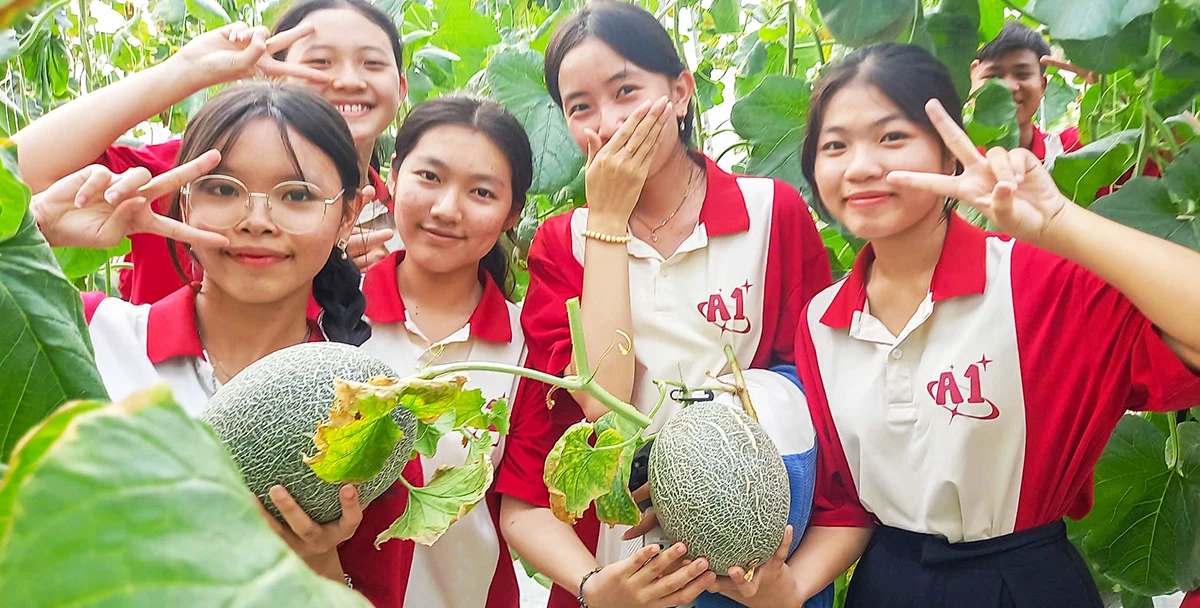
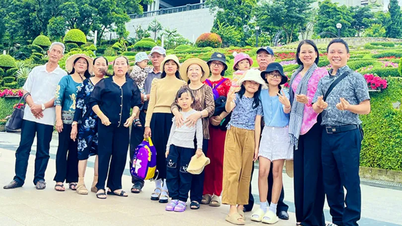
Students visit and experience the melon garden at Tan Hiep Farm. Photo: provided by the farm.
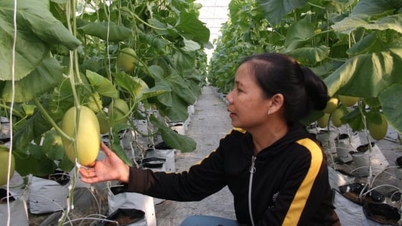
Next, the healthy, green plants are pruned, removing leaves and side branches, then hung on trellises. When the plants are 30 days old and flower, pollination begins. From days 40-55, fruit selection takes place; only the best fruit is left on each vine, while the rest are removed to ensure proper development and high sweetness. Once the fruit is selected, no pesticides are used; the hydroponic system only provides the necessary nutrients for the melons. When the melons reach a sweetness level of 13-15 prisms and weigh between 2.5-4 kg, they are harvested. The melons have a green rind, a yellow-orange interior when cut open, and a sweet, refreshing taste.
Mr. Nguyen Quoc Bao added: "We have harvested watermelons weighing 4-5kg, and some even over 6kg, while still maintaining their sweetness. Our facility is registered for pesticide residue testing, ensuring product safety and providing standard-compliant watermelons to the market."
Besides selling fresh melons, Tan Hiep Farm also sells cantaloupe juice and dried melons to meet the diverse needs of consumers. In particular, the dried melons are made using freeze-drying technology, which helps the melons retain the same nutritional value as fresh melons. The dried melons are crispy, sweet, and a suitable snack for all ages, especially children.
Besides production and business, Tan Hiep Farm also welcomes groups of students from various schools to experience, visit, learn, and find out more about the high-tech agricultural model.
LE THU
Source: https://baocantho.com.vn/trong-dua-luoi-chat-luong-cao-bang-mo-hinh-thuy-canh-tuan-hoan-nuoc-a192736.html




































































Comment (0)