

China is becoming less hesitant to retaliate economically against the US, according to The Economist.
In 2019, as the trade war between the US and China heated up, the People's Daily predicted that China's monopoly on rare earth minerals, crucial for manufacturing modern hardware products, would become a tool for it to counter US pressure.
According to the Organization for Economic Cooperation and Development (OECD), the number of export control regulations imposed by China increased ninefold from 2009 to 2020. However, these restrictions were unplanned, informal, and targeted narrowly. The Economist argues that they were more random than a strategic economic offensive.
But recently, as the US has intensified sanctions against China, Beijing's response has been faster and more extensive. After the US blocked Western chip companies from selling advanced semiconductors and the machinery to manufacture them to China, the country is no longer just making verbal threats as before.
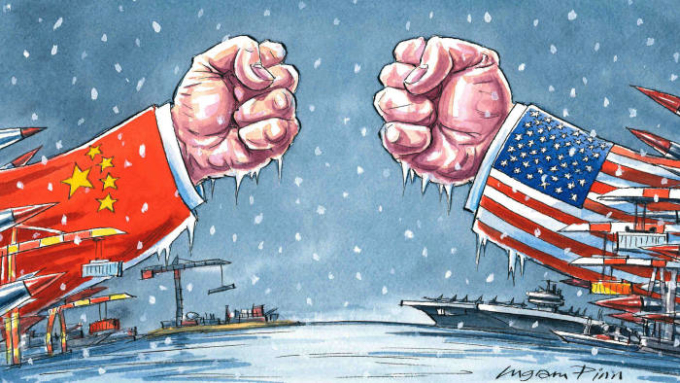
A painting depicting the US-China trade war. Photo: Financial Times
In early July, China announced its latest export controls, focusing on a pair of metals used in chips and advanced technology. A former US Commerce Department official assessed these measures as "just the beginning" of China's retaliation. On July 20, China's new ambassador to the US, Xie Feng, said that his country "cannot remain silent" in the escalating technology war. He hinted that there would be further responses.
This time, Beijing's move appears far more deliberate, according to The Economist . To counter US pressure on the technology sector, Chinese President Xi Jinping has urged regulators to fight back against Western encroachment through international legal action. Lawmakers are building a framework for a stronger Chinese response to the trade war.
Quite a few policies have been introduced recently. In 2020, Beijing released a list of "unreliable entities" to punish any company that undermines China's interests. The export control law, enacted that same year, provided the legal basis for an export licensing regime.
In 2021, the anti-sanctions law allowed for retaliation against organizations and individuals implementing sanctions imposed by other countries. This year, a comprehensive foreign relations law was enacted, permitting countermeasures against a range of economic and national security threats facing the country. It just came into effect on July 1st.
On the same day, an anti-espionage law also came into effect, expanding the scope of operations for Chinese security agencies. Meanwhile, the country also tightened various cybersecurity and data security rules.
The new policies were implemented immediately, not just for show. In February, Lockheed Martin and a subsidiary of Raytheon—two American arms manufacturers—were placed on a list of unreliable entities after shipping weapons to Taiwan.
These companies are blocked from new investments in China as well as trade, among other restrictions. In April, Micron, a US chipmaker, was investigated by China's cybersecurity authorities under a new cybersecurity law. After Micron failed a security review, regulators banned the use of its chips in the country's critical infrastructure.
The vague wording of the laws makes it difficult for Western companies to assess the potential impact on their business operations in China. Henry Gao of the Singapore Management University cites, for example, the punishment of anyone acting in a way deemed "harmful to China's national interests in the course of engaging in international trade."
Several foreign law firms in China have been asked by Western clients to assess the risk of being investigated. One lawyer noted that American technology companies specializing in manufacturing hardware components such as memory chips should be wary of surprise investigations.
Similarly, new Chinese laws allowing the government to restrict various minerals and components are creating uncertainty for foreign buyers. David Oxely, Head of Climate Economics at Capital Economics, notes that one group affected is Western green energy technology manufacturers. Battery manufacturers, in particular, are heavily reliant on China throughout their supply chains.
Last year, China's Ministry of Commerce proposed banning the export of precast technology used in the manufacture of solar panels. If implemented, this ban could stifle the development of solar energy technology in the West, while increasing demand for finished solar panels from China.
Restrictions on gallium and germanium could also cause headaches for the U.S. Effective August 1, exporters must obtain licenses to sell these two metals to foreign customers. China produces 98% of the world's crude gallium, a key component in advanced military technology, including the U.S. next-generation missile defense and radar systems.
A shock to the gallium supply could cause long-term problems for the U.S. defense industry, according to CSIS, a Washington-based think tank. Furthermore, a gallium-based compound, gallium nitrite, could form the basis of a new generation of high-performance semiconductors.
But China is also said to need to proceed cautiously with its retaliatory actions. Peter Arkell, chairman of the China Global Mining Association, noted that the country re-imports many finished products manufactured overseas using rare earth elements, so the bans could backfire on Chinese companies.
Complete export bans would also prompt the West to build its own suitable production capacity and seek substitutes, according to commodity strategist Ewa Manthey at ING Bank (Netherlands). This would ultimately weaken China's power.
China's labeling of Western companies with significant operations as unreliable entities could also jeopardize thousands of Chinese jobs. This explains why, instead of blacklisting the entirety of Raytheon—a Pratt & Whitney subsidiary with 2,000 employees in China—the Ministry of Commerce limited the ban to the company's defense business.
To date, only the Chinese Ministry of Commerce and Foreign Affairs has implemented retaliatory policies. According to Henry Gao, Western businesses fear that tougher authorities in Beijing will intervene. Accordingly, if the technology war escalates further, China's National Security Commission could orchestrate an economic response. If that happens, the consequences would be far greater, not just for American and Chinese CEOs.
Phiên An ( according to The Economist )
Source link
![[Photo] Ba Lang An Lighthouse - the "eye of the sea" amidst the "rock museum" of Quang Ngai province.](https://vphoto.vietnam.vn/thumb/1200x675/vietnam/resource/IMAGE/2026/05/29/1780038698840_anh-man-hinh-2026-05-29-luc-14-10-42.png)
![[Image] Pleasant weather helps students enter the 10th grade entrance exam with confidence.](https://vphoto.vietnam.vn/thumb/1200x675/vietnam/resource/IMAGE/2026/05/29/1780034401612_ngay-1-thi-lop-10-minh-duy-8-5009-jpg.webp)

























































































Comment (0)