

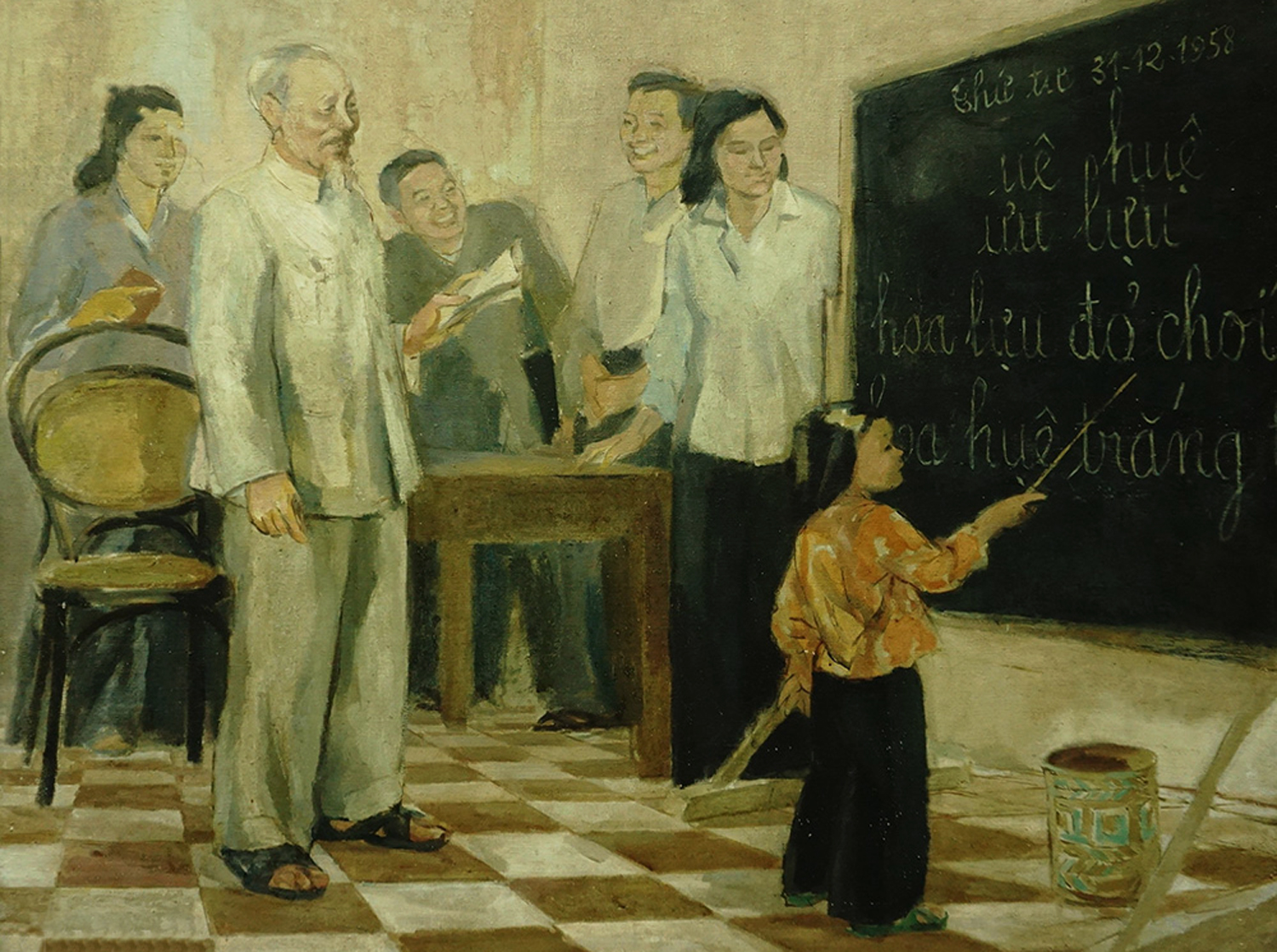
Uncle Ho visits a primary school classroom (painting by artist Do Huu Hue). Source: nhandan.vn
The fundamental content of Ho Chi Minh's thought on human rights is central to, and serves as the goal and driving force of, the country's development.
Firstly , Ho Chi Minh's thought on human rights is a system of scientific , objective, comprehensive, and dialectical viewpoints, distilled from the cultural and historical values of thousands of years of the nation and the essence of human culture regarding humanity and human liberation; a unique and developing system of scientific theories on human rights, encompassing rights, needs, and interests stemming from the inherent, natural dignity of each person, as an individual, a member of the community, the nation, and humanity.
The key values in Ho Chi Minh's thought on human rights include: 1- The goal/ideal value: Independence - Freedom - Happiness for each individual and the entire nation; 2- The driving/means value of innovation and creativity; 3- A human rights-based approach in the activities of the Party, government, political and social organizations, and other social organizations to build a new social order - socialism; 4- The prerequisite value of legal thinking, establishing a new democracy, and building a socialist rule of law state in Vietnam for human rights; 5- Ho Chi Minh's thought on human rights is an important cultural, historical, and ideological value, serving as a guiding principle for better human rights protection in Vietnam. 6. Ho Chi Minh's thought on human rights has timeless value not only in Vietnam but also worldwide, reflecting the fundamental principles of justice, freedom, and humanity.
In Ho Chi Minh's thought, the core values of human rights are three immutable elements: "Independence - Freedom - Happiness." National independence is a prerequisite for guaranteeing human rights. Freedom is a natural and fundamental right of every individual, including freedom of thought, freedom of speech, freedom of association, freedom of business, etc.; only when each individual is free to develop can the country develop comprehensively. The happiness of the people is not only about a comfortable material life, but also about spiritual satisfaction, essentially ensuring that all citizens are guaranteed their basic rights and live in a just, democratic, and civilized society, a safe and healthy environment. For President Ho Chi Minh, human rights are: Independence for my Fatherland, Freedom for my compatriots, and Happiness for the people of my country. His ultimate desire was "to make our country completely independent, our people completely free, everyone has enough food and clothing, everyone has access to education" (1) , to free the working people from poverty, to give everyone jobs, to make them well-fed and live a happy life. He affirmed, "if the country is independent but the people do not enjoy happiness and freedom, then independence is meaningless" (2) .
“ Independence – Freedom – Happiness” are dialectically related and inseparable from the goal of national independence and happiness for all – the burning aspiration of President Ho Chi Minh, which became the national name of Vietnam. From 1945, when the Democratic Republic of Vietnam was first established, the national name emphasized these three core values: “ Independence – Freedom – Happiness ”.
Human rights are a central, core, and crucial value in Ho Chi Minh's thought, encompassing national, contemporary, and state values throughout all revolutionary periods, especially in the current context of new development. Applying and creatively developing Ho Chi Minh's thought and absorbing the best of humanity, the value of human rights should be placed at the center of the national value system . This recognition will provide important guidance for building and perfecting institutions and for implementing policies and laws; simultaneously, it will uphold the values of human rights in addressing political, economic, cultural, and social issues, serving as a criterion for evaluating the effectiveness of institutions, particularly the socialist rule of law in Vietnam.
Secondly , Ho Chi Minh's thought on human rights has been and continues to be a guiding principle for supplementing and developing the Party's theories on humanity, human liberation, comprehensive human development, human rights, socialist democracy, the socialist rule of law state of the people, by the people, and for the people, and the socialist-oriented market economy.
Continuing to thoroughly understand Ho Chi Minh's thought on human rights throughout the Party, the people, and the armed forces is a prerequisite for ensuring the implementation of the Party's resolutions, the State's policies and laws, as well as international commitments on human rights, and for building and perfecting Vietnam's development model from now until 2030, with a vision to 2045, for a peaceful, independent, democratic, prosperous, civilized, and happy Vietnam.
Thirdly, the people are always the subject of all power, the invincible source of strength and the highest goal and driving force of all national development policies and viewpoints. The 13th Party Congress affirmed: “The people are the center and the subject of the renovation, construction and protection of the Fatherland; all policies and guidelines must truly originate from the lives, aspirations, rights and legitimate interests of the people, taking the happiness and well-being of the people as the goal to strive for” (3) . During his lifetime, President Ho Chi Minh always emphasized the role and strength of the people, people's sovereignty, and the freedoms and happiness of the people. Therefore, it is necessary to continue to thoroughly understand and correctly apply the viewpoint that the people are the subject, the center and the highest goal of all policies, guidelines and development paths. “ Happiness for the people is a noble and sacred value system of the nation and people, a value system that the path to socialism needs to achieve in our country, and at the same time it is also the value system of every Vietnamese citizen. President Ho Chi Minh affirmed when asked by an international journalist about “What is socialism?”, he replied: “Independence for my Fatherland , freedom for my nation and my people , happiness for my compatriots , that is all I want, that is what I understand!” (4) . He emphasized: “Socialism is about how to make the people have enough to eat and wear, become happier and happier, everyone can go to school, have medicine when sick, the elderly can rest when they can no longer work, bad customs and traditions are gradually eliminated... In short, society is progressing more and more, material wealth is increasing, and the spirit is getting better and better…” (5) .
Ho Chi Minh's thought on human rights is a revolutionary, scientific and practical theoretical system on the basic rights and freedoms of each person, linked to the right to national independence, the right to national self-determination, and the necessary and realistic conditions to ensure and realize these rights. The thought is based on the human being as the center, where human rights need to be realized. He affirmed: "Our State must develop the democratic rights and political life of the entire people, to promote the activeness and creativity of the people, making every Vietnamese citizen truly participate in managing State affairs" (6) .
Fourthly , Ho Chi Minh's thought on human rights is a system of theories developed based on Marxism-Leninism, the essence of traditional national values on human beings, human liberation, and fundamental human rights and freedoms, and is a direct result of the process of summarizing practical experience and revolutionary activities of the President. The Marxist viewpoint points out that the development of freedom and comprehensive human development is a historical process; at the same time, respecting, guaranteeing and realizing human rights and the freedoms of each person is also the driving force and goal of rapid, sustainable and inclusive development. President Ho Chi Minh always placed the fundamental rights and interests of the people at the center of all decisions: "The most important thing in our current economic plan is to gradually improve the lives of the people " (7) . The revolutionary cause of successfully building socialism, ultimately and with its noble goal, is for the development of freedom, prosperity, happiness, empowerment, and the enjoyment of fundamental human rights in all areas—political, civil, economic, social, cultural, environmental, and security. This stems from Ho Chi Minh's thought on human rights and the right to development; therefore, it is necessary to particularly emphasize the dialectical and inseparable connection between the elements of the goal of "National independence linked with socialism" and the continuous guarantee and realization of human rights. Ho Chi Minh's thought on human rights reflects a contemporary vision of inclusive and comprehensive development, which has been and continues to be deeply reflected in all the Party's guidelines and viewpoints, and in the State's policies and laws, placing human beings and human rights at the center. Therefore, recognizing, protecting, and guaranteeing human rights and civil rights has always been the goal and driving force of building socialism and achieving comprehensive human development, freedom, and happiness.
President Ho Chi Minh always emphasized the principle of social justice, equality, empowering and enjoying rights for all people, considering it the essence of the new social system, the socialist system. He affirmed that it is “a society without the exploitation of man by man, an equal society, meaning that everyone must work and has the right to work, those who work more receive more, those who work less receive less, and those who do not work receive nothing” (8) . According to him, social justice and equality for all people can only be achieved in the new social system, which is the democratic republic, the socialist system. Only under such a good social system can the working people enjoy more and more, more fully, justice and equality, and have both “obligations and rights ” (9) .
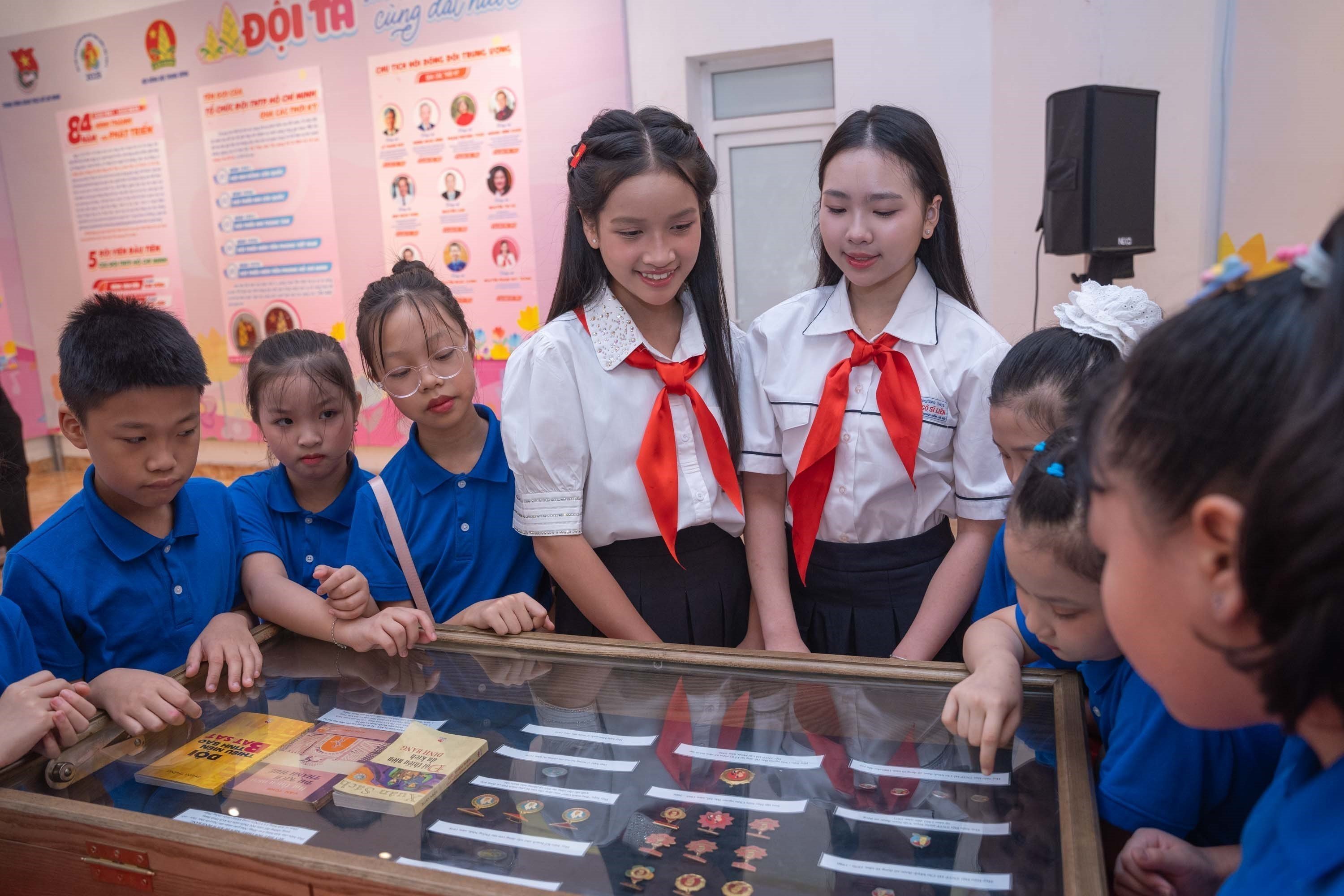
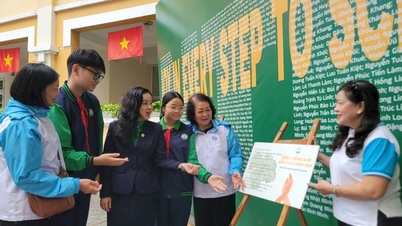
Children and teenagers listen to a presentation about the glorious 84-year journey of formation and development of the Ho Chi Minh Young Pioneers Organization. (Photo: VNA)
The timeless value of Ho Chi Minh's thought on human rights is central to and a driving force of social development.
Ho Chi Minh's thought on human rights holds timeless significance, especially when viewed through the lens of modern international legal theory and international human rights law. The United Nations has begun emphasizing an all-encompassing, holistic, and comprehensive approach to human rights in socio-economic development and national development policies in general, starting in 2000 (less than a quarter of a century). However, Ho Chi Minh's thought on human rights already contained profound and forward-thinking content, nearly a century prior. The United Nations Millennium Development Goals and the United Nations Sustainable Development Goals, as reflected in the action programs of international organizations and institutions, have recently shown particular interest in viewing human rights as the central focus of development.
President Ho Chi Minh emphasized the importance of the dialectical unity and inseparable connection between individual rights and national rights in development, and that development must aim to bring about substantive rights, such as "everyone having enough food and clothing, everyone having access to education." This is an all-encompassing approach that places everyone, each individual, at the center of development. In particular, he always stressed: "a country under slavery cannot have free people," therefore, individual freedom must be linked to the freedom and independence of the nation, and the right to life of the individual is inextricably linked to the right to existence of the nation. Ho Chi Minh's thought on realizing the right to life, freedom, and the pursuit of happiness for the Vietnamese people in the 20th century serves as a model of the indomitable spirit and will to fight for freedom, peace, and development of colonial peoples around the world. Vietnam is also one of the exemplary countries of the United Nations in guaranteeing and realizing human rights, freedom, and the right to development, especially freedom from the oppression and enslavement of imperialism and colonialism, freedom from poverty, the right to life, and the right to comprehensive development in all aspects, including material and spiritual life (the right to housing, employment, education, access to and enjoyment of cultural values, living in a healthy environment),... through achieving the Millennium Development Goals very early and successfully achieving the Sustainable Development Goals. Vietnam has actively participated in many multilateral and bilateral mechanisms and institutions in the region and globally, such as ASEAN, the United Nations, the United Nations Human Rights Council, etc.
Nearly 40 years of national renewal and development have proven the superiority of the socialist regime and the Vietnamese development model, which places people and human rights at the center, as the driving force and goal of rapid and sustainable development for "Independence - Freedom - Happiness" for the nation, for each individual, and for all citizens. The achievements of the Vietnamese development model stem from the theoretical and practical premise of continuously ensuring and realizing human rights, freedom, and happiness for each person. It is considered a model by the United Nations for guaranteeing freedom from fear (from enslavement, injustice, inequality), freedom from extreme poverty, and the freedom to develop the inherent capabilities of each individual, each community, and each nation. The timeless values of Ho Chi Minh's thought on human rights remain relevant, especially in the context of the country entering a new era of development, an era of national progress for Vietnam.
------------------------
(1) Ho Chi Minh: Complete Works , National Political Publishing House, Hanoi, 2011, vol. 4, p. 187
(2) Ho Chi Minh: Complete Works , op. cit ., vol. 4, p. 64
(3) Documents of the 13th National Congress of Delegates, National Political Publishing House, Hanoi, 2021, Vol. I, pp. 27-28
(4) Ho Chi Minh : Biographical Chronicle, National Political Publishing House, Hanoi, 2006, Vol. 1, p. 112
(5) Ho Chi Minh: Complete Works , op. cit ., vol. 13, p. 438
(6) Ho Chi Minh: Complete Works , op. cit ., vol. 12, p. 374
(7) Ho Chi Minh: Complete Works , op. cit ., vol. 10, p. 314
(8) Ho Chi Minh: Complete Works , op. cit. , vol. 11, p. 241
(9) Ho Chi Minh, Complete Works , op. cit. , vol. 8, p. 264
Source: https://tapchicongsan.org.vn/web/guest/van_hoa_xa_hoi/-/2018/1086002/tu-tuong-ho-chi-minh-ve-quyen-con-nguoi-la-trung-tam%2C-muc-tieu%2C-dong-luc-phat-trien-dat-nuoc.aspx

















![[Image] Close-up of the newly discovered "sacred road" at My Son Sanctuary](/_next/image?url=https%3A%2F%2Fvphoto.vietnam.vn%2Fthumb%2F1200x675%2Fvietnam%2Fresource%2FIMAGE%2F2025%2F12%2F13%2F1765587881240_ndo_br_ms5-jpg.webp&w=3840&q=75)











































Comment (0)