

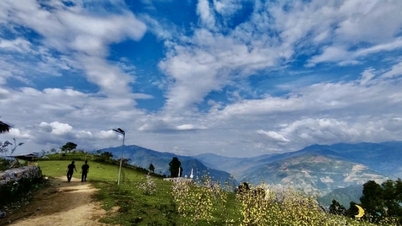
Chi Linh Mountain – a majestic and rugged mountain range in western Thanh Hoa province – is closely associated with the early, arduous days of the Lam Son Uprising. It is also home to a large number of ethnic minority communities. With its historical and cultural relics, beautiful natural scenery, and cool climate, Chi Linh Mountain is gradually transforming, becoming an attractive destination for community-based tourism , exploration, and experiences.
 Ma Hao Waterfall, located at the foot of Chi Linh Mountain, is associated with the story of the loyal dog of the Lam Son rebels.
Chi Linh Mountain, also known as Pu Rinh (or Bu Rinh) Mountain, has its highest peak reaching over 1,000m and stretches across the territories of Lang Chanh and Thuong Xuan districts in Thanh Hoa province. More than just a majestic mountain range, Chi Linh Mountain is also one of the bases associated with the arduous years of the Lam Son Uprising.
Tracing back through history, future generations learn many interesting things about the famous Chi Linh mountain in western Thanh Hoa province. More than 600 years ago, the Tran dynasty weakened, and the Ho dynasty took over but lacked popular support, leading to national instability. Taking advantage of this situation, the Ming dynasty from the North invaded our country. Under the Ming rule, the lives of our people were miserable and desperate. Many uprisings against the foreign invaders broke out, but all failed.
At that time, Le Loi, the leader of the Kha Lam region, rallied the people to gather in the Lam Son mountains to discuss strategies for fighting the enemy. After the Lung Nhai Oath, Le Loi proclaimed himself King of Binh Dinh and raised the banner of rebellion.
In the beginning, the uprising faced countless difficulties due to its weakness and lack of resources. In particular, with the ambition to crush the rebellion, the Ming invaders concentrated their forces to suppress it. In this situation, with his resourcefulness, King Le Loi of Binh Dinh decided to withdraw his troops to the high mountains of Muong Mot (believed to be Bat Mot today), from there advancing deep into the Chi Linh mountains. At that time, all roads into the Chi Linh mountains were "blocked" by the enemy, who sent troops to search everywhere, determined to capture their leader, Le Loi.
The Lam Son rebels found themselves in a perilous situation: food supplies were scarce, transportation routes were cut off, soldiers suffered from hunger, cold, and rampant disease, and morale wavered... In this critical situation, to relieve the siege, in the mountains of Chi Linh, Le Lai risked his life to save his leader.
“This was not just a plan, but a bold and strategic decision in Le Loi's military art in the mountainous region of Lang Chanh. This land witnessed the steadfast sons and daughters of the nation sacrificing themselves for independence and freedom... And this very land witnessed special and rare events of the long and arduous resistance war, a bloody battlefield where the ‘bloody path’ was opened to deceive the enemy and escape the most perilous situation during the initial siege at Chi Linh - Lang Chanh, in order to preserve the forces and the central command - the soul of the resistance war” (Lang Chanh District Gazetteer).
After consolidating their forces, the Lam Son rebels left Chi Linh mountain and engaged in fierce battles with the Ming invaders, causing them to panic. This only fueled the enemy's desperate attempt to crush the uprising. Once again, the Lam Son rebels had to retreat to the Chi Linh mountains. There, they received support and solidarity from the people of various ethnic groups, who shared their hardships and fought alongside them against the foreign invaders.
During their time in the Lang Chánh mountains, Lê Lợi and his generals and rebel army remained steadfast, maintaining their resolve and determination to overcome all dangers. The support of the people of various ethnic groups in the Chí Linh and Lang Chánh mountain areas, along with the resourcefulness of the supply general Nguyễn Nhữ Lãm, helped the Lam Sơn rebels overcome those arduous months, escape the encirclement and pursuit of the Ming army, and survive and develop.
During the Lam Son Uprising, the rebel army retreated to Chi Linh Mountain many times to preserve and consolidate their forces. Each retreat to Chi Linh was under perilous circumstances. Assessing the role of Chi Linh Mountain in the Lam Son Uprising, many researchers agree that it was truly "a place of departure and a place of return." A return to seek refuge, hide, and restore forces. From there, they would continue to go forth and fight...
Not only was it one of the bases of the Lam Son Uprising, according to author Bui Van Nguyen (in the book "Patriotism in Literature during the Lam Son Uprising"), but a crucial oath ceremony took place at Chi Linh Mountain – after the Lung Nhai Oath Ceremony: “It is unclear whether, after the Lung Nhai Oath Ceremony, there were other oath ceremonies between Le Loi and his generals at the beginning of the uprising. We only know that after the ninth day of the first month of the Mau Tuat year (1418), when the enemy surrounded them and Le Lai exchanged clothes to save his life, Le Loi took refuge in Chi Linh Mountain. On the eighteenth day of that month, an oath ceremony was held with 35 generals present. This may have been an important oath ceremony, both to strengthen confidence and to expand forces… Although Linh Son is ranked after Lam Son, it is much more strategically important. The four times Le Loi and his army retreated to Linh Son were all perilous.”
As time passes, returning to the majestic mountains and forests of Chi Linh in Lang Chanh district, following the course of history, future generations are once again immersed in the heroic spirit of the uprising of yesteryear, through stories and legends.
Legend has it that once, after being besieged for a long time by the Ming invaders on Chi Linh Mountain, the rebel army ran out of food and water. At that time, a cuckoo's call echoed from afar, and the soldiers followed the sound and found a water source. From then on, the people of the region considered the cuckoo a benevolent bird and therefore did not eat its meat. Instead, they would offer sticky rice cooked in bamboo tubes and roasted chicken as offerings... (according to the Lang Chanh District Gazetteer).
The Ma Hao waterfall (Ma Hao meaning "dog yawning") in Tri Nang commune (Lang Chanh district) is associated with a legend about the loyalty of a dog that followed the Lam Son rebels. According to legend, during a pursuit by the Ming invaders and their pack of ferocious mastiffs, the loyal dog that followed King Le Loi of Binh Dinh bravely fought back against the ferocious dogs, allowing the rebels to successfully cross the waterfall. Moved by the dog's loyalty, King Le Loi later named the waterfall Ma Hao.
Also in the Nang Cat village area, Tri Nang commune (Lang Chanh district) - the central area of Chi Linh mountain, there used to be a shrine dedicated to the Lam Son rebels and a temple dedicated to Le Loi. Today, the shrine dedicated to the Lam Son rebels at the foot of Ma Hao waterfall has been restored.
From its historical significance, Chi Linh Mountain has become a tourist destination and a cultural exploration spot for visitors from near and far. In particular, Tri Nang commune, home to Ma Hao Waterfall (on Chi Linh Mountain) and the Nang Cat Community Ecotourism Area, is gradually becoming a popular destination.
In particular, in recent years, the Chi Linh Son Festival, held at the Nang Cat - Ma Hao Waterfall community eco-tourism area organized by Lang Chanh district with many vibrant activities, has created an attraction, drawing tourists to the cultural space at the foot of Chi Linh mountain.
Mr. Trinh Duc Hung, Head of the Culture and Information Department of Lang Chanh District, said: “Nang Cat is one of the oldest Thai ethnic villages in Lang Chanh District. It bears the mark of the Lam Son Uprising, associated with the Chi Linh mountain base, and boasts advantages in natural landscapes, surrounded by mountains and forests, with a clean and cool climate, and the Ma Hao waterfall – one of the most beautiful waterfalls in Thanh Hoa province… These are important conditions for developing community tourism, exploration, and experiences in Nang Cat village… In order to make Nang Cat a truly attractive destination, Lang Chanh District is completing the necessary procedures to attract investors to develop community tourism in Nang Cat village…”
Text and photos: Khánh Lộc
Source

![[Photo] Ba Lang An Lighthouse - the "eye of the sea" amidst the "rock museum" of Quang Ngai province.](https://vphoto.vietnam.vn/thumb/1200x675/vietnam/resource/IMAGE/2026/05/29/1780038698840_anh-man-hinh-2026-05-29-luc-14-10-42.png)


![[Image] Pleasant weather helps students enter the 10th grade entrance exam with confidence.](https://vphoto.vietnam.vn/thumb/1200x675/vietnam/resource/IMAGE/2026/05/29/1780034401612_ngay-1-thi-lop-10-minh-duy-8-5009-jpg.webp)




























































































Comment (0)