

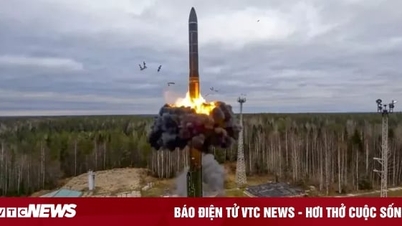
Russia's Zircon hypersonic missile can fly at speeds up to 11,000 km/h and strike a moving ship.
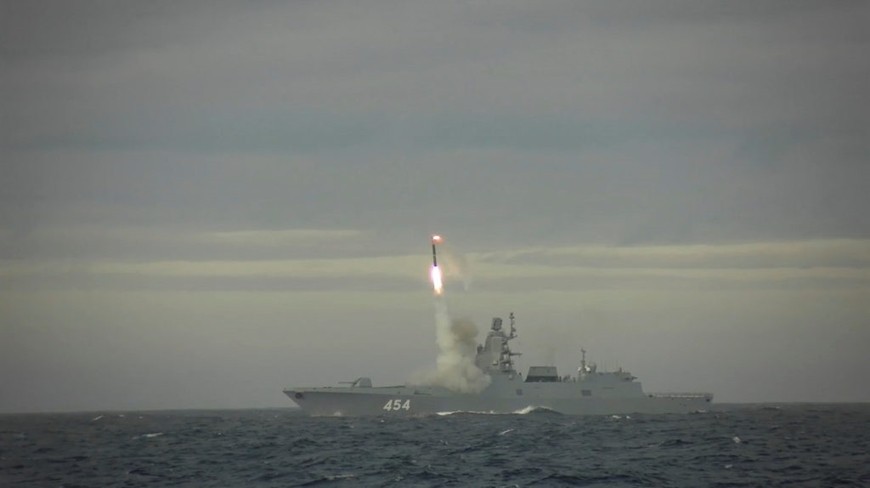 |
| The frigate Admiral Gorshkov test-fired Russia's Zircon hypersonic missile in December 2020. (Source: RIAN) |
On January 26, the TASS news agency quoted Alexander Leonov, head of NPO Mashinostroyeniya, the company that produces Russia's new generation Zircon hypersonic missile, as saying that the missile needs further testing before it can be put into service, and this process will take some time.
Leonov noted that putting the Zircon missile into service "is not a quick procedure" and will involve "a certain number of tests".
It is not yet clear what form this will take.
The Zircon hypersonic missiles, launched from the sea, are believed to have a range of 900 km and can travel at speeds many times faster than the speed of sound, making defense against this type of missile extremely difficult.
Russia has announced it will equip its new nuclear submarines with Zircon missiles.
In February 2023, Sidharth Kaushal, a naval warfare expert at the Royal United Services, a British defense think tank, stated that Zircon is a powerful weapon but also has significant limitations.
The expert said: "The deployment of Zircon is a significant development, but its importance should not be overstated."
According to him, Russia's Zircon hypersonic missile can do two things: fly at speeds up to 11,000 km/h – making it very difficult to shoot down; and hit a moving ship. However, this missile cannot do both things at the same time.
Russian President Vladimir Putin hailed this hypersonic weapon as "invincible." Meanwhile, Moscow officials claim the 3M22 Zircon missile can travel at Mach 9, equivalent to approximately 11,000 km/h, a speed far beyond the capabilities of current tactical anti-missile defense systems.
However, experts note that objects moving at supersonic speeds—from Mach 5 and above—ionize the surrounding air, creating a plasma shell around the object that blocks radar signals.
Source

![[Image] Leaked images ahead of the 2025 Community Action Awards gala.](/_next/image?url=https%3A%2F%2Fvphoto.vietnam.vn%2Fthumb%2F1200x675%2Fvietnam%2Fresource%2FIMAGE%2F2025%2F12%2F16%2F1765882828720_ndo_br_thiet-ke-chua-co-ten-45-png.webp&w=3840&q=75)
![[Live] 2025 Community Action Awards Gala](/_next/image?url=https%3A%2F%2Fvphoto.vietnam.vn%2Fthumb%2F1200x675%2Fvietnam%2Fresource%2FIMAGE%2F2025%2F12%2F16%2F1765899631650_ndo_tr_z7334013144784-9f9fe10a6d63584c85aff40f2957c250-jpg.webp&w=3840&q=75)
![[Photo] Prime Minister Pham Minh Chinh receives Lao Minister of Education and Sports Thongsalith Mangnormek](/_next/image?url=https%3A%2F%2Fvphoto.vietnam.vn%2Fthumb%2F1200x675%2Fvietnam%2Fresource%2FIMAGE%2F2025%2F12%2F16%2F1765876834721_dsc-7519-jpg.webp&w=3840&q=75)

![[Photo] Prime Minister Pham Minh Chinh receives the Governor of Tochigi Province (Japan)](/_next/image?url=https%3A%2F%2Fvphoto.vietnam.vn%2Fthumb%2F1200x675%2Fvietnam%2Fresource%2FIMAGE%2F2025%2F12%2F16%2F1765892133176_dsc-8082-6425-jpg.webp&w=3840&q=75)














































![[Live] Closing Ceremony and Award Presentation for the "Impressive Vietnam Tourism" Video/Clip Creation Contest 2025](https://vphoto.vietnam.vn/thumb/402x226/vietnam/resource/IMAGE/2025/12/17/1765974650260_z7273498850699-00d2fd6b0972cb39494cfa2559bf85ac-1765959338756946072104-627-0-1338-1138-crop-1765959347256801551121.jpeg)




















Comment (0)