

 |
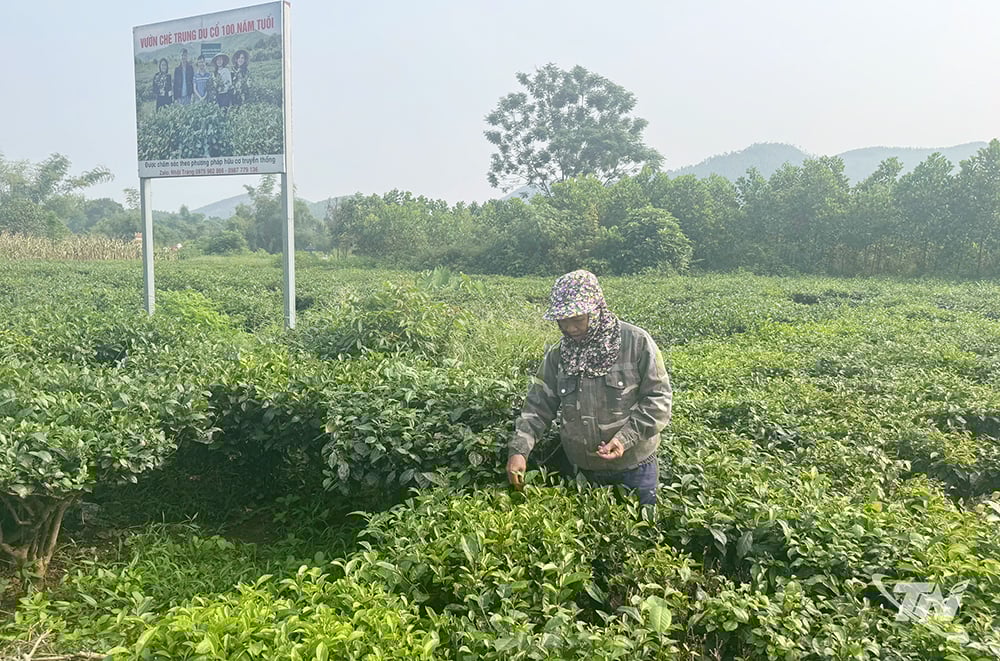
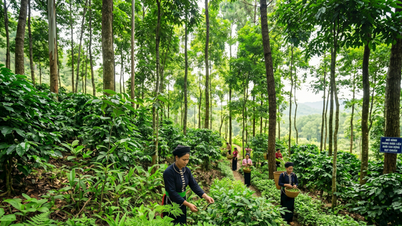
| The ancient tea garden of Mr. Pham Van Nhat's family in Lam Son hamlet, Tan Cuong commune, is approximately 100 years old. |
Stepping into a 100-year-old tea garden.
In my mind, an ancient tea garden would have trees taller than a person's head, like the tea trees I had seen at the Tan Cuong Spring Tea Festival. But no, when we set foot in the ancient tea garden of Mr. Nhat's family in Lam Son hamlet, we saw tea trees sprouting tender young buds, not much different from tea gardens of varieties like LDP1, Kim Tuyen, and Phuc Van Tien.
Only when we looked down at the base of the trees did we see the difference. The trunks were thick, each tree spreading out widely, looking like giant mushrooms. Mr. Nhat shared: "If these ancient tea trees were left to grow naturally, each tree could reach 4 to 5 meters in height and would be unusable. However, to 'rejuvenate' the trees and help them yield a harvest, I have to prune and shape the tea garden once a year."
According to Mr. Nhat, this ancient tea garden was previously managed by a cooperative. In 1987, the garden was handed over to his family for management. Later, when he got married (more than 22 years ago), his parents gave him and his wife over 6,000 square meters of tea land, more than half of which was old, mature tea plantation.
Recounting the story with regret, Mr. Nhat said that due to lack of strength, his family had to cut down more than one sao (approximately 1000 square meters) of old tea plants in 2000. He explained that the old tea plants were a midland variety, grown from seeds, and therefore very resilient. This variety also had many advantages, such as the ability to withstand cold, heat, and drought, and good resistance to pests and diseases. Furthermore, the roots of the midland tea plant penetrate deep into the soil, thus preventing soil erosion.
However, he has to dedicate a lot of time and effort to caring for this area of long-standing tea plants. Not only does it require meticulous attention to weeding and gardening, but because the garden has many open spaces (medium-sized tea plants are planted in rows further apart than hybrid tea plants), the frequency of watering must be higher, requiring more effort.
In return for the effort put in, the tea produced in the midland region yields significantly higher quality. For many tea connoisseurs, the flavor of midland tea is distinctly different from hybrid teas. Besides its fragrant aroma, rich and sweet taste on the tip of the tongue, and astringent aftertaste, the tea liquor is a shimmering green color, and midland tea also possesses a characteristic aroma reminiscent of roasted rice.
This is also the reason why Mr. Nhat invested in this ancient tea garden. He said: "Each year, I only harvest over 200 kg of dried tea buds from the garden, but the selling price is quite high (from 700,000 VND to over 1 million VND/kg of dried tea buds). In particular, the ancient tea products are building prestige and a brand for my family."
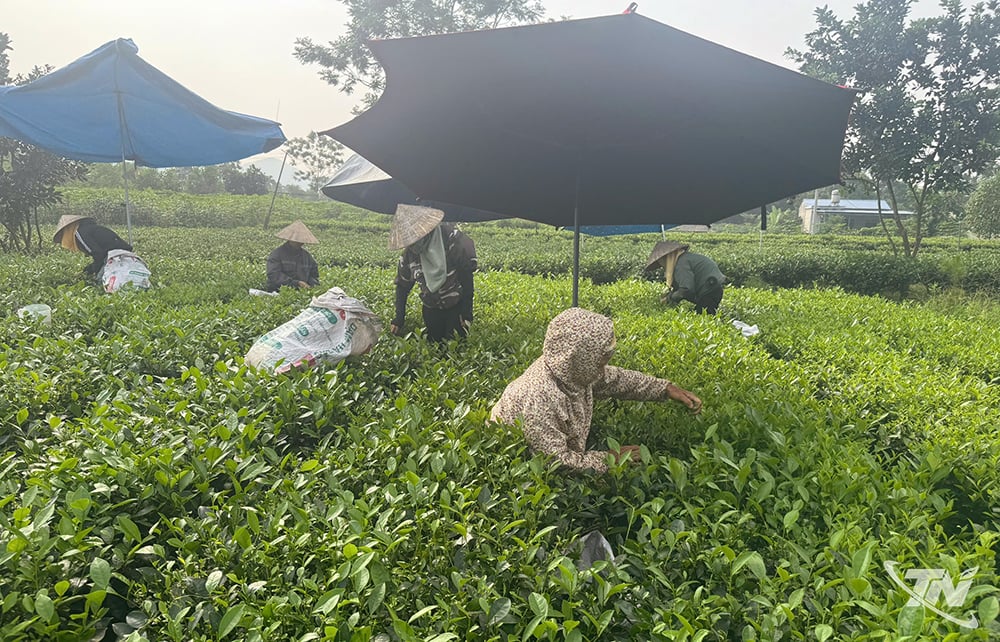 |
| Despite the low yield, the traditional tea produced by Mr. Pham Van Nhat's family sells at a higher price than other types of tea. |
In fact, Mr. Nhat's family's ancient tea garden doesn't yield high productivity, and its care requires much more meticulous attention. Therefore, we wondered why Mr. Nhat didn't follow the crowd and cut down this century-old tea garden to plant hybrid tea varieties with higher yields and production, like many households in the area.
Explaining these questions, Mr. Nhat openly admitted: "There was a time when my wife and I wanted to clear our old tea plantation to replace it with new varieties. However, thanks to the encouragement and guidance from relevant authorities, we understood the significance of our ancient tea garden and decided to preserve it. Now, I see that my decision was absolutely correct, as our family's tea garden is the oldest in the entire Tan Cuong tea region."
Upon arriving here, visitors can not only admire the captivating scenery of the tea gardens nestled along the picturesque riverbank, but also enjoy the unique specialty teas that reflect the rich culture of the Tan Cuong tea region. This is especially true as the owner of the tea garden is investing considerable effort in developing high-quality tea products.
Mr. Nhat said: "Previously, due to a lack of proper understanding of the value of the ancient tea garden, I only exploited it in a 'natural' way, without knowing how to invest properly. However, for about 5 years now, the care and exploitation have been done systematically."
Each year, my wife and I only harvest about 5 or 6 batches of tea leaves and let the tea plants "rest" for 2 months (equivalent to 2 batches). This moderate harvesting helps the tea garden develop steadily, produce consistent buds, and create a beautiful space year-round. We also process a variety of tea products such as traditional tea infused with lotus fragrance, bud tea, and young shoot tea…
In the process of bringing his family's traditional tea products to market, Mr. Nhat is still facing many difficulties as not many customers are aware of them. This is why he is still striving every day to build his own unique tea brand. Along with caring for and intensively cultivating the tea using organic methods to create safe products, Mr. Nhat is actively promoting his products through social media platforms such as Zalo and Facebook.
According to Mr. Nhat, with its beautiful location, his family's ancient tea garden could become an ideal eco -tourism and photo-taking destination for visitors in the future. Therefore, he and his wife are currently developing and branding their traditional tea products while also investing in beautifying the garden.
However, in order for the goal of developing the ancient tea garden into an eco-tourism area to become a reality, Mr. Nhat hopes that relevant authorities will pay attention and provide financial support, as well as allocate land to build a road leading to the ancient tea garden for convenient access.
Source: https://baothainguyen.vn/xa-hoi/202507/vuon-che-co-o-noide-nhat-danh-tra-1d51215/






















![[Photo] Reception to welcome General Secretary and President To Lam and his wife on their State visit to the Philippines](https://vphoto.vietnam.vn/thumb/1200x675/vietnam/resource/IMAGE/2026/06/01/1780295488620_vna-potal-chieu-dai-chao-mung-tong-bi-thu-chu-tich-nuoc-to-lam-va-phu-nhan-tham-cap-nha-nuoc-toi-philippines-8798060-7855-jpg.webp)






















































Comment (0)