

Despite pressure from US tariffs, China still achieved a trade surplus of over $1 trillion in the first 11 months of this year, a record high. This demonstrates that exports remain a key driver of growth for the world's second-largest economy , thanks to efforts to diversify markets and adjust its trade strategy.
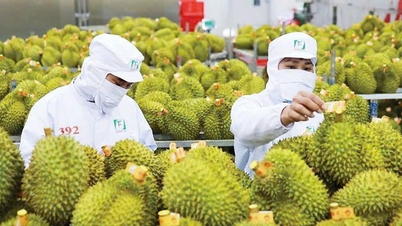
Agricultural exports are one of the sectors that will make a mark on China's trade landscape in 2025, with a value reaching $84 billion in the first 10 months of the year. Proactive efforts by businesses to diversify markets and supportive government policies are considered key to this positive result.
Wang Fei, director of an agricultural export company, said: "This year, our products have entered emerging markets in Southeast Asia, the Middle East, and South America for the first time."
Shang Guimin, Deputy Director of the Yinchuan Customs Bureau in the Ningxia Hui Autonomous Region, said: "To expand export market share and diversify markets, companies have been thoroughly guided on the regulations and technical standards of target markets. Quality control is the foundation for successful entry into international markets."
The shift in market focus has helped China's export sector remain resilient in the face of trade tensions. The sharp decline in exports to the US during the first 11 months of the year has been offset by strong growth in European, Southeast Asian, and African markets.
Heron Lim, a China economist at ESSEC Business School, assessed: "Chinese exporters have successfully pivoted to various markets, including ASEAN, Latin America, and Europe – these markets now account for the majority of growth. Furthermore, products have diversified to meet demand. China is not just selling cheap goods, but also high-value products, especially in areas where it has a significant competitive advantage, such as electric vehicles and green energy infrastructure like batteries and solar panels."
However, according to experts, after a booming 2025, China will face significant difficulties in maintaining its export growth momentum in 2026.
Heron Lim, a China economist at ESSEC Business School, commented: "The export growth trend will continue next year, although the pace may be hampered by some cyclical factors, as the global economy is showing signs of slowing down. Not only developed countries like the US, Japan, and South Korea, but also many emerging economies are affected. The high surplus also means China may face protectionist trade measures in many countries. Therefore, China still needs to seek new growth drivers, as a breakthrough like the recent period is unlikely."
Strong export performance has prompted many organizations, including the International Monetary Fund (IMF), to raise their forecasts for China's economic growth this year and next. However, the IMF also recommended that Beijing gradually reduce its reliance on exports and shift its focus to boosting domestic consumption – a challenge predicted to be difficult for the world's second-largest economy.
Source: https://vtv.vn/xuat-khau-dong-luc-tang-truong-chu-chot-cua-trung-quoc-100251218063705995.htm
![[Photo] Enchanting ancient rose garden on the mountainside in Nghe An](/_next/image?url=https%3A%2F%2Fvphoto.vietnam.vn%2Fthumb%2F1200x675%2Fvietnam%2Fresource%2FIMAGE%2F2025%2F12%2F19%2F1766109900916_vuon-hong-chin-do-thu-hut-du-khach-toi-check-in-o-ha-noi-3-20162778-1671624890024-1671624890104198100259.jpeg&w=3840&q=75)


![[Photo] General Secretary To Lam visits the exhibition space showcasing books, photo exhibitions, and achievements of digital transformation in journalism.](/_next/image?url=https%3A%2F%2Fvphoto.vietnam.vn%2Fthumb%2F1200x675%2Fvietnam%2Fresource%2FIMAGE%2F2025%2F12%2F19%2F1766110879215_1766110240024-jpg.webp&w=3840&q=75)

















































































Comment (0)