

Rapid growth, setting export records.
On December 12th, in Pleiku ward (Gia Lai province), the Agriculture and Environment Newspaper, in collaboration with the Department of Crop Production and Plant Protection and the Gia Lai Department of Agriculture and Environment, organized the forum "Sustainable Development of Passion Fruit Industry through Supply Chain Linkages".
According to Mr. To Van Huan, representative of the Department of Crop Production and Plant Protection, Vietnam's passion fruit exports have grown "rapidly," from 20 million USD in 2015 to 222.5 million USD in 2023. By October 2025, export turnover reached over 202 million USD.
Currently, the Central Highlands is the passion fruit capital of the country, accounting for 86.4% of the area and 92.5% of the production in 2024; the North accounts for 12.5% of the area. Vietnam has announced the circulation of 43 passion fruit varieties to serve the increasing demand for production and export.
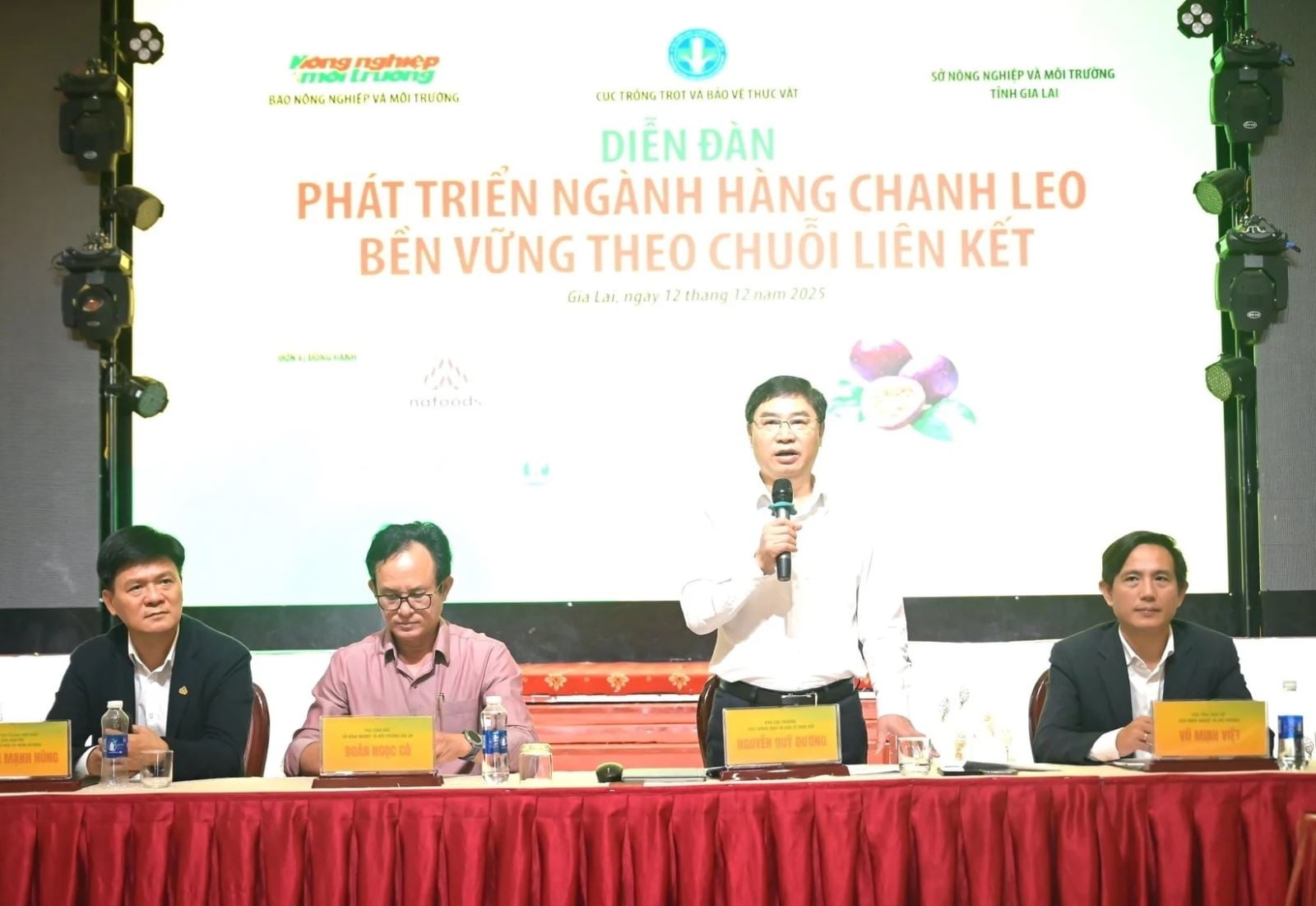
Mr. Huan assessed that passion fruit cultivation in Vietnam possesses many advantages in terms of favorable topography, soil, and climate conditions. Especially when cultivated in the Central Highlands and some other regions, the plant has a short growth cycle (4-5 months) and achieves high yields. The market is also wide open with diverse demand (over 80% are processed products and fresh fruit).
However, the passion fruit industry is facing challenges related to managing disease-free varieties, small-scale production, and the lack of comprehensive advanced cultivation practices. Furthermore, supply chain linkages are weak, preservation and deep processing technologies are inconsistent, supply is unstable, while technical barriers and international quarantine requirements are becoming increasingly stringent.
According to the Project for the Development of Key Fruit Crops in the period 2025-2030, passion fruit is oriented to become a sustainable industry, with the goal of maintaining 12-15 thousand hectares and a production of 250-300 thousand tons, concentrated in key provinces such as Lam Dong, Gia Lai, Dak Lak , Quang Tri, Nghe An and Son La.
“To realize the goal, localities need to review the area, form concentrated production zones linked with infrastructure and processing. At the same time, control spontaneous development, encourage cooperatives to link with businesses and produce under contract, according to safety standards and traceability. Regarding seed management, it is necessary to invest in the production of disease-free seeds domestically, issue seed standards and strengthen inspection. Technology transfer, pest and disease forecasting, organizing staggered production and improving harvesting and preservation capacity are also key links. Besides maintaining traditional markets, the industry needs to remove quarantine barriers to expand markets and elevate the brand of Vietnamese passion fruit on the world agricultural map,” Mr. Huan said.
Mr. Doan Ngoc Co, Deputy Director of the Gia Lai Department of Agriculture and Environment, said that the official export of passion fruit to the Chinese market since July 2022 has created a major boost, significantly increasing the value of the entire chain. Many businesses have partnered with cooperatives and farmers to form a closed production-processing-consumption chain, meeting the requirements for planting area codes, packaging, and deep processing.
However, the industry still faces challenges such as climate change, fragmented land area, spontaneous planting practices, inconsistent seed quality, and stringent requirements from the EU, the US, Japan, and China.
Developing a sustainable passion fruit industry through a value chain.
According to Mr. Dao Van Cuong, Specialist at the SPS Vietnam Office, Vietnam has issued specific standards for passion fruit, including TCVN 11411:2016 for fresh passion fruit, applicable to common passion fruit varieties (dark yellow, purple, light yellow, and hybrid varieties), TCVN 13941:2023 for frozen passion fruit, and TCVN 13942:2023 for dried passion fruit.
Export markets impose strict technical and phytosanitary (SPS) barriers. In China, the export of fresh passion fruit is governed by the Protocol on Phytosanitary Requirements between the Ministry of Agriculture and Environment of Vietnam (MAE) and the General Administration of Customs of China (GACC).
According to Mr. Cuong, the product must comply with the laws and food safety standards of both countries, especially not be contaminated with plant quarantine pests of concern to either country. After a biosecurity risk analysis, Australia allowed the import of fresh passion fruit from Vietnam. The main risk management measure agreed upon was the use of irradiation before export to control pests such as fruit flies, mealybugs, scale insects, and spider mites in order to achieve the appropriate level of protection required by Australia. The Vietnam Department of Crop Production and Plant Protection is responsible for maintaining traceability, registering supply chain entities, and conducting inspections and issuing quarantine certificates.
In the United States, imported passion fruit must strictly comply with FDA (Food and Drug Administration) regulations, specifically: it must not contain pesticide residues or chemicals exceeding permitted limits. Production facilities must implement a HACCP system to control food safety risks. Besides origin and product quality, the U.S. Department of Agriculture and the U.S. Animal and Plant Health Inspection Service (APHIS) also stipulate additional phytosanitary requirements.
Meanwhile, the European Union (EU) market is continuously updating its SPS regulations, strengthening border controls for high-risk product groups, such as passion fruit from Thailand and durian from Vietnam, which are being added to the list of products subject to increased control due to the risk of pesticide residue.
Several other countries, such as Japan and the UK, continue to regulate maximum residue levels (MRLs) for active ingredients like Inpyrfluxam, Spirotetramat, and Fenamiphos, demonstrating increasingly stringent technical requirements.
Ms. Nguyen Thi Bich Ngoc, Deputy Director of the Institute of Plant Protection (Vietnam Academy of Agricultural Sciences), recommended the early development of a national standard for disease-free passion fruit seedlings, strengthening the management of commercial varieties, and applying a three-tiered greenhouse system in seed production.
At the same time, it is proposed to establish large-scale raw material areas with uniform varieties and technical processes, with the participation of the Institute of Plant Protection in monitoring and warning about pests and diseases. The development of production models meeting VietGAP and GlobalGAP standards should be promoted to improve the quality of passion fruit and better meet the requirements of the export market.
Mr. Ho Hai Quan, Director of Nafoods Tay Nguyen Joint Stock Company, said that the global passion fruit market is changing rapidly, presenting both opportunities and challenges for Vietnamese producers and businesses. Current consumer trends strongly favor natural beverages with minimal chemical processing, prioritizing organic products and those that are nutritious, low in sugar, and good for health. Consumers are also seeking new flavors, creating conditions for passion fruit products to expand their market share.
According to business representatives, in the global competitive landscape, Vietnam is directly competing with South American countries such as Brazil, Peru, and Ecuador. Vietnam has advantages in competitive costs, fruit quality, and seasonality, but still faces challenges in production scale and brand recognition in the international market. Therefore, building sustainable linkages between farmers, cooperatives, processing businesses, suppliers, and distributors is considered crucial. These linkages need to be based on clear purchase agreements, fair sharing of benefits and risks, and strict adherence to technical standards and traceability.
Source: https://baotintuc.vn/kinh-te/xuat-khau-chanh-leo-tang-truong-than-toc-trong-10-nam-20251212154731825.htm


















![[Photo] Prime Minister Pham Minh Chinh holds a phone call with the CEO of Russia's Rosatom Corporation.](/_next/image?url=https%3A%2F%2Fvphoto.vietnam.vn%2Fthumb%2F1200x675%2Fvietnam%2Fresource%2FIMAGE%2F2025%2F12%2F11%2F1765464552365_dsc-5295-jpg.webp&w=3840&q=75)













































Comment (0)