

The winners of the VinFuture 2024 Grand Prize have just been honored at the prestigious Queen Elizabeth II Engineering Awards 2025 for their inventions that are shaping modern machine learning technology.
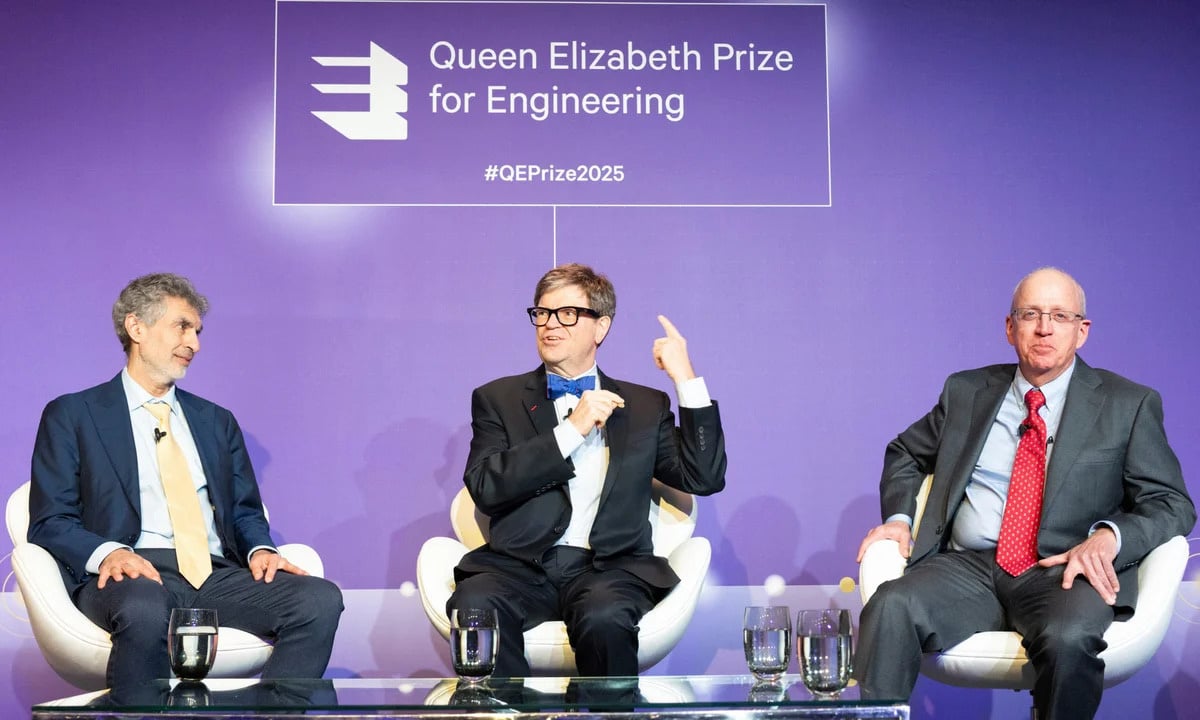
Professor Yoshua Bengio, Professor Yann LeCun, and Dr. Bill Daily (from left) are three of the seven scientists honored at the Queen Elizabeth Prize 2025. Previously, Professor Bengio and Professor LeCun, along with Professor Geoffrey Hinton, Mr. Jensen Huang, and Professor Fei-Fei Li, were awarded the main VinFuture Prize 2024. - Photo: Guardian
Previously, many VinFuture award winners have been consecutively honored with Nobel Prizes, which is proof of the VinFuture award's ability to identify globally influential projects early on.
According to the Queen Elizabeth Prize announcement, scientists including Professor Yoshua Bengio, Professor Geoffrey Hinton, Professor John Hopfield, Professor Yann LeCun, Mr. Jensen Huang, Dr. Bill Dally and Professor Fei-Fei Li were honored for their significant contributions to the development of modern machine learning – a key factor in the remarkable progress of artificial intelligence (AI). The award for the group of scientists is £500,000.
Explaining the selection of scientists to honor this year, the Queen Elizabeth II Prize Foundation stated that they wanted to recognize all three core pillars of modern machine learning: algorithms, high-performance hardware, and quality datasets.
This comprehensive recognition also coincides with the VinFuture Awards Council's decision to award a $3 million political prize to a group of 5 leading scientists in the field of AI in December 2024.
At that time, Professors Geoffrey Hinton, Yann LeCun, and Yoshua Bengio were honored for their revolutionary contributions to neural networks and deep learning algorithms.
In addition, computing performance has also increased rapidly thanks to advances driven by Jensen Huang in the use of graphics processing units (GPUs). Professor Fei-Fei Li's creation of the ImageNet dataset has propelled progress in image recognition systems, enabling the training of deep learning models on a large scale.
Beyond simply honoring outstanding scientists, the VinFuture Award sets it apart from most international awards in its recognition and celebration of pioneers who integrate science into daily life to serve humanity.
VinFuture is the first major international science award to honor Jensen Huang – a figure outside of academia – and Professor Fei-Fei Li, reflecting the comprehensive vision of the VinFuture Award Council and aligning with the development trends of modern science and technology, where achievements with significant impact are the result of a combination of academic research and practical application.
Professor Richard Henry Friend, chairman of the VinFuture Awards Board, said this is exactly what VinFuture aims for – comprehensive recognition of contributions from all components of the science and technology ecosystem.
Breakthrough innovations often stem from the intersection of academic research and industrial development. Only when scientists and businesses work together can truly meaningful breakthroughs for humanity be achieved.
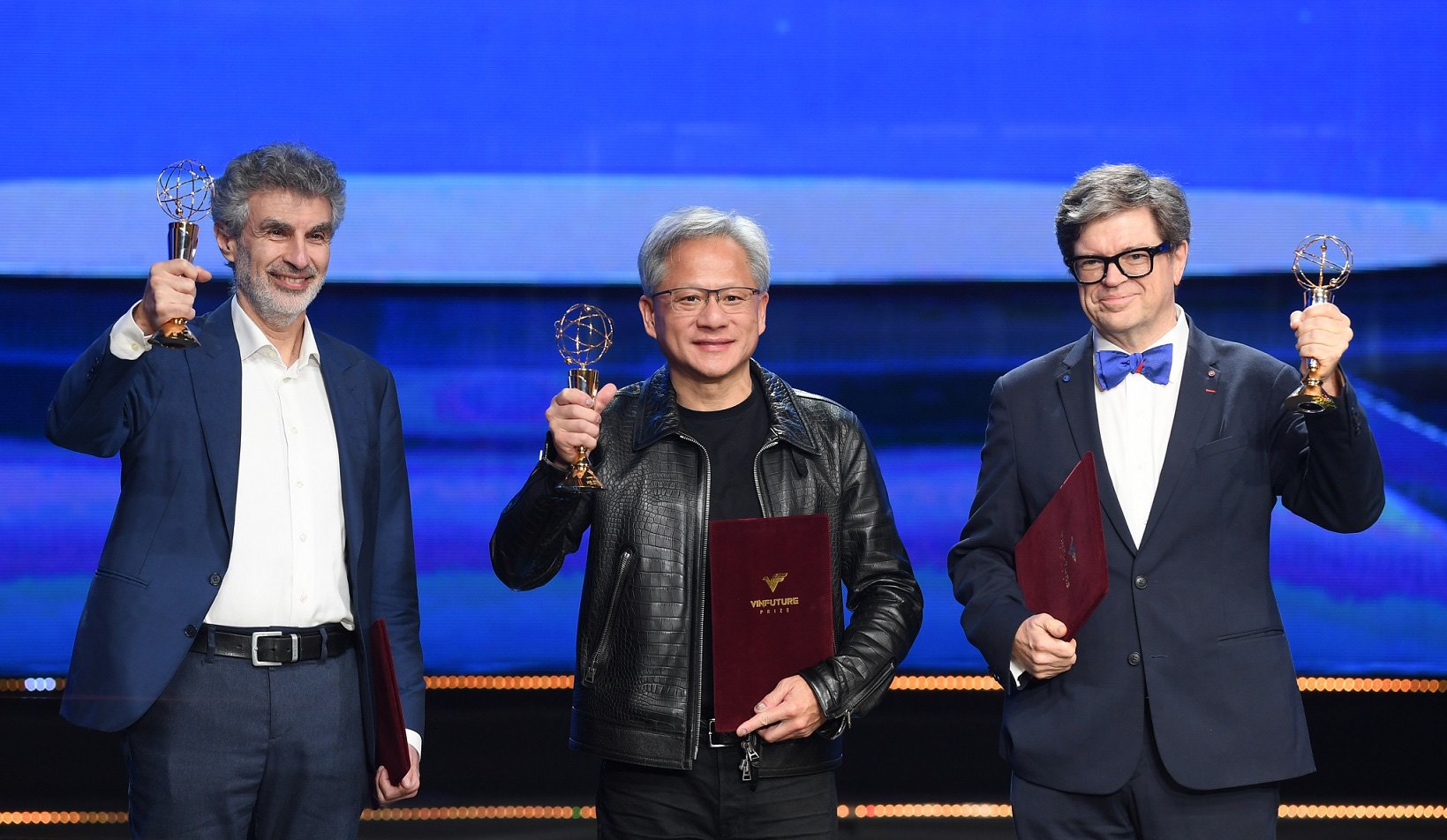
The Queen Elizabeth Prize shares a vision with the VinFuture Prize by comprehensively honoring the three core pillars of modern machine learning, while also recognizing representatives from industry alongside outstanding scientists - Photo: VinFuture
The vision and mission of the VinFuture Award are increasingly solidified within the global science and technology community, as many VinFuture Award winners continue to be honored with prestigious international awards, especially the Nobel Prize.
In 2023, Dr. Katalin Karikó and Professor Drew Weissman, the two main recipients of the VinFuture 2021 award, were honored with the Nobel Prize in Medicine for their research on nucleoside modifications, a crucial prerequisite for the development of mRNA vaccines against COVID-19.
In 2024, Dr. Demis Hassabis (UK) and Dr. John Jumper (USA) – co-recipients of the VinFuture Special Prize for scientists researching new fields in 2022 – were awarded the Nobel Prize in Chemistry for creating an AI model that predicts protein structure.
In the same year, Professor Geoffrey Hinton was honored with the 2024 Nobel Prize in Physics for his fundamental discoveries and inventions that enable machine learning using artificial neural networks.
According to Professor Friend, these accolades are the clearest evidence of the VinFuture Award's ability to identify globally influential projects early on, even though the award has only been in operation for just over four years.
The Queen Elizabeth II Award for Engineering was launched in 2012 to honor groundbreaking engineering innovations that benefit humanity worldwide.
To date, 26 scientists have been honored with this award. The 2025 award winners will share a prize pool of £500,000.
Source: https://tuoitre.vn/5-chu-nhan-giai-thuong-vinfuture-duoc-vinh-danh-tai-giai-thuong-nu-hoang-elizabeth-2025-20250206103028934.htm



































































Comment (0)