

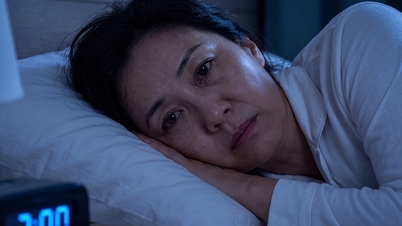
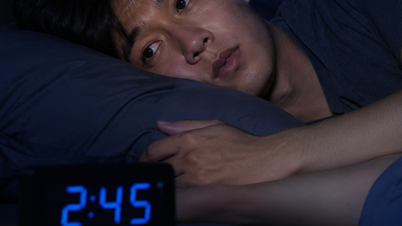
Due to the demands of work and study, signals that the body needs more sleep are often overlooked.
Dull skin
Lack of sleep increases cortisol levels, disrupting skin structure and inhibiting collagen production. As a result, the skin looks dull, less elastic, and prone to wrinkles and puffiness. These factors make sleep-deprived individuals appear tired and lifeless, according to the health website Healthline (USA).

Reduced concentration is one of the consequences of sleep deprivation.
PHOTO: AI
Craving snacks
Lack of sleep disrupts hormones that control hunger and satiety, leading to decreased satiety and increased hunger. As a result, sleep-deprived individuals tend to eat sugary, fatty, and high-calorie foods, such as cakes, fried foods, and bubble tea.
Meanwhile, dinners with these unhealthy foods can negatively impact sleep quality at night. Sugary foods cause blood sugar to spike and then drop rapidly, leading to hunger and difficulty sleeping. Fatty and oily foods can easily cause bloating and acid reflux.
Easily irritated
Sleep deprivation damages the prefrontal cortex and overactivates the amygdala, the area responsible for controlling emotions. This results in reduced cognitive ability, irritability, fatigue, impatience, or mild depression.
Memory and concentration decline
A person who is sleep-deprived may find their body trying to function, move around, and work, but their brain is constantly tired and wants to rest. This condition manifests in various ways, from having to reread a sentence to understand it, to being distracted at work, or forgetting the names of acquaintances.
This is because sleep plays a vital role in consolidating short-term memory, improving concentration, and enhancing flexible thinking. Lack of sleep impairs these functions.
Lack of sleep can lead to slow reflexes.
Lack of sleep reduces alertness, leading to slower reflexes and making individuals more prone to collisions or falls. This is especially dangerous when driving or operating machinery, increasing the risk of workplace accidents. If a person performs intellectual work rather than manual labor, lack of sleep will significantly impair their information processing, reaction time, and decision-making speed.
Weakened immune system
Insufficient sleep weakens the immune system, making the body more susceptible to illness and prolonging recovery time. A study published in the journal Archives of Internal Medicine showed that people who sleep less than 6 hours a night are at a higher risk of catching colds and other infections compared to those who sleep 7 hours or more, according to Healthline .
Source: https://thanhnien.vn/6-bieu-hien-canh-bao-co-the-can-ngu-nhieu-hon-185250820184649319.htm
![[Photo] General Secretary and President To Lam presides over a meeting on the implementation of Directive No. 34-CT/TW of the Party Central Committee.](https://vphoto.vietnam.vn/thumb/1200x675/vietnam/resource/IMAGE/2026/05/19/1779187768672_a1-bnd-2350-631-jpg.webp)
![[Photo] Capturing the moment the tide recedes at Yen Binh Son rapids - a million-year-old scenic spot in Quang Ngai.](https://vphoto.vietnam.vn/thumb/1200x675/vietnam/resource/IMAGE/2026/05/19/1779175463885_yen9-1199-jpg.webp)
![[Photo] National Assembly Chairman Tran Thanh Man attends the groundbreaking ceremony for the National Highway 1A spatial axis project.](https://vphoto.vietnam.vn/thumb/1200x675/vietnam/resource/IMAGE/2026/05/19/1779161360398_ndo_br_bnd-1412-jpg.webp)


















































![[Photo] General Secretary and President To Lam receives Indian Defense Minister Rajnath Singh](https://vphoto.vietnam.vn/thumb/402x226/vietnam/resource/IMAGE/2026/05/19/1779184046302_anh-man-hinh-2026-05-19-luc-16-46-58.png)































Comment (0)