|
ChatGPT can impair cognitive abilities if used improperly. (Illustration: Adobe Stock) |
In 2008, The Atlantic sparked controversy with an article titled "Is Google Making Us Dumber?". In the 4,000-word article, author Nicholas Carr argued that technologies like search engines undermine our ability to think and remember.
Carr emphasizes the point that people don't need to memorize important facts when they can look them up instantly on the internet. While this argument has some merit, search engines still require critical thinking to interpret and understand the context of their results.
After 17 years, the question is repeated, but this time for generative AI. With ChatGPT or Google Gemini, internet users are entrusting not only their memorization skills but also their thinking abilities. Generative AI can not only gather information but also create, analyze, and summarize data.
Writing in Fast Company , author Aaron French, an associate professor of Information Systems at Kennesaw State University (USA), argues that people need to weigh the benefits and potential losses whenever they delegate cognitive tasks to AI.
The Dunning-Kruger effect when using ChatGPT
According to Associate Professor French, AI generation is changing the way people access and process information. For example, many people are using AI to filter, compare viewpoints, and combat ambiguity. The tools can provide clear, coherent answers in just seconds.
"Whether the results are accurate or not, we cannot deny that they are very effective. This leads to major changes in the way we work and think," Associate Professor French added.
However, there is a price to pay for this convenience. When relying on AI to think and complete tasks, people's ability to think critically, solve complex problems, and access a wide range of information may decrease.
Although research on these issues is limited, passively consuming AI-generated content can diminish intellectual curiosity, reduce concentration, and create dependence, hindering long-term cognitive development.



 |
ChatGPT's interface. Photo: Bloomberg . |
Associate Professor French cited the Dunning-Kruger effect as an example, a phenomenon where people overestimate their abilities and knowledge. This occurs when they perceive complex things they don't fully understand. The peak of this effect is Mount Stupid.
“This framework could be applied to the use of generative AI. Some people might rely heavily on ChatGPT instead of making their own cognitive efforts, while others use it to enhance their capabilities.”
If they fall into the first category, they might mistakenly believe they truly understand the subject simply by repeating content generated by the AI. In this way, AI can artificially inflate its intelligence, while in reality it diminishes cognitive abilities,” Associate Professor French analyzed.
This has created a divide in how AI is used. Some people are increasingly using AI to replace creativity and critical thinking, while others are leveraging it to enhance existing cognitive abilities.
The author argues that the problem stems from the way AI is used. If used indiscriminately, ChatGPT can lead to cognitive complacency. Users may accept the results without questioning the assumptions, seeking alternative perspectives, or conducting further analysis.
Meanwhile, when used as a supporting tool, ChatGPT can stimulate curiosity, generate ideas, clarify complex topics, and spark intellectual engagement.
The future of work with AI
Associate Professor French emphasized that whether ChatGPT makes us dumber or enhances our cognitive abilities depends on how it is used. Specifically, AI generation "should be used to enhance human intelligence, not replace it."
"The effective way to use ChatGPT is to support the search and query process, not to shorten it. That means viewing AI responses as the beginning of the thinking process, not the end," he said.
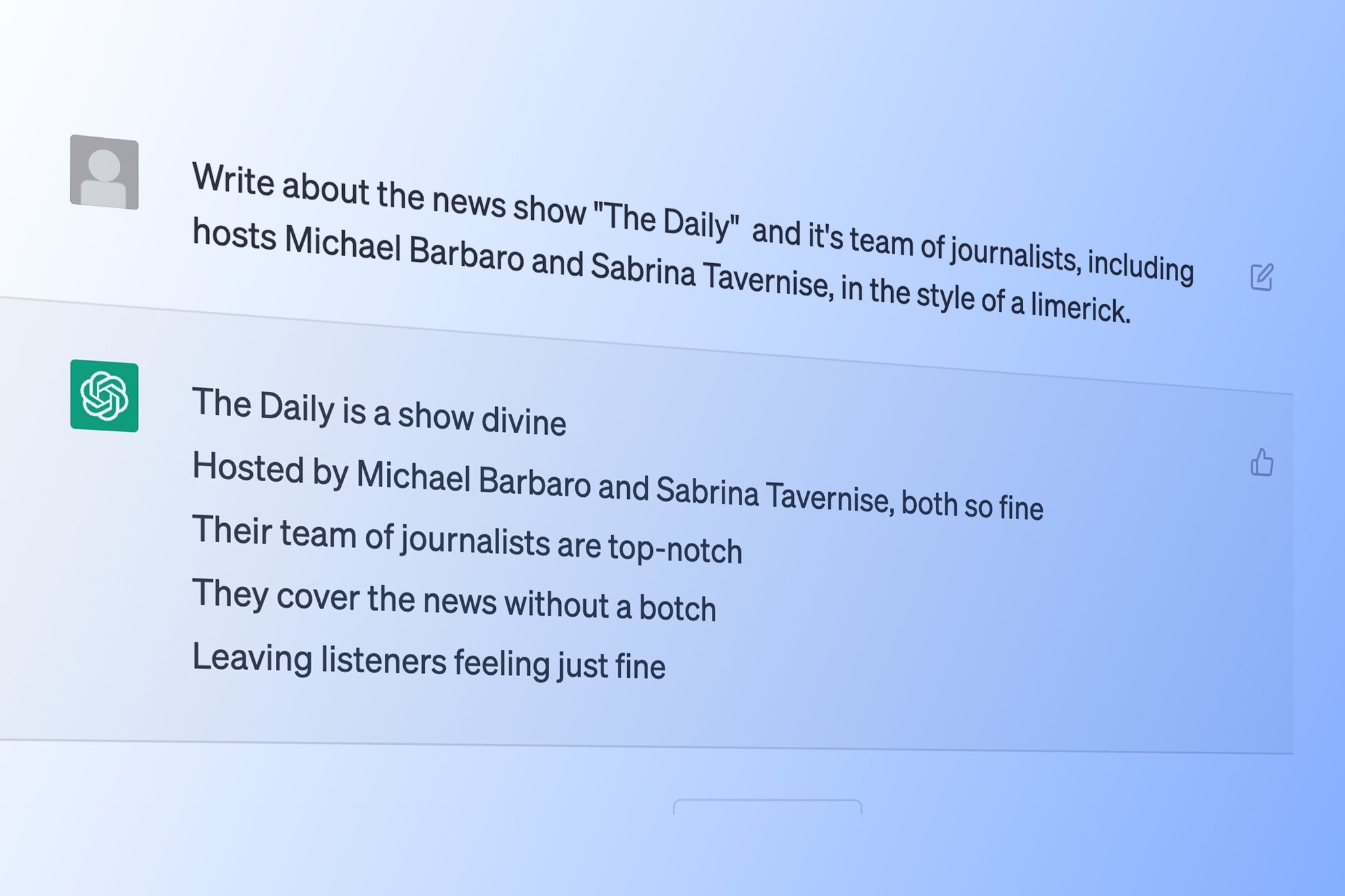 |
A conversation with ChatGPT. Photo: New York Times .  Vietnam encourages US businesses to expand investment in high technology.On the morning of June 26th, at the Government Headquarters, Deputy Prime Minister Ho Quoc Dung received Mr. Jeff Place, Supply Chain Director of Coherent Group (USA). During the meeting, the Deputy Prime Minister affirmed that Vietnam encourages US businesses to expand investment, especially in high-tech, innovation, and semiconductor industries.  Encourage U.S. businesses to expand investment in high-tech sectors.Deputy Prime Minister Ho Quoc Dung said that Vietnam welcomes US businesses to continue expanding their operations in Vietnam, especially in high-tech industries and sectors with high added value.  Vietnam and the United States strengthen cooperation in addressing the consequences of war.VTV.vn - On June 22, General Secretary and President To Lam received Acting Secretary of the US Navy Hung Cao. |
According to Associate Professor French, the mass proliferation of AI applications is putting Internet users at a crossroads. One path leads to intellectual decline when humans allow AI to think for them, while the other offers opportunities to enhance understanding through collaboration with AI.
"People often say AI won't take your job, but the AI users will. However, I think those who use AI to replace their cognitive abilities will get stuck on the Peak of Stupidity. Those are the most replaceable people."
Conversely, those who use AI to enhance their thinking skills can collaborate to achieve results they couldn't produce alone. This is the future of work,” Associate Professor French added.
Source: https://znews.vn/ai-co-lam-chung-ta-ngoc-hon-post1572871.html





![[Photo] Strengthening character and expertise: Intense training for artillery soldiers.](https://vphoto.vietnam.vn/thumb/1200x675/vietnam/resource/IMAGE/2026/06/30/1782815602541_lu-368-1875-4571-jpg.webp)