

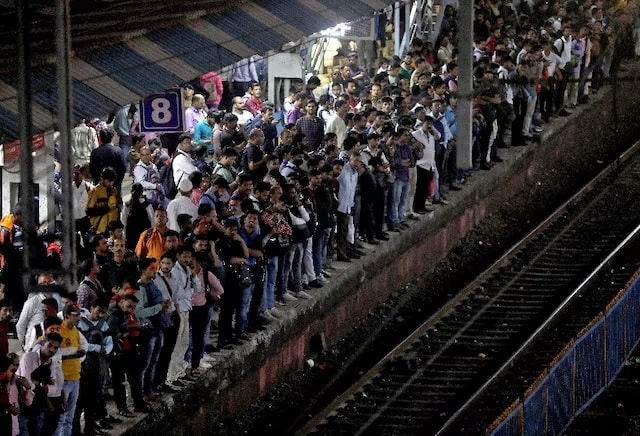
India is currently the world's most populous country with approximately 1.42 billion people and is facing a range of social welfare challenges, such as high youth unemployment rates.
However, a paradox is unfolding as some close allies of Prime Minister Narendra Modi are consistently promoting policies to encourage people to have more children, including providing financial support to families with many children, in order to counter the declining birth rate.
Reuters, citing statistical data, reported that India's overall fertility rate, or the average number of children a woman gives birth to in her lifetime, fell to 2 between 2019 and 2021, compared to 3.4 recorded in 1992-1993.
Experts believe the main reasons stem from the widespread availability of contraceptives and the increasing educational attainment of women.
According to estimates by the Indian government , the country needs to maintain a birth rate of 2.1 to sustain its replacement population size.
In response to this situation, several Indian states have quickly taken action. In the southern Indian state of Andhra Pradesh, a coalition between a regional party and Prime Minister Modi's ruling party has announced a one-time cash payment of 30,000 rupees (approximately $311.57) for families having a third child and 40,000 rupees for a fourth child.
This move represents a significant shift from the previous proposal of 25,000 rupees for the second child and no direct support for the first child. However, the state government has yet to announce a specific timeframe for implementing this plan.
Andhra Pradesh Chief Minister Chandrababu Naidu emphasized that declining birth rates in many countries are accelerating population aging and increasing pressure on the economy.
Chandrababu Naidu acknowledged that the government had once strongly promoted family planning, but in the current context, children need to be seen as a "national treasure."
Similarly, the state of Sikkim in northeastern India encourages families to have more children through policies such as a one-year paternity leave for mothers and a one-month paternity leave for fathers, as well as financial support for in-vitro fertilization (IVF) procedures.
Pressure to change policies comes not only from government officials but also from a number of social organizations.
The Rashtriya Swayamsevak Sangh (RSS), an influential Hindu group and the organization from which Modi's party grew, also urged families to have more children.
RSS Secretary-General Dattatreya Hosabale warned that declining birth rates and population imbalances could create social tensions in the future.
According to official government figures, India's overall unemployment rate for those aged 15 and over is projected to reach 3.1% by 2025.
However, considering only the young workforce aged 15 to 29, this rate is much higher, at 9.9%; of which, urban areas are most severely affected with a rate of 13.6%, while the figure in rural areas is 8.3%.
Source: https://baodanang.vn/an-do-khuyen-khich-sinh-them-con-du-ap-luc-that-nghiep-3337327.html


































































































Comment (0)