

- Improving the quality of administrative procedures.
- Complete the restructuring of administrative procedures.
- The government has issued eight resolutions to reduce, decentralize, and simplify administrative procedures and business conditions.
The role and significance of Resolution 66
Resolution 66 plays a central role in administrative reform . The goal is to reduce the cost and time required for businesses to comply with administrative procedures by 30-50%; thereby promoting production and business, and enhancing national competitiveness.
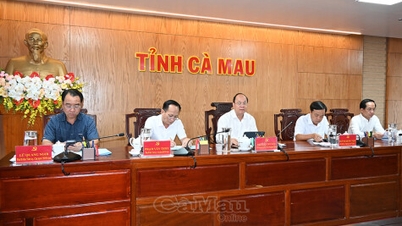
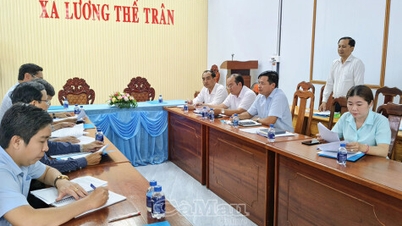
 The inspection team from the Department of Justice, led by Mr. Tran Hoang Loc, Deputy Director of the Department of Justice (on the left), inspected the posting of administrative procedures at Ho Thi Ky Commune.
The resolution aims to implement the Party and Government's policy on reducing and simplifying administrative procedures and investment and business conditions; creating a favorable, healthy, and fair business environment; promoting innovation and modernization of national governance; and enhancing the effectiveness and efficiency of state management. In this context, citizens and businesses are identified as the center, driving force, and goal of development; and the satisfaction of citizens and businesses is used as a measure of the quality of service provided by state administrative agencies at all levels. Implementation must ensure "5 clear points" (clear person, clear task, clear time, clear result, clear responsibility) to facilitate evaluation, inspection, and supervision; while simultaneously enhancing the role and responsibility of heads of state administrative agencies in carrying out administrative procedure reform.
Specifically, the goal for 2026 is to reduce and simplify 100% of unnecessary, overlapping, or unclear investment and business conditions; and to abolish all investment and business conditions for sectors not included in the list of conditional investment and business sectors under the Investment Law. Along with this, the goal is to reduce the processing time for administrative procedures by 50%, and reduce compliance costs by 50% compared to 2024; to have 100% of business reporting electronically; to have 100% of information and documents in administrative procedures related to production and business activities provided only once to the state agency; and to have 100% of eligible administrative procedures conducted online throughout.
Directives from the Central Government
To ensure timely completion as directed by the Prime Minister, the Ministry of Justice requests ministries, sectors, and localities to focus on reviewing and submitting to competent authorities for approval plans for reducing and simplifying administrative procedures and business investment conditions during the process of drafting and promulgating legal documents, ensuring that the Government's targets for 2026 are met.
The review must adhere to the directives of General Secretary and President To Lam on “resolutely eliminating the ‘request-and-grant’ mechanism, minimizing administrative procedures; promoting comprehensive digitalization and data interconnection; using the time and costs of citizens and businesses as a measure of the quality of reform; ensuring a safe, transparent, and healthy competitive investment and business environment.” At the same time, localities should continue to implement the orientation of administrative procedure reform and business conditions according to key resolutions of the Politburo such as Resolutions No. 57-NQ/TW, 66-NQ/TW, 68-NQ/TW, and 79-NQ/TW.
Furthermore, the application of digital technology, big data, and artificial intelligence in state management continues to be promoted, aiming to form a proactive and intelligent public service model; reducing the need for citizens and businesses to re-provide information and documents. The connection, sharing, and reuse of data between information systems are enhanced to facilitate the digitization of records, the results of administrative procedures, and the streamlining of data-driven procedures.
Implementation in Ca Mau province
As of the end of the first quarter of 2026, the entire province had 2,177 administrative procedures under the jurisdiction of departments, agencies, and commune-level authorities (excluding vertically integrated agencies). Of these, 2,172 procedures were regulated by the central government and 5 procedures were regulated by the local government; the provincial level handled 1,729 procedures, and the commune level handled 448 procedures.
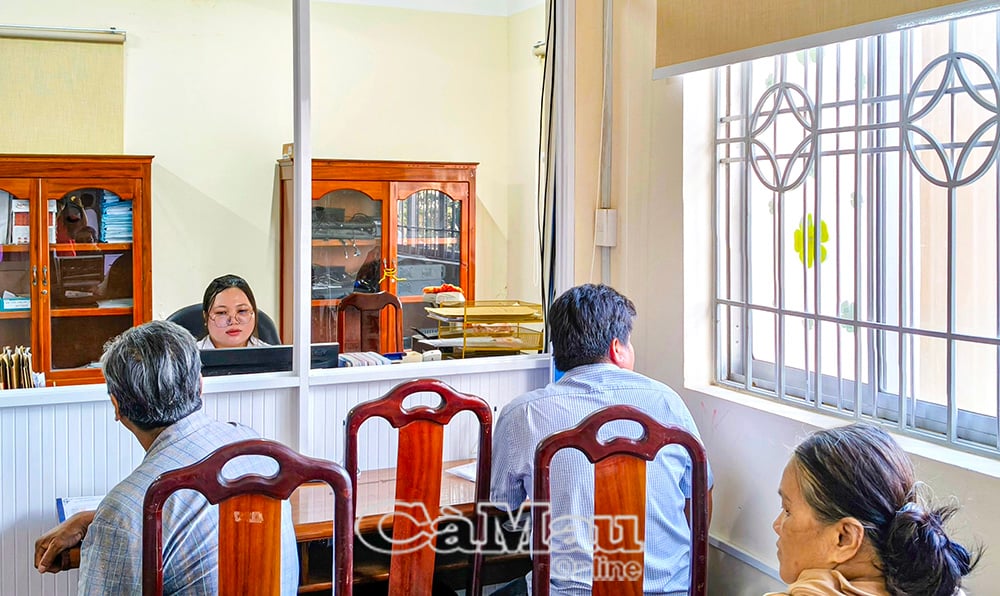 People register secured transactions in Nam Can commune.
Regarding internal administrative procedures, the province has announced 558 procedures as prescribed, including 528 procedures at the provincial level and 30 procedures at the commune level.
In the first quarter of 2026, the entire province received 132,801 applications, of which 124,331 were online applications, equivalent to 93.62%. The results showed that 113,775 applications were processed on time or ahead of schedule, accounting for 99.60%; only 448 applications were delayed, and all were addressed with apologies as per regulations. The satisfaction level of citizens and businesses reached over 96.94%.
In 2025, the Department of Justice advised the Chairman of the Provincial People's Committee to issue two decisions announcing the list of administrative procedures with reduced processing times related to investment, production, and business activities, with a total of 35 procedures having their processing time reduced by 30% or more. In addition, the Department of Justice also advised on the announcement of the list of administrative procedures that have been amended, supplemented, or abolished in the field of notarization under the authority of the Department of Justice and the People's Committees of communes in the province.
Currently, the Department of Justice receives and processes applications at the Provincial Administrative Procedure Resolution Center, which has been fully invested in facilities to meet the requirements of the task. Out of a total of 162 procedures under its management, the Department has advised on the issuance of 22 decisions announcing the list of administrative procedures that have been amended, supplemented, or abolished.
In 2025, the Department of Justice received 4,378 applications, including 3,403 online and 629 in person; 4,366 applications were processed ahead of schedule.
According to the 2026 roadmap, the reduction and simplification of administrative procedures related to production and business activities will continue to be accelerated. For individuals and business households, processing time will be reduced by 20-40%; for enterprises, the reduction will be over 30%, applicable to all administrative procedures, including those that can be processed within the same day.
Reducing and simplifying administrative procedures not only helps businesses reduce compliance costs, save time and resources, but also contributes to improving the investment environment, creating a transparent, open, and attractive business environment for investors; facilitating businesses to enter the market, and promoting efficient and sustainable production and business development.
Kim Phuong
Source: https://baocamau.vn/day-manh-cat-giam-don-gian-hoa-thu-tuc-hanh-chinh-a128762.html





































































































Comment (0)