

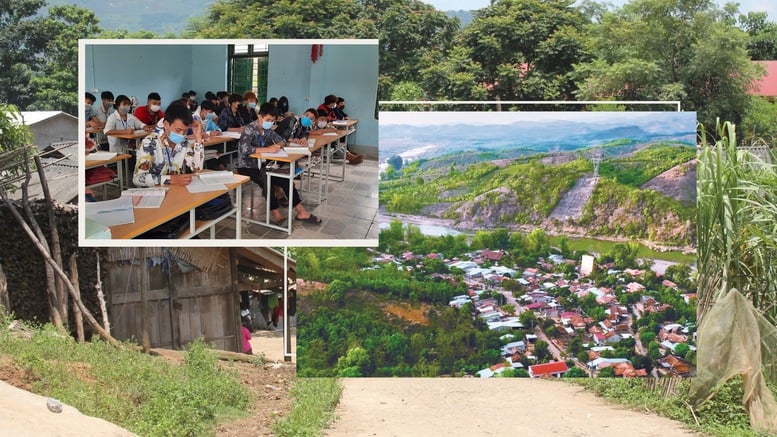
Decree 66/2025/ND-CP has increased opportunities for ethnic minority students in remote areas to access education - Photo: VGP/Son Hao
From 2016 to the end of 2024, secondary school students in particularly disadvantaged communes and villages in mountainous ethnic minority areas, and particularly disadvantaged communes in coastal and island areas will receive educational support according to Government Decree No. 116/2016/ND-CP.
According to Decree No. 116/2016/ND-CP and previous decisions, one of the conditions for receiving the policy benefits is that the educational institution where the student is studying must be located in a commune classified as Area III (commune with particularly difficult socio -economic conditions). This means that when the area where the educational institution is located is no longer on the list of poor communes according to the decision of the competent authority, the student will no longer receive the support policy.
In reality, with investment and support from the State, the number of particularly disadvantaged areas in ethnic minority and mountainous regions has gradually decreased year by year. According to the report of the Committee for Ethnic Minorities (now the Ministry of Ethnic Minorities and Religion) at the 4th Session of the 15th National Assembly (October 2022), in the period 2021-2025, according to Decision No. 861/QD-TTg dated June 4, 2021, ethnic minority and mountainous regions have 1,551 communes in Zone III, a decrease of 406 communes compared to the period 2016-2020.
This change resulted in approximately 700,000 students ceasing to benefit from educational policies in the 2021-2022 school year, including those stipulated in Decree No. 116/2016/ND-CP. Many ethnic minority students from poor and near-poor households in remote areas were forced to drop out of school due to the "interruption" of support policies while their families lacked the financial means to continue their education.
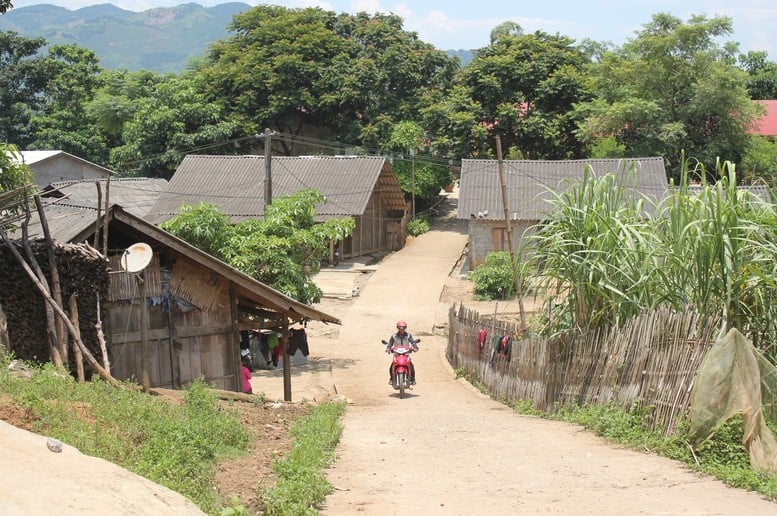
A view of A Mú Sung commune, Bát Xát district, Lào Cai province - Photo: VGP
A Minh's family, residing in Tung Sang village, A Mu Sung commune (Bat Xat district, Lao Cai province), consists of six siblings who all attended school from kindergarten to grade 7. Previously, A Minh and her siblings could attend school with peace of mind because they benefited from the boarding school policy under Decree No. 116/2016/ND-CP. However, after A Mu Sung commune achieved the new rural standard (in 2020), they no longer benefited from the policy. In the 2021-2022 school year, A Minh (grade 6) and her younger brother, A Tho (grade 4), had to drop out of school to help the family. Sadly, both siblings were excellent students at their school.
Cases like A Minh and A Tho are not uncommon after the issuance of Decision No. 861/QD-TTg. From the 2021-2022 school year to the end of 2024, the People's Petition Committee under the Standing Committee of the National Assembly (now the People's Petition and Supervision Committee) received and compiled petitions from voters in various localities regarding this issue and sent them to the Ministry of Education and Training. Most recently, voters in Bac Kan province petitioned the Government to research and amend the regulation that students are eligible for learning support policies based only on the student's place of residence and the distance from the student's home to the school, without specifying which area the school belongs to.
On December 17, 2024, in Official Letter No. 7989/BGDĐT-KHTC responding to voters in Bac Kan province, the Ministry of Education and Training stated that the recommendations of voters in Bac Kan province in particular, and other localities in general, have been accepted and concretized in the draft decree (now Decree No. 66/2025/NĐ-CP) replacing Decree No. 116/2016/NĐ-CP. The new decree does not stipulate that educational institutions must be located in particularly difficult areas for students to benefit from the policy; instead, they only need to meet the conditions regarding distance, or geographical isolation, difficult transportation requiring crossing seas, lakes, rivers, streams, high mountain passes, or areas prone to landslides and rockfalls to be eligible.
Furthermore, the new decree adds ethnic minority students from poor households in areas not classified as particularly difficult, but rather in ethnic minority and mountainous regions, who meet the distance requirements, to be eligible for the boarding school policy. In its submission No. 1573/TTr-BGDĐT dated October 25, 2024 (third time) to the Government regarding the draft new decree, the Ministry of Education and Training explained that this addition aims to overcome difficulties and inadequacies in implementing the policy when the number of particularly difficult areas decreases according to decisions of competent authorities in each period.
Fairness in policy
The difficulties and shortcomings in Decree No. 116/2016/ND-CP, which were raised by voters in ethnic minority and mountainous areas, have been fundamentally amended and supplemented in Decree No. 66/2025/ND-CP dated March 12, 2025, of the Government, which stipulates policies for children in nurseries, students, and trainees in ethnic minority and mountainous areas; coastal and island areas; and educational institutions with children in nurseries and students benefiting from these policies. The Decree takes effect from May 1, 2025, replacing Decree No. 116/2016/ND-CP.
Besides not basing the eligibility criteria for boarding school policies on geographical location, a notable point in Decree No. 66/2025/ND-CP is the addition of students enrolled in continuing education programs at the lower and upper secondary levels to the list of those eligible for boarding school policies, provided they meet the conditions regarding distance from home to school and reside in particularly disadvantaged areas (ethnic minority students from poor households in communes in areas II and I are also eligible for boarding school policies even if their homes are far from school).
The Ministry of Education and Training explained that the addition of more beneficiaries to the boarding school policy is as follows: Currently, there are approximately 8,000 students studying general education programs at continuing education institutions who, despite meeting the eligibility requirements of regular high school students, do not have access to the policy stipulated in Decree No. 116/2016/ND-CP.
According to the Ministry of Education and Training, this does not ensure fairness in education between high school students and continuing education students. Therefore, adding continuing education students to the group eligible for boarding school policies under Decree No. 66/2025/ND-CP is necessary to meet the aspirations of voters in ethnic minority and mountainous areas, and directly the teachers and students at continuing education institutions.
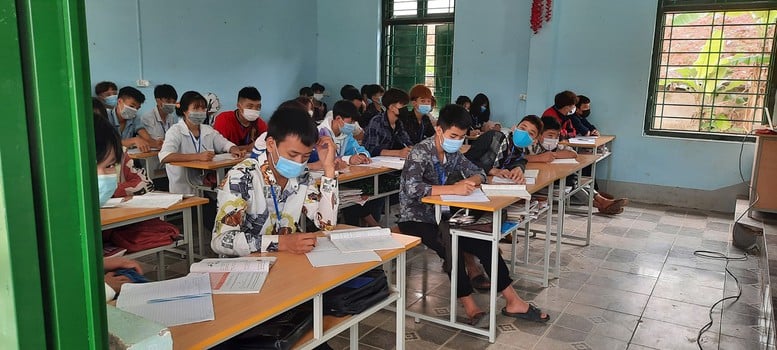
Students at the Vocational Education and Continuing Education Center of Quang Binh district, Ha Giang province - Photo: VGP
According to Ms. Hoang Thi Hue, Director of the Vocational Education and Continuing Education Center of Quang Binh district (Ha Giang province), the center trains an average of over 300 students per academic year. In the 2023-2024 academic year alone, the center had 340 students; of which 99% were ethnic minorities, and 80% were from disadvantaged backgrounds.
According to Decree No. 84/2020/ND-CP, vocational students receive a policy scholarship equivalent to 80% of the basic salary during their first two years of vocational training. However, this support is discontinued in the third year of general education. Consequently, many students, due to living far from the city center, facing financial difficulties, and lacking boarding facilities, are forced to drop out midway through their studies. This not only impacts the students' future but also wastes the resources from the policy scholarship already provided for them during the previous two years.
This is also the reality in many other continuing education institutions. According to a report by the Ministry of Education and Training, 19,391 continuing education institutions nationwide are currently training 5,724 students in the lower secondary level program and nearly 430,000 students in the upper secondary level program; of which about 8,000 students are eligible for boarding school support but do not have access to it. Therefore, with Decree No. 66/2025/ND-CP, the number of students at continuing education institutions who meet the conditions to receive boarding school support will have more opportunities to complete their studies at these institutions; creating a solid foundation for self-development, career building, and contributing to the socio-economic development of the locality.
According to Decree No. 66/2025/ND-CP, eligible students and trainees receiving boarding school support will receive a monthly allowance of 936,000 VND (for no more than 9 months per academic year). If the educational institution cannot provide dormitory accommodation, each student or trainee will receive an additional monthly allowance of 360,000 VND (for no more than 9 months per academic year); they will also receive 15 kg of rice per month (for no more than 9 months per academic year).
Son Hao
(to be continued) - Final part: Joy for the people and all levels of government
![[Photo] Prime Minister Pham Minh Chinh receives the Governor of Tochigi Province (Japan)](/_next/image?url=https%3A%2F%2Fvphoto.vietnam.vn%2Fthumb%2F1200x675%2Fvietnam%2Fresource%2FIMAGE%2F2025%2F12%2F16%2F1765892133176_dsc-8082-6425-jpg.webp&w=3840&q=75)


![[Live] 2025 Community Action Awards Gala](/_next/image?url=https%3A%2F%2Fvphoto.vietnam.vn%2Fthumb%2F1200x675%2Fvietnam%2Fresource%2FIMAGE%2F2025%2F12%2F16%2F1765899631650_ndo_tr_z7334013144784-9f9fe10a6d63584c85aff40f2957c250-jpg.webp&w=3840&q=75)
![[Image] The tenacious fighting spirit of Vietnamese women's football](/_next/image?url=https%3A%2F%2Fvphoto.vietnam.vn%2Fthumb%2F1200x675%2Fvietnam%2Fresource%2FIMAGE%2F2025%2F12%2F17%2F1765990260956_ndo_br_4224760955870434771-copy-jpg.webp&w=3840&q=75)

















































































Comment (0)