

Inter-Korean tensions continue to escalate ahead of the US presidential election. This latest wave of tension began after a series of artillery exchanges in January and the release of balloons filled with trash, as well as loudspeaker announcements in the border area since late May.
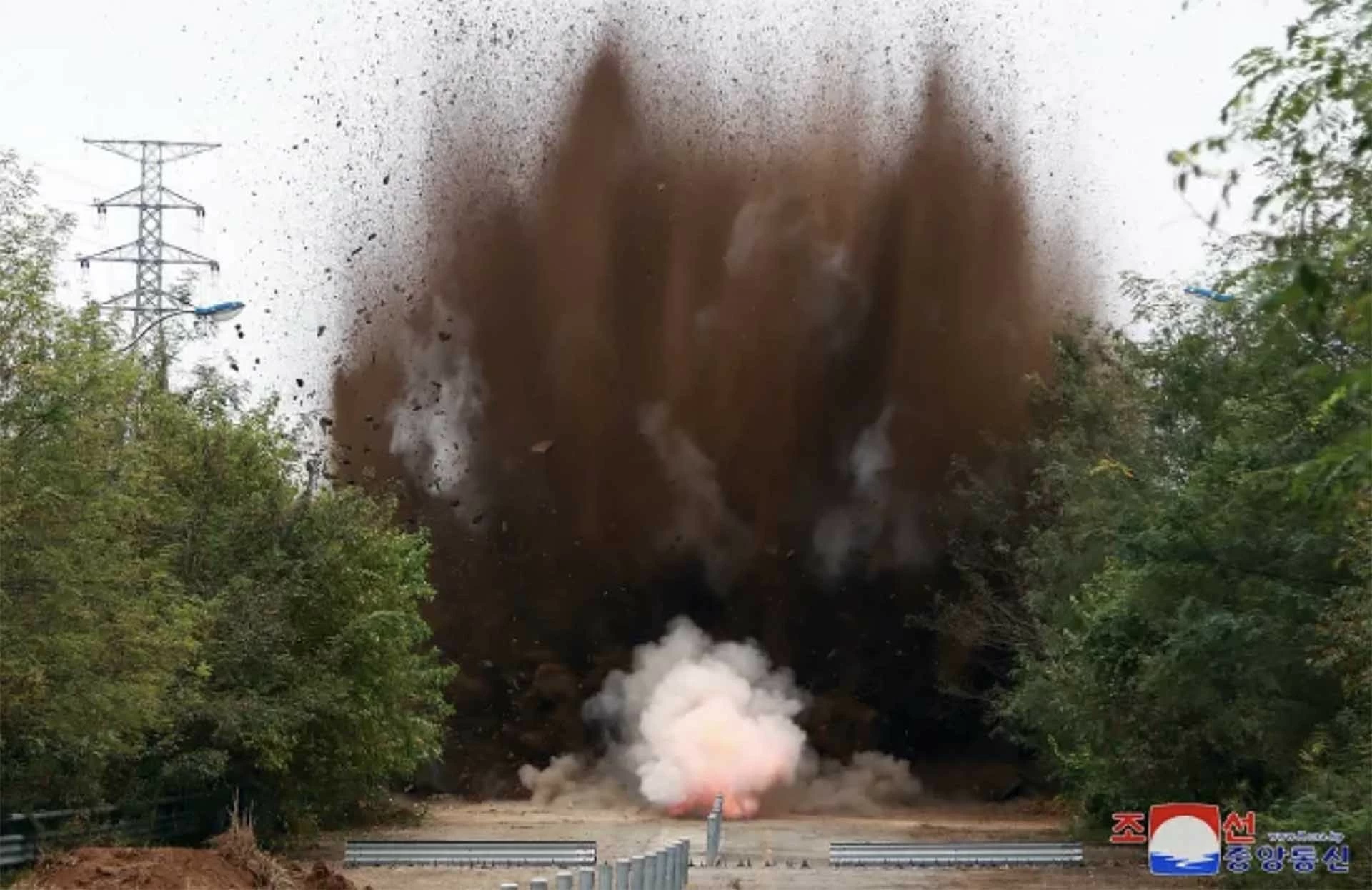 |
| Images show damaged roads and railways along the South Korea-North Korea border on October 15. (Photo: Reuters) |
In particular, this latest escalation of tension occurred after North Korea blew up sections of two road and rail links (Gyeongui and Donghae) connecting with South Korea on October 15, following a warning that it would completely sever territorial ties between the two Koreas. Seoul criticized this move and said it was considering suing Pyongyang because the aforementioned road and rail connection project involved a South Korean loan worth $133 million.
On October 17, North Korean state media reported that the country had amended its constitution, officially designating South Korea as a "hostile nation." On October 19, Pyongyang announced the detection of at least one South Korean unmanned aerial vehicle (UAV) that had entered North Korean territory… Overall, the recent tensions are a continuation of the escalating conflict and deadlock on the Korean Peninsula since the US-North Korea summit in Hanoi .
Currently, resuming dialogue between the two Koreas is almost impossible in the near future. Furthermore, the escalating conflict between them makes it very difficult for third parties, including the United Nations, to play a mediating role.
In fact, the Gyeongui and Donghae railways, two of the most important symbols of reconciliation and cooperation between the two Koreas, were built in the mid-2000s but have recently fallen out of use. North Korea's detonation of explosives on these two railways is seen as a drastic step in its policy of viewing South Korea as the "main enemy" and abandoning the peaceful reunification that Chairman Kim Jong Un had previously emphasized. Prior to this, North Korea had also demolished a monument symbolizing reunification in January.
Historically, the Korean Peninsula has experienced alternating cycles of tension and détente, but without ever erupting into armed conflict. While the current tensions are considered a dangerous escalation, the likelihood of armed conflict remains uncertain. In this context, the outcome of the US presidential election on November 5th is a crucial factor in breaking the current stalemate on the peninsula.
If Donald Trump wins, US policy toward North Korea could shift in a direction seen during his first term: the US-South Korea alliance fractured over cost-sharing issues; and US-North Korea could resume denuclearization talks. If Vice President Kamala Harris is elected, current US policy is likely to continue, with key approaches including: strengthening the US-South Korea alliance and reinforcing trilateral cooperation between the US, Japan, and South Korea to enhance expanded deterrence against Pyongyang.
It can be seen that, although inter-Korean relations are increasingly tense, both sides have mainly remained at the level of deterrence through statements; carrying out a few retaliatory actions against each other but avoiding direct military conflict. It is likely that Seoul and Pyongyang will keep the "temperature" from escalating into conflict until the US has a new president to adjust their respective policies.
Source: https://baoquocte.vn/ban-dao-trieu-tien-truoc-buoc-ngoat-moi-291238.html


![[Photo] General Secretary and President To Lam and the President of the Philippines hold talks.](https://vphoto.vietnam.vn/thumb/1200x675/vietnam/resource/IMAGE/2026/06/01/1780286997787_anh-man-hinh-2026-06-01-luc-11-09-43.png)
















































































Comment (0)