


Why do locals rarely eat at Michelin-starred restaurants?
H., a chef at an international hotel in Hanoi, regularly takes food tours to Hue and Hai Phong whenever he has free time. For this chef, discovering new culinary destinations and bringing delicious dishes to Hanoi also helps increase his income. Interestingly, H. has always managed to "overthrow" traditional establishments. "Everyone praises O Tho's banh mi, but for me, Be Na's banh mi is the best," H. explains about importing Be Na's banh mi from Hue to sell. H.'s customers also love Be Na's banh mi, and it has become a regular item that H. imports weekly.
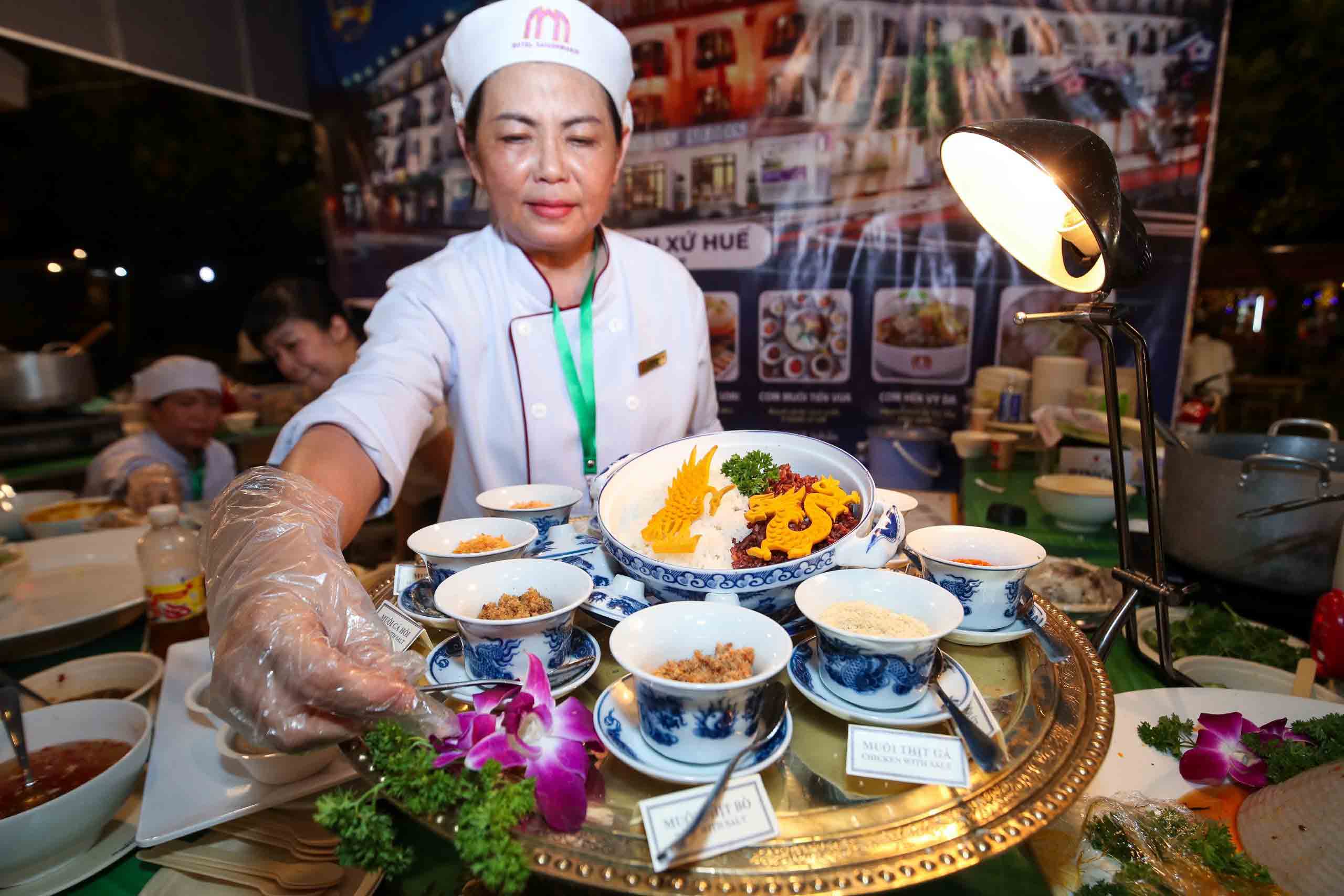
The delicious dishes of different regions need to be mapped to promote domestic culinary tourism and attract international visitors.
Such "overthrows" of famous brands in the culinary world are not uncommon, as everyone has different tastes, and arguing about taste is rather pointless. However, with the Michelin list, although only announced in Vietnam in the last two years, the debate has been quite positive. On one hand, the orderliness in restaurant management is highlighted. On the other hand, the fact that "purely Vietnamese" flavors or restaurants selected by Michelin mainly cater to tourists is often considered a "negative point" for Michelin.
The Dac Kim bun cha restaurant on Hang Manh Street ( Hanoi ), which made it onto the Michelin list for the first time, is one such controversial establishment. On online forums, many people argue that the restaurant mainly caters to tourists. Also in Hanoi, the beef pho at 10 Ly Quoc Su Street, although selected for Michelin, is also considered to be only eaten by locals. In a documentary about Hanoi and its culture, writer Nguyen Truong Quy took a foreign film crew to Phung Hung pho restaurant. This is a pho restaurant said to have the same quality as the Ly Quoc Su pho from the subsidy era.
In Ho Chi Minh City, Ky Dong chicken noodle soup restaurant has also been criticized by many for its chicken meat not being firm enough, the broth lacking a deep, sweet flavor, and its high prices; despite the fact that this restaurant made it onto the Michelin list in its first year. Meanwhile, the Hue beef noodle soup restaurant in Vo Van Tan alley (Ho Chi Minh City), which was included in this year's list, also raised questions because of the excessive amount of fat floating on the surface – something a bowl of Hue beef noodle soup should avoid. Discussions on online forums even pointed to another nearby beef noodle soup restaurant that locals often frequent because of its better taste.
Gap in identifying good restaurants
Despite the Michelin-starred list, it cannot fill the need to know about good restaurants in the country. These gaps are clearly visible.
Firstly, with its limited staff, Michelin has not been able to cover all of Vietnam's major tourist destinations, as well as every province and city nationwide. Starting with Hanoi and Ho Chi Minh City in its first year, Michelin only added restaurants in Da Nang this year. Hoi An, just a few hundred thousand dong taxi ride from Da Nang, has yet to be covered by Michelin. Meanwhile, Hoi An boasts a high-quality culinary system with its own unique principles. Hoi An's cuisine is so diverse, culturally profound, and flavorful that anthropologist Nir Avieli (Ben Gurion University, Israel) has researched and written an entire book about it. This book has also recently been translated and published in Vietnamese under the title "Stories of Hoi An Cuisine." Even Hue, a city with a rich culinary heritage, has yet to be visited by Michelin.
This map of delicious Hai Phong dishes is designed with a rather "teen" style, very similar to the language used in online discussions. It features typical Hai Phong dishes such as crab noodle soup, crab spring rolls, spicy fish noodle soup, and steamed rice cakes, along with a list of restaurants, each with a clearly indicated address and opening/closing hours.
Secondly, the selected dishes are still quite monotonous, mainly limited to rice and pho/vermicelli. The Michelin list is still in its "early stages," not yet showing the diversity of pho and vermicelli dishes. Therefore, we don't see fish vermicelli or taro stem vermicelli appearing on the list. The absence of banh mi (Vietnamese baguette) from the list is also something the public has repeatedly mentioned over the past two years whenever Michelin announces its selections.
The fact that Michelin has not yet been able to widely cover all localities and dishes shows that we shouldn't rely solely on Michelin to develop Vietnamese cuisine and promote Vietnamese culinary tourism. Furthermore, Vietnamese tourism needs to be on "two legs"; while welcoming foreign visitors, we must not forget domestic tourists. Therefore, lists of "domestic" cuisines need to be created early.
Hai Phong's approach: creating a culinary map.
Simply searching "Hai Phong Food Map" will immediately lead readers to the city's news portal. There you'll find a map of Hai Phong's delicious dishes, designed in a rather "teen" style, very similar to the language used in online discussions. Typical Hai Phong dishes such as crab noodle soup, crab spring rolls, spicy fish noodle soup, and steamed rice cakes are introduced along with a list of restaurants, each with its address and opening/closing hours clearly indicated.
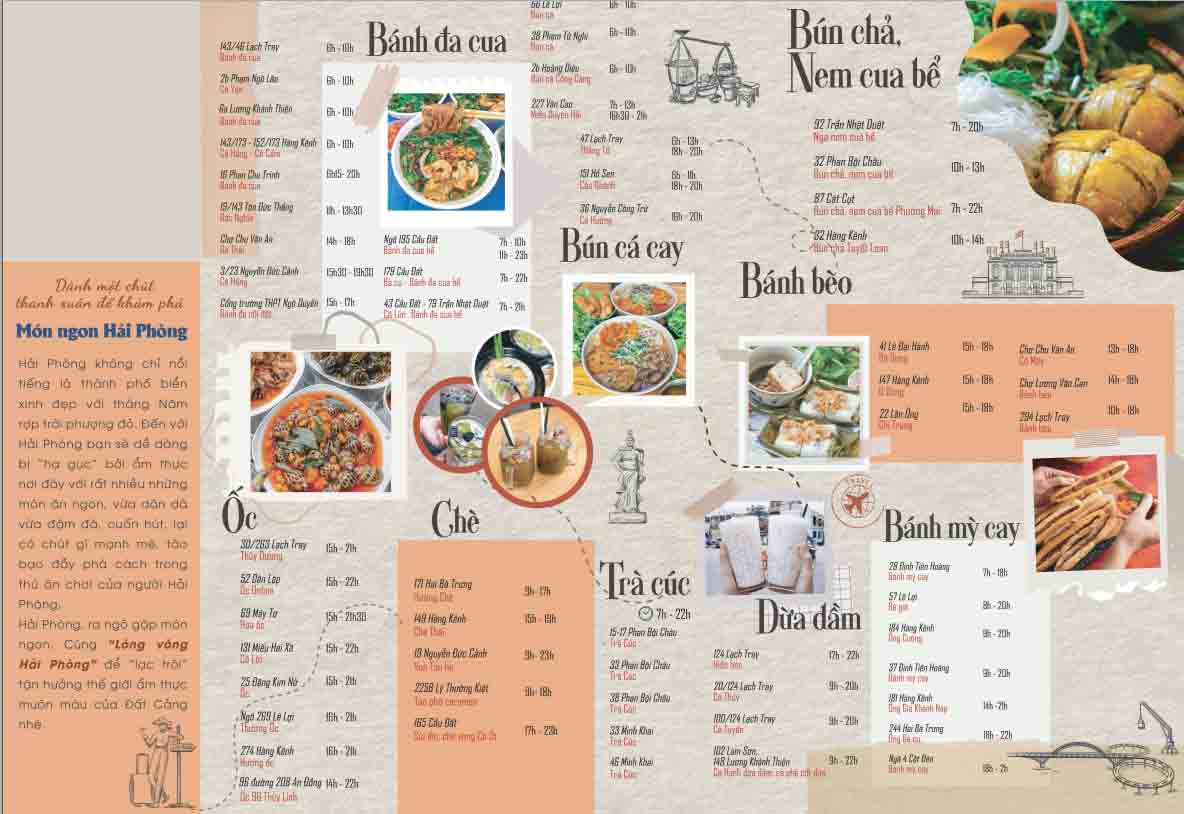
A culinary map of Hai Phong, created by the Hai Phong Department of Tourism.
According to this list, customers are advised to eat snails at Thuy Duong restaurant in Lach Tray, Huong Oc restaurant on Le Loi street, Co Loi restaurant at Mieu Hai Xa... Recommended dessert shops include Huong Che Hai Ba Trung, Vua Tau Hu Nguyen Duc Canh, Sui Din Cau Dat...
The creator of this map also offers a range of food tour recommendations for the day. According to the map, for breakfast, you can choose egg custard sandwiches at 64 Ly Thuong Kiet, Ba Bay rice rolls at 66 Cat Cut, pork sausage and sticky rice sandwiches at 23 Minh Khai, duck rice crackers at alley 23 Le Dai Hanh… For afternoon snacks, you can choose sweet potato porridge at 63 Cho Con, dried beef salad at 24 Pham Hong Thai, steamed rice cakes at 186 Hai Ba Trung… For late-night meals, the map recommends fried pig brain rice crackers with eggs at 1 Le Chan, crab hotpot at 278 Lach Tray, mixed vermicelli at 34 Hang Kenh…
A culinary list like the one for Hai Phong could initially satisfy the needs of food lovers and those wishing to experience food tours there. Creating a list in Hai Phong is also less complicated than in larger cities like Hanoi and Ho Chi Minh City. These two cities have larger areas and a vast number of culinary heritage sites, thus requiring a more comprehensive culinary inventory.
In fact, Hanoi also conducted a similar inventory of culinary heritage in 2018. However, because it only included traditional culinary heritage, the list leaned towards traditional vermicelli and pho. Meanwhile, new eateries can always emerge, especially those offering new dishes. This further demonstrates that cities, if they want to promote culinary tourism and advertise their cuisine, should find ways to create their own culinary maps.
Source: https://thanhnien.vn/ban-do-am-thuc-dia-phuong-tu-chon-18524070623281927.htm








![[Photo] Prime Minister Pham Minh Chinh inspects the readiness of personnel to ensure order, safety, and security.](https://vphoto.vietnam.vn/thumb/1200x675/vietnam/resource/IMAGE/2026/02/16/1771254005385_ndo_br_dsc-3981-jpg.webp)

















































Comment (0)