


Community gathering place
In the traditional stilt house of Meritorious Artisan Dinh Thanh Son, in Nuoc Min village, there was a lively atmosphere filled with laughter and conversation. Today, 25 members of the Wi A Lu Gong and Drum Folk Culture Club gathered for their regular meeting.
Everyone tested the sound of each gong together and began performing rhythmic gong pieces under the guidance of the elderly artisans. Some took the opportunity to play other instruments, harmonizing with the resonant gong rhythms that echoed throughout the mountainous region.
Meritorious Artist Dinh Thanh Son shared that gongs are not just musical instruments, but the soul of the Ca Dong people. Each gong sound is connected to their lives, festivals, joys, and the memories left behind by their ancestors. Therefore, maintaining the club's activities is not simply about playing gongs for fun, but also about preserving the roots and soul of their ethnic group's culture.
Through each meeting, members not only practice playing and tuning the gongs but are also reminded of the meaning of each gong piece and rhythm in community life.
The Wi A Lu Gong Folk Culture Club is considered the "cradle" of gong activities in Nuoc Min village. Dinh Van Tung (28 years old), a young and active member of the club, said that participating in the club has not only taught him techniques but also helped him understand and appreciate the meaning of each gong piece.
"Currently, I know how to play two types of gongs, Hnâng and Hlênh, but the more I learn, the more I realize there's still much more I need to practice," Tùng confided.
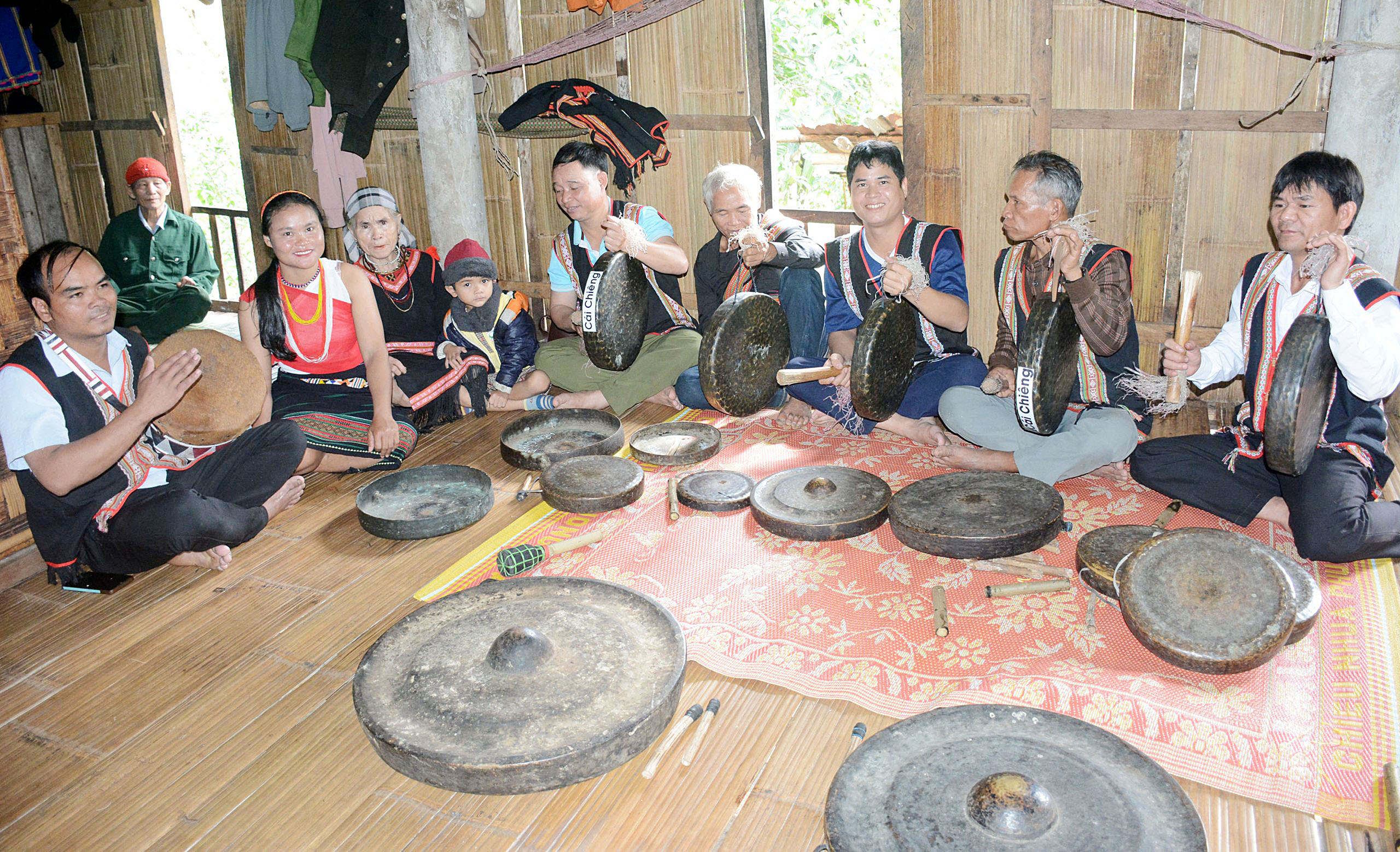
Members of the Nuoc Min Village Gong and Drum Folk Culture Club hold regular gong and drum performances.
Meanwhile, in Tu La village, the atmosphere of the folk culture club specializing in gong music is equally vibrant. The village's traditional cultural house has become a familiar meeting place for club members during their regular activities.
Under the lamplight, the resonant sound of the gongs, sometimes low, sometimes high, sometimes rapid, reflects the unique nuances of each gong piece. Here, Meritorious Artist Dinh Van Khoang plays a connecting role, teaching and adjusting the gong-playing techniques for the club members.
These days, taking advantage of the evenings, the gong ensemble of Tu La village club diligently practices to prepare for performances during Tet and other end-of-year festivals. Each gong piece is meticulously rehearsed by the members, and every beat is adjusted to be perfectly even and precise.
The training atmosphere is always lively and filled with the warmth of community spirit.
Unique cultural highlights
Along with other ethnic groups in the Central Highlands, gongs are central to and the soul of the festivals, rituals, and community activities of the Ca Dong people, such as the new rice harvest festival, the forest god worship ceremony, the buffalo worship ceremony, and the New Year celebration. Each resounding gong note is not just music , but also a message, a story about history and tradition, and a spiritual anchor for the community.
The Ca Dong people have two types of gongs: Hnâng gongs (6-9 gongs per set) and Hlênh gongs (9-14 gongs).
According to the distinguished artisan Dinh Van Khoang, when using Hnâng gongs, one must test and adjust them so that the sound resonates with the characteristics of each type.
A Hlênh gong set must have at least 11 gongs, including 8 flat gongs, each with its own unique sound, struck with a mallet on the inside. These eight gongs are considered a family, consisting of the parent gong, the eldest child gong, the second child gong, the youngest child gong, and so on.
The Hnâng gong is mainly used in rituals, while the Hlênh gong is usually used in festivals and cultural activities.
The establishment of folk culture clubs featuring gong music by the Ca Dong ethnic group in the villages of Son Tay Thuong commune is not only aimed at encouraging community participation in stage performances, tourism , or cultural exchange with other localities. More importantly, it is a correct approach to sustainably preserve and transmit the heritage within the community itself. When gong music is passed down within the natural living environment of the community, that heritage will truly be preserved for a long time and have enduring vitality through generations.” Dr. Nguyen Dang Vu, Former Director of the Department of Culture, Sports and Tourism |
Along with the two exemplary clubs mentioned above, in the remaining 7 villages of Son Tay Thuong commune and Son Bua Ethnic Boarding Primary and Secondary School, the gong and drum folk culture clubs also maintain regular activities.
Amidst the majestic mountains, the sound of gongs continues to resonate daily, cherished and preserved by the community, passed down through generations. From the hands of skilled artisans to today's youth, the Ca Dong gongs endure alongside the villagers, reminding them of their roots and igniting a sense of pride.
According to Nguyen Quyet Chien, Standing Vice Chairman of the People's Committee of Son Tay Thuong commune, the establishment of these clubs is an important first step, creating conditions for artisans and people to interact, exchange ideas, and spread cultural identity. Through this, artisans have the opportunity to teach traditional musical instruments, including gongs, and folk dances to the younger generation.
The commune will continue to invest in and effectively utilize its natural and indigenous cultural potential, aiming for community-based tourism development. Linking the activities of gong clubs with community-based tourism development will contribute to diversifying products, creating unique cultural highlights, and attracting tourists.
Source: https://baoangiang.com.vn/bao-ton-van-hoa-cong-chieng-ca-dong-a471246.html




























































![[Photo] Coc Ly market bustling on the eve of Tet](https://vphoto.vietnam.vn/thumb/402x226/vietnam/resource/IMAGE/2026/02/14/1771062261424_baolaocai-br_img-6457-jpg.webp)




Comment (0)