

In Quang Nam province, during the wasp nesting season, people in Tien Phuoc district put on protective clothing and go into the forest to catch wasps, bringing them back to raise them to control pests in their gardens and sell the pupae.
At over 4 a.m., Pham Van Chien, 35, and Le Hoang Day, 42, from Tien Canh commune, Tien Phuoc district, packed their protective gear and forest tools. They rode their motorbikes to Tra Giac mountainous commune, Bac Tra My district, more than 30 km from their homes, to hunt for wasp nests.
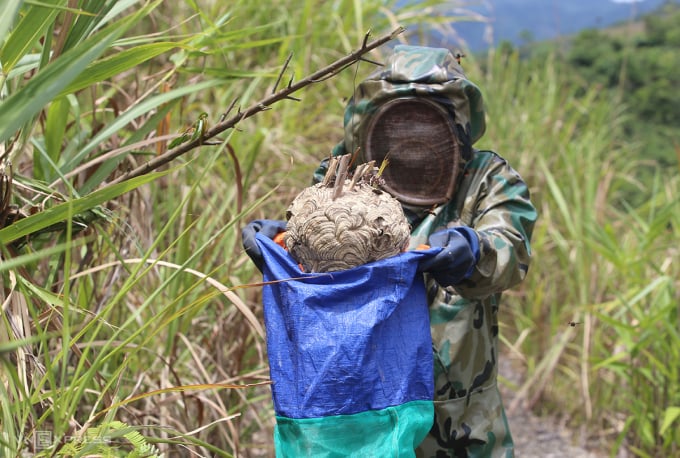
Mr. Pham Van Chien put the beehive in a bag to take home and raise bees. Photo: Dac Thanh
Leaving their motorbikes at the edge of the forest, Mr. Chien and Mr. Day split up, each heading in a different direction. Before the sun rose above the mountains, they chose an open spot and scanned the area, observing the bees to locate their nest. This was the easiest time to observe; by midday and afternoon, the sunlight would make it difficult to see.
Wasps, scientifically known as Vespa affinis , are a species of hornet. They typically choose secluded nesting sites with dense vegetation and rugged terrain. Nesting season lasts from early May to September (lunar calendar). At the beginning of the season, the queen wasp selects a suitable location, lays her eggs, and cares for them to create a colony. The young wasps, upon reaching maturity, will continue to hunt and build nests.
Carnivorous wasps often hunt for insects like worms, butterflies, spiders, and larvae. With over 10 years of experience hunting wasps, Mr. Chien is familiar with areas where many wasps nest. Stopping near flowering plants, he observes each wasp catching prey and follows them back to their nest. Besides the predators, worker wasps also gather dry, decaying branches to build their nests.
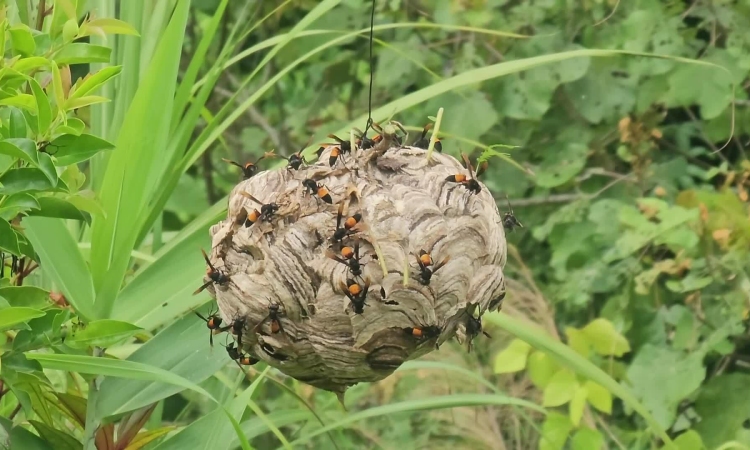
Hunters search for and capture wasp nests. Video : Dac Thanh
By midday, under the hot sun, the two beekeepers went to puddles and streams to observe the bees taking water in order to locate their nests. "Bees usually land near their nests, so we can identify their location. By observing where many bees fly out, we can pinpoint their position," Chiến said. However, they couldn't always find the nests; the beekeepers could only observe them flying nearby, not when they flew far away.
Unlike Mr. Chien, Mr. Day sought out places where cosmos flowers bloomed. In the morning, honeybees came to collect pollen and nectar, attracting many wasps to hunt for prey. Mr. Day used a piece of pork tied to a branch to lure the wasps to eat. "This is called 'bee baiting,' because it takes a long time for them to hunt, so we invented this method. They eat the meat very quickly and carry it back, and I just need to observe their flight path to find the nest," he said.
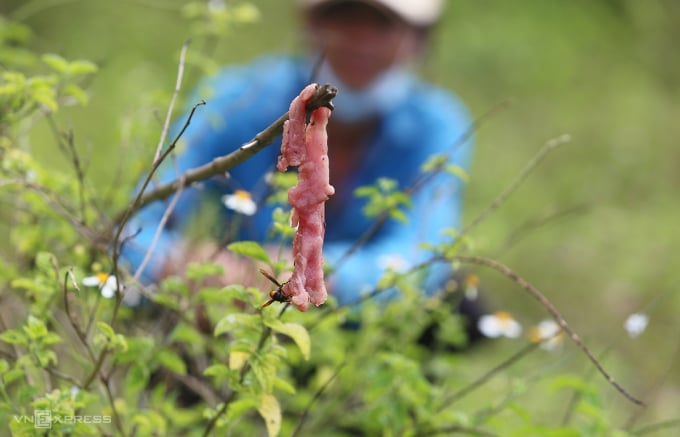
Mr. Le Hoang Day used pork to lure bees to eat it. Photo: Dac Thanh
After half an hour of searching, the two discovered a wasp nest in a dense thicket of reeds. Wearing specialized protective gear costing over 1.3 million VND, Chiến approached and used pliers to cut the branch containing the nest. "Wasps have very high venom and can be fatal. That's why they're also called 'the killer'," Chiến said.
Each day, the two beekeepers find at most eight, and at least two beehives. The beehives are removed from the bushes and hung nearby to wait for the bees to fly inside. After half an hour, Mr. Chien uses a mesh bag to cover the entire hive and collect the bees.
The beehives he brought home are hung on the branches of trees in his garden. Mr. Chien said that thanks to the beehives he raises in his garden, there are no more pests harming his crops. After raising the bees for more than a month, he starts harvesting the pupae. The hives have many layers, and when harvesting, he leaves the top layer so the bees can continue building. Each hive can be harvested 2-3 times per season, and since the beginning of the season, he has raised nearly 50 hives.
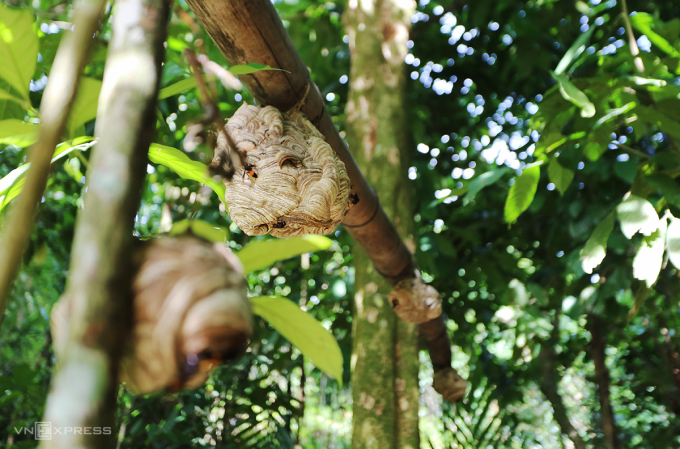
Mr. Chien brought the beehive home and kept it in his garden. Photo: Dac Thanh
Besides raising wasps, he also sells them to many people in the area at a price of 250,000 VND for large hives and 150,000 VND for small hives. Each hives, after three months of raising, yields an income of about 400,000 VND. Traders buy wasp pupae at a price of over 300,000 VND per kilogram to sell to restaurants and eateries for use in various dishes such as porridge, stir-fries, and fried dishes.
The job of catching wasps also faces many dangers. In recent times, there have been many critical cases and deaths due to wasp stings. Doctors warn that wasp venom is highly toxic and can cause anaphylactic shock, hemolysis, red blood cell rupture, blood clotting disorders, muscle damage, and severe kidney damage... If not treated promptly, the victim's life is in great danger.
Source link



























![[Photo] Reception to welcome General Secretary and President To Lam and his wife on their State visit to the Philippines](https://vphoto.vietnam.vn/thumb/1200x675/vietnam/resource/IMAGE/2026/06/01/1780295488620_vna-potal-chieu-dai-chao-mung-tong-bi-thu-chu-tich-nuoc-to-lam-va-phu-nhan-tham-cap-nha-nuoc-toi-philippines-8798060-7855-jpg.webp)

































































Comment (0)