


Seventeen years isn't a very long time, but it's enough to make a place that isn't my hometown feel deeply connected. Strangely, whenever someone asks me about Phu My town, where I live, I immediately think of a river, the Thi Vai River.
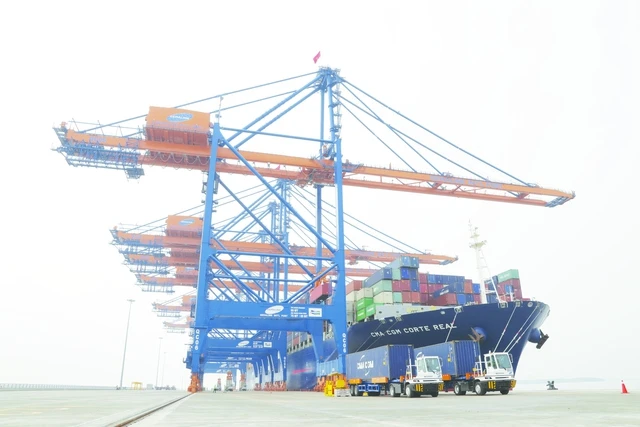
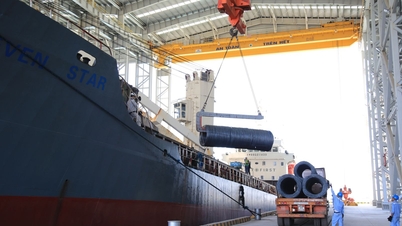
A container ship docks at Gemalink Port, Vietnam's largest deep-water port located at the mouth of the Thi Vai and Cai Mep rivers.
It's unknown who named the river, but it flows near a mountainous area, and like many other places in Ba Ria-Vung Tau named after women, such as Ba Ria and Ba To, the mountain is named Thi Vai, and the river shares the same name. The Thi Vai River isn't long; from its source in Long An commune (Long Thanh district, Dong Nai province) to Phu My town, where it merges with the Go Gia River to form the Cai Mep River, and flows into Ganh Rai Bay, it's less than eighty kilometers. Therefore, it can't be compared to the Red River, Dong Nai River, or the Mekong River in terms of length or flow. But if we liken those other rivers to mother rivers, then the Thi Vai River, in its youthful springtime, carries a great mission: to contribute to our trade with the world .
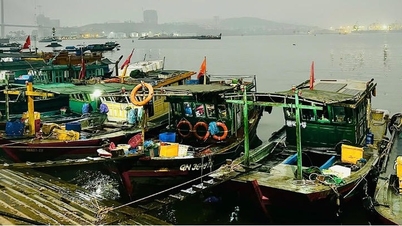
When I first moved here, I rented a room in Phuoc Hoa, a commune located downstream of the Thi Vai River. At that time, there were already several industrial zones along the Thi Vai River, such as Go Dau, My Xuan A, and Phu My 1... but the downstream area was still undeveloped. Many people still made a living by fishing with nets and traps along this river.
I remember back then, I sometimes went with Uncle Luon to the river at night to cast his nets. From the dock, the motorboat would rumble along the canal, weaving through the mangrove forest to reach the river. After casting all the nets, Uncle Luon would steer the boat to a spot where the water was still, turn off the engine, and wait to retrieve the nets. While waiting, I listened to him tell many stories related to the Thi Vai River. These could be stories about occupational hazards that always lurked around fishermen, or more mysteriously, stories of encounters with "ghosts" that caused the boat engine to fail, leaving them lost in the mangrove forest and unable to find their way out. I also learned that during the resistance war to liberate South Vietnam and unify the country, along with the Long Tau River, the Thi Vai River was a place that marked the activities of the special forces soldiers of the Sac Forest. Many battles took place on this river, contributing to the heroic victory of the nation.
I moved house and changed jobs many times, but it seems my destiny hasn't ended, and I'm still connected to the river.
In 2007, the SP-PSA international port, Vietnam's first deep-water port, was started construction along the Thi Vai River. And in 2009, the Tan Cang - Cai Mep international port was also started construction, transforming the area into a gateway port cluster for the entire southern key economic region.
Looking back now, the Thi Vai River is home to a comprehensive system of seaports, contributing to the formation of many new industrial parks such as Phu My 2, Cai Mep... and especially Phu My 3 Industrial Park, the first specialized industrial park in our country built based on cooperation between the Vietnamese and Japanese governments . This alone demonstrates the importance of the Thi Vai River to the economic development of Phu My town in particular, Ba Ria-Vung Tau province, and the whole country in general.
Source link

















































Comment (0)