

Teacher Kpă Pual recounted that: In the old days, people from Krông Pông ( Đắk Lắk ) migrated to establish a village in this area, so they named it Buôn Pông (which is now Buôn Gum Gốp, Ia Rmok commune, Krông Pa district) to commemorate their homeland.
When we first arrived at the school, life for us teachers was very difficult. The staff housing was cramped, far from the market and the district center. The school had invested in digging a well, but there was no water. All our daily activities depended on the Ba River.
In the afternoons, my colleagues and I would often follow the villagers to the water source in Buon Pong to fetch water for bathing and washing. The women would dig deep into the sand at the river's edge, waiting for the spring water to come out, then pour it through a cloth filter into a plastic can or gourd shell, and carry it back home.
The village children would gather at the nearby sandy beach to play football. After the game, they would rush to fetch water to drink, then splash into the river to cool off under the supervision of adults. At night, the young men of the village would bring nets, flashlights, or torches to the water's edge to catch fish and sleep there. The next morning, someone would come to the water's edge to fetch water. Because of this, the water's edge in Pông village was always bustling with laughter and conversation. They shared their work, their joys and sorrows in life. Almost everything in the village was passed on at the water's edge, so I also called it the "information hub."
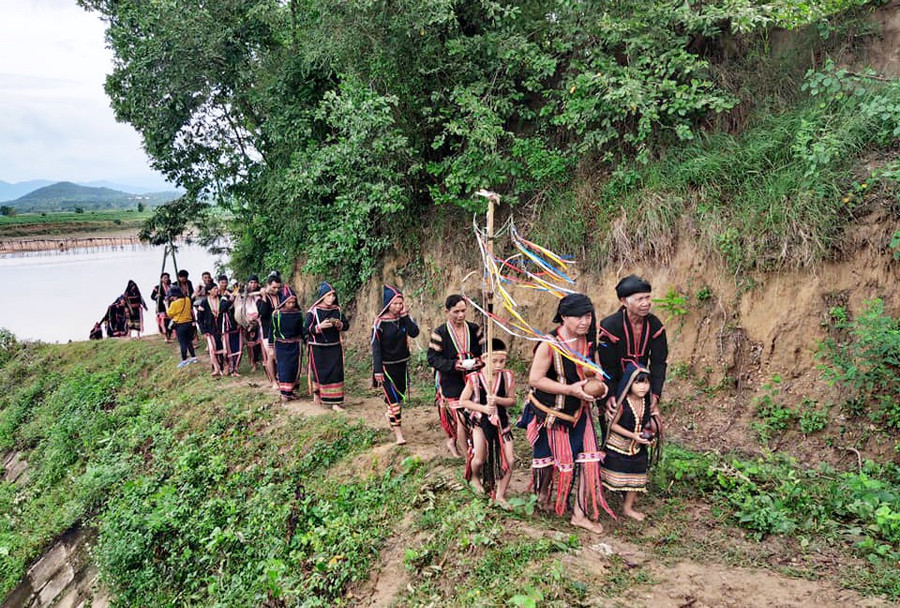
For the Jrai people, everything, from grains of rice and knives to wine jars, possesses a soul and a life of its own. Every stroke of luck or misfortune that befalls individuals, families, and communities is connected to the world around them, especially the water source—the very thing that sustains them daily. This is why they have the custom of worshipping the water source, offering thanks and praying to the spirits for good health and freedom from illness for the villagers.
More than half a century ago, scholar Jacques Dournes—a "Central Highlands expert"—subtly recognized that the most fundamental and profound aspect of the local people's water-worshiping ritual was the emphasis on preserving the integrity and sustainability of their living space. They skillfully utilized religious and spiritual elements to convey this message.
During a water-worshiping ceremony, I heard the village elder, Rơ Ô Bhung, share: Before the ceremony, he calls for contributions from all households in the village to buy offerings. Women sweep and pick up trash along the village roads and riverbanks. Young men go into the forest to cut bamboo and reeds to hold water and erect two ceremonial poles. The larger pole is erected right in front of the longhouse where the ceremony takes place, while the smaller pole is used when the procession goes to fetch the water spirit. The offerings consist of five jars of wine, one large pig, and one castrated rooster.
Besides the water-worshiping ceremony, which aims to pray for health and peace, the Jrai people here also believe that water helps people "cleanse" themselves of all misfortunes, hence the custom of bathing in the river to wash away bad luck. While the water-worshiping ceremony is communal, the river-worshiping ceremony is for individuals. This ceremony is also held at the village's water source, hoping for a return to good fortune. The offerings include one pig, one duck, and one jar of rice wine. Those who have experienced misfortune must personally bathe in the river, hoping the water will wash away their bad luck and troubles. After the ceremony, they bring the offerings home to share with the villagers.
As time passed, the Song Ba Ha hydroelectric dam ( Phu Yen province) was built downstream of the Ba River. The section of the river flowing through the Pong village water landing became a water reservoir. The area is almost always full of water, so there are no longer sandy areas where people used to dig holes to collect water. Instead, the villagers use water from drilled wells or bottled water. The rituals associated with the water landing gradually became less frequent. The Pong village water landing is now just a memory for me and the people of that time.
Source: https://baogialai.com.vn/ben-nuoc-buon-pong-post318014.html
![[Photo] Golden season of organic farming under the canopy of the vast Mang Den forest.](/_next/image?url=https%3A%2F%2Fvphoto.vietnam.vn%2Fthumb%2F1200x675%2Fvietnam%2Fresource%2FIMAGE%2F2026%2F01%2F24%2F1769247398190_ndo_br_cam-15-jpg.webp&w=3840&q=75)


Comment (0)