


Ancient people believed that a cool fire meant a declining house, while a warm fire meant a prosperous house. If the house was neither prosperous nor declining, and generally average, the fire would simply burn steadily and persistently (this was the most common case).
Talking about fire in a figurative sense is endless; here we'll only discuss fire in its literal sense – the hearth of every Vietnamese family in the countryside. Nowadays, the minimum living standards of most people are rising daily, so household items like gas stoves are no longer luxuries, no longer confined to the city, but have reached many homes in the countryside. This reminds me of days long gone...
I don't know about other places, but in my hometown several decades ago, firewood for cooking was usually bought from local sources. Only when absolutely necessary or as a last resort would we "splurge" on buying firewood from woodcutters who transported it to the city, then reselling it to individual households in need through intermediaries.
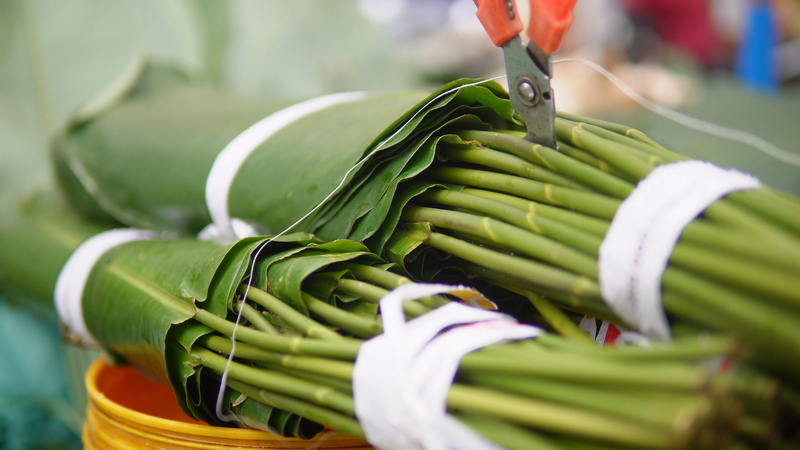
"Củi niền" is what people in my hometown call it, I'm not sure if it's a common term or not, I just know it's a name based on what we see. It means a large bundle of firewood, about the diameter of a mini bicycle wheel, consisting of many pieces of wood about half a meter long, bundled together, with both ends "sealed" tightly with rattan or braided cords made from tree bark or other forest vines. That's why it's called "củi niền".
There's also another "theory" that says it's called "rimmed firewood" because the two rims at either end of the bundle look just like bicycle rims! I think the "rim" in the psychological sense is more important, because housewives have to carefully consider how to "use" such a luxurious piece of firewood. If they just use whatever they can find, then during religious ceremonies or holidays they'll have to burn straw and hay, which burn quickly and produce pungent smoke that stings the eyes!
There are many insightful folk sayings about firewood that I really... agree with, such as "rice from the highlands, firewood from the cinnamon trees," or "expensive means cinnamon, unsold means firewood." So true!
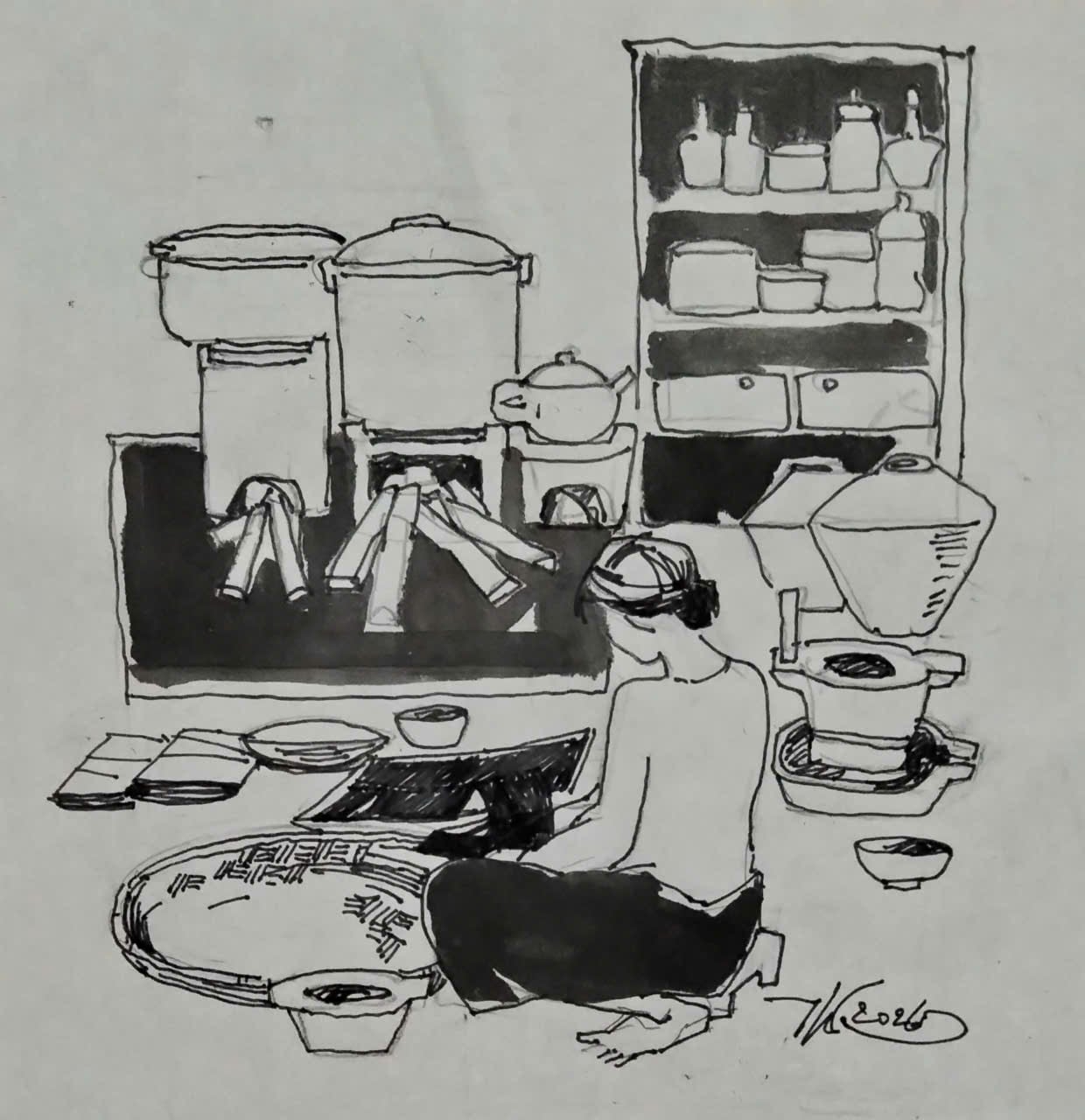 |
| Illustration: Hung Dung |
It's understandable why my mother cherished every piece of firewood she gathered, not daring to burn it before important occasions like Tet (Lunar New Year). Only by understanding how important "keeping the fire burning" in the house is to a woman can one realize how precious firewood is compared to a pot of rice! Therefore, during the twelfth lunar month, I usually have to help my mother "go hunting" in our garden.
Luckily, the natural hedge around the house often had naturally growing neem trees. And these neem trees, withered inside but fresh outside, dry quickly and burn easily, were just as good as firewood. Every time I cut down neem trees and split them open, my mother would happily arrange the pieces of firewood on the yard to dry in the sun, her heart filled with joy like drying rice during harvest season! I shared in her happiness, as if I had just given her a precious gift.
That's why, even many years later, no matter how busy I was, I never forgot to make time to prepare firewood for my mother as Tet approached. The December sun was sometimes strong, sometimes weak, but the durian wood was always dry enough for my mother to burn until after the Lunar New Year. While in the past she was frugal with every piece of firewood, lately she's been more "generous," meaning she always kept the fire burning throughout the Tet holidays.
In a family, the New Year wouldn't truly be the New Year without one important ritual: the ceremony of welcoming the Kitchen God back home.
Every year, once all the preparations are complete, the family thinks about offering sacrifices to welcome the Kitchen God back to the mortal world after a week in the heavens reporting on the year's events; this ceremony is called the welcoming ceremony.
In folklore, during the twelfth lunar month, everyone is familiar with the saying:
"The twenty-third Kitchen God ascends to heaven."
The Kitchen Goddess stayed behind to endure life... and cook rice."
When I was little, I heard my mother warn me: "Only the Kitchen Goddess is left, so you have to be careful when cooking rice, otherwise it will burn, be overcooked, or be mushy and undercooked, and there will be no Kitchen God to fix it!" I wasn't bothered by the threat, but I felt sad for the Kitchen Goddess, who was all alone during the last days of the year, while the work piled up like a mountain – making ginger jam, coconut jam, sticky rice cakes, and other things that required her help.
Too busy, the Kitchen God has to come back to help! The "round-trip ticket" that people grant him, covering both the journey there and back, is only for one week. And the ritual of welcoming him is usually performed on the last day of the year, before New Year's Eve, so that he can be present on the morning of the first day of Tet, assisting with all the major and minor affairs in the house for the new year.
On the last day of the year, amidst the hustle and bustle of the world, the ceremony of welcoming the Kitchen God back to the mortal world is always as heartwarming as welcoming back grandparents, welcoming back the most familiar things to a Vietnamese soul before the new year. And this is like a flowing stream in every family from year to year, never-ending...
Huynh Van Quoc
Source: https://baodaklak.vn/van-hoa-xa-hoi/van-hoa/202602/bep-cua-tet-xa-6b43199/


![[Photo] General Secretary To Lam works and extends New Year greetings to the Party Committee, government and people of Dak Lak province.](https://vphoto.vietnam.vn/thumb/1200x675/vietnam/resource/IMAGE/2026/02/11/1770808701306_ndo_tl_img-4099-5201-jpg.webp)

















































Comment (0)