Many people know about Lung Cu, especially the Lung Cu flagpole on the summit of Dragon Mountain in the famous Dong Van karst plateau. But perhaps not everyone knows about the hardships of the border guards here, who day and night manage the border markers and guard the Lung Cu flagpole. The national flag, proudly flying atop Dragon Mountain, covers an area of 54 square meters and represents the 54 ethnic groups of Vietnam, becoming a symbol affirming the sovereignty of the country at its northernmost point.
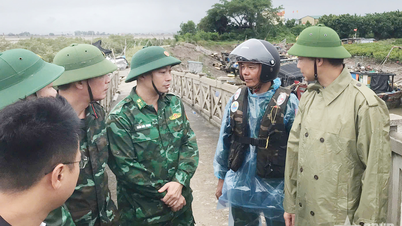
In this remote border region, border guards are working alongside the H'mong, Lo Lo, and Giay ethnic communities to stabilize their lives, develop their economy and culture, and especially manage 25.5km of border with 26 sovereignty markers in the Ma Le and Lung Cu areas of Ha Giang province. The Nho Que River, like a silver thread winding its way, seems to represent the sweat and hard work of generations of people in this area.
The story goes that, immediately after defeating the Qing army, Emperor Quang Trung ordered a large drum to be placed at the guard post on the summit of Dragon Mountain. Whenever the drum sounded, its sound could be heard for miles. This was a way of asserting sovereignty, demonstrating the majestic power and prestige of Dai Viet, and reminding those with ambitions of invasion to learn from history. That heroic drum sound continues to resonate today and into the future.
 |
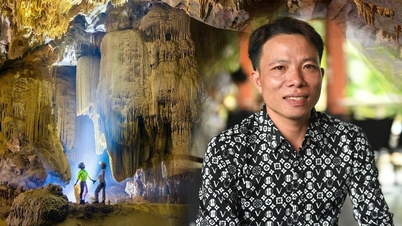
Writer Phùng Văn Khai with border guards in Cát Bà, Hải Phòng. |
The Lung Cu Border Guard Post was established in 1978 with the designation Post 161. In 1990, due to operational requirements, the Lung Tao Border Guard Post was dissolved and merged with the Lung Cu Post, now designated as Post 169. Currently, the Post manages the area from border marker 411 to 428, which is the furthest protruding part of Dong Van. Although it's called a rocky plateau, 8 km of the 25.5 km border is a river border. Here, rocks are piled upon rocks. Sweat drips down. The terrain is heavily fragmented. Sometimes, during patrols, our soldiers have to pack their own meals or dig for wild roots and catch fish in the streams for days on end. The climate here is very harsh. During the rainy season, the soil and rocks are muddy, and roads are constantly eroded. In the dry season, thick fog obscures visibility; you can't see people even seven or eight steps apart. Temperatures can sometimes drop to 0 ° C, and snowfall is common in Lung Cu. There are times when people can only look at the rocks and weep because planting crops is so difficult. They wish they could transport the rocks down to the lowlands to make cement, for example; that would bring in a fortune. But that's too unrealistic. A single rock transported down to the lowlands would be worth as much as gold. That's why the vast expanse of gray rocks remains forever on the Dong Van plateau.
*
* *
I've traveled to many places, but every time I come to the Central Highlands, this land still evokes a powerful and indescribable emotion in me. Arriving at Border Guard Post 731, also known as Ya Lop, a newly established post and one of the most disadvantaged border guard posts in Ia Mo commune, Chu Prong district, Gia Lai province, it was already late afternoon. Because it's a newly established post, everything is scarce, especially water. We only managed to resupply a small amount of food, and now we are at a makeshift guard post of Border Guard Post 731.
The simple guard post, nestled in a remote border region, felt a pang of sadness in the men on the guard post on a windy afternoon. It was over 100 kilometers from the center of Pleiku to this place, and the roads were still very difficult. Down below, it was bustling and vibrant; here, it was quiet, simple, and silent. Many places lacked electricity, and water had to be carried from dozens of kilometers away, and even that unclean water had to be used. The blackened pots lying upside down on the crudely carved wooden shelf only added to the harsh atmosphere of the outpost.


There are four officers and soldiers here. Three of them are married. The youngest is Private Rơ Chăm Sư, a twenty-one-year-old Jơ Rai man from Ia Zôm - Đức Cơ - Gia Lai, who married Rơ Mah Phơm, only eighteen years old, who works in the fields at home. Rơ Mah Phơm's family has seven siblings, and they all got married around eighteen or nineteen years old. In the past, it was even earlier, sometimes as young as thirteen or fourteen, and that was naturally associated with poverty and disease.
Watching the border guard anxiously gaze out at the low hillside dotted with oil palms and dipterocarpus trees, where the sun was setting, a lump formed in my throat. The border field outpost of Post 731 has four officers and soldiers from four different hometowns. Nguyen Chi Thiet is from Son Tay, the land of white clouds in the West; Nguyen Van Hao is from Thanh Hoa, the land of indomitable and resilient Thanh Hoa; and Private Chu Duc Xam is from Mang Giang, Gia Lai. For these soldiers, the Central Highlands today is a warm and welcoming land, visited by people from all over. The Central Highlands is etched on the shoulders of the soldiers, including the border guards. Today, a significant percentage of children from the Central Highlands ethnic groups have become border guards, taking control of their own lands.
 |
| A delegation of military writers at border marker 1116 in Lang Son province. |
 |
| Writer Phùng Văn Khai at the family home of martyr Ngô Văn Vinh in Lạng Sơn. |
That morning, while at Border Post 729, the deputy commander informed me that five of our comrades had married women from ethnic minority groups in the area. Their wives taught literacy and provided medical care, while the husbands engaged in community mobilization. Although they married nearby, they sometimes only saw each other once a month. A Kinh man with a Bana, Jơrai, or Êđê woman, or a Suđăng or Mơnông man with a beautiful Kinh teacher in the village, had become commonplace at the border posts in the Central Highlands. This was something few would have imagined two or three decades ago.
Along the Central Highlands border, everything seems to be flourishing. Here and there, slopes are covered with vibrant red wild ginger flowers, red wild bananas, and dark red dipterocarp forests, occasionally interspersed with patches of bright yellow sunflowers. Beside the wooden walls of the border outpost, branches of rustic wild orchids, still carrying the scent of the deep forest, are revealing round, swaying buds in the late afternoon light, as if sharing a moment of peace with the border guards. It's hard to say what anyone is thinking. Everything seems to be blending with the earth, sky, and plants, lost in their own shared thoughts.
We arrived at Post 747 (Po Heng Post) in Krong Na commune, Buon Don district, Dak Lak province. This is the most remote and difficult post in the province. The journey involves winding through forests, hillsides, and streams in the districts of Dak Nong province.
Post 747 is located opposite Krông Te commune, Pách Chăn Đa district, Mon Dun Ki Ri province, Cambodia. The post commander was away. The two deputy commanders warmly welcomed us. Sitting and chatting on the border, everyone felt closer. Over a cup of green tea, stories flowed freely, from wives and children, villages, customs and culture to farming, production, and personal aspirations… the young soldiers from all over the country whispered and confided in each other.
I've said many times that the Border Guard highly values and looks forward to military writers visiting their units, especially in remote areas, and there's a reason for that. When the Military Arts and Literature Magazine organized a writing camp in Quy Nhon, Binh Dinh, and I was assigned the task of organizing the logistics for the camp, I was very worried, at times even stressed. Even before the camp opened, while still in Hanoi, I reported to my superiors about some of the camp's activities, including the evening of interaction with officers, soldiers, and people on Nhon Chau Island. With their support and trust, I boldly called to request a ship from the Binh Dinh Border Guard to transport the writers and poets to the island. I envisioned the difficulties of transporting an entire group of over 20 people to the sea at once. How would they manage food and accommodation? How would they provide services? And what about fuel, expenses, the ship's departure order, and the reasons for the trip?

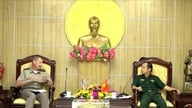
To my surprise, on the other end of the line, Mr. Chau, the Deputy Commander of the Binh Dinh Border Guard, eagerly accepted my invitation and meticulously inquired about each of our requests. He warmly invited the writers and poets to visit the Border Guard of the province. I was truly moved by their kindness. That's what the Border Guard is like: warm, sincere, respectful, and hospitable. When we were preparing to board the ship, the Border Guard soldiers had been waiting for us for a long time. Their handshakes were firm, their eyes and smiles weathered by the sun and wind. Their questions and greetings were sincere and simple, yet so full of the sea's essence. My nose stung. The other members of the delegation felt the same way. On the journey to the island, we and the Border Guard soldiers of Nhon Chau always sang loudly, in various accents from Thanh Hoa, Nghe An, Quang Nam, Doai, and Dong provinces... What could be more refreshing than singing and listening to our comrades sing on the sea?
That night, we interacted with the officers, soldiers, and people on Nhon Chau island commune.
This is my first time taking on the role of host.
Surprisingly, I wasn't flustered at all. I opened my heart, the heart of a writer, to my comrades, colleagues, especially the soldiers, including the border guards sitting there. And the children with sun-scorched hair, and the teachers who came here to teach literacy and morality, seemed to instill in us writers a profound and heartfelt feeling. Writers and poets Pham Trong Thanh, Binh Nguyen, Nguyen Du, Ngoc Tuyet, Manh Hung, Tran Tri Thong, Thai Sac, Pham Xuan Phung, Ninh Duc Hau, Du An... were invited onto the stage to sing, recite poetry, and share their deepest and truest thoughts with the soldiers who endure the harsh conditions on the island. The night deepened. We continued to sing, recite poetry, and confide in each other. Far out there was the sea. High above, the stars twinkled and whispered, encouraging the soldiers, writers, and poets. We sat close together, singing endlessly songs about life, about the lives of soldiers.
Source: https://www.qdnd.vn/van-hoa/van-hoc-nghe-thuat/bien-phong-du-ky-1025235