

Millet porridge is made from millet grains, a type of grain also known as small rice, grain, or white millet. The aroma of millet porridge during Tet (Vietnamese New Year) is truly captivating; it has enchanted me since childhood. The fragrance of millet, the sweetness of brown sugar, the spiciness of ginger, the pungent taste of lime—all blend together in a thick, creamy bowl of porridge...
When I was little, every year on the 23rd of the 12th lunar month, when we offered sacrifices to the Kitchen God and the Stove God before they ascended to heaven, my grandmother would cook millet porridge. She would prepare it early: several stalks of millet, washed clean, mixed with a little diluted lime to remove any sediment, and then put it on the stove to cook. She would cook until the porridge started to boil, then stir continuously with chopsticks to prevent clumping. When the porridge was cooked, she would add a few pieces of brown sugar and some finely chopped ginger.
My grandmother used to say: Millet porridge without ginger can't be delicious! To make millet porridge, you have to add brown sugar to get that attractive golden-brown color. However, back when we had to use ration coupons, brown sugar (the kind made from crushed sugarcane, filtered to extract the juice, then boiled and poured into molds to solidify into cakes) was quite scarce, and we always had to buy it secretly at the market.
Later, to make the millet porridge sweet, in addition to adding sugar, a little salt had to be added. Later, sugar mills produced less brown sugar and had to use refined white granulated sugar, which made the color of the millet porridge less appealing than before.
Every year, seeing those tempting bowls of golden-brown millet porridge makes my mouth water... The longer the millet porridge sits during Tet (Lunar New Year), the better it tastes. At that point, it thickens in the bowl; you have to use a spoon to scoop it up. It seems that the winter weather and the slight chill from the drizzling rain outside have gradually permeated each grain of millet, giving you a feeling of coolness and sweetness that follows with every bite, invigorating the spirit.
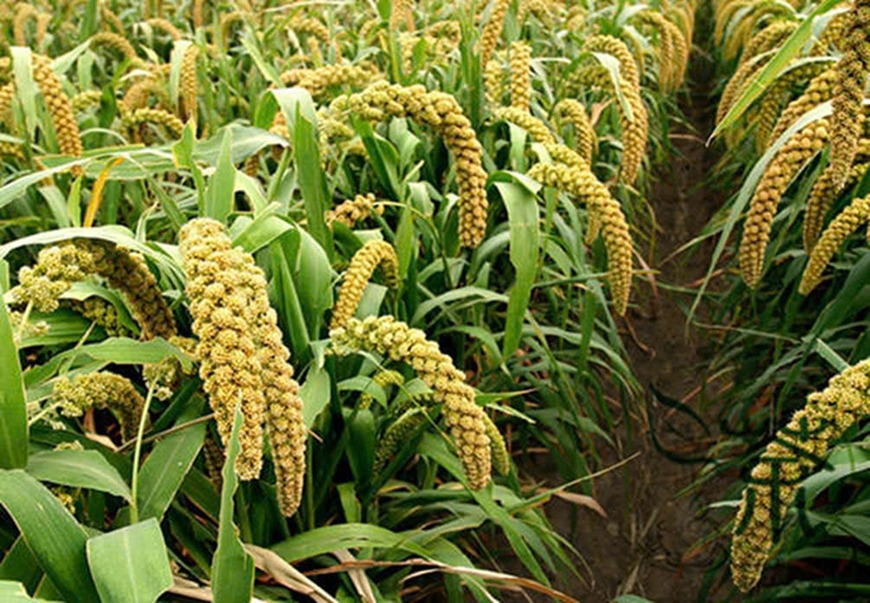 |
| The main ingredient for making millet porridge is the golden yellow millet grains. Source: Internet |
It's quite remarkable how tiny millet seeds, no bigger than the tip of a toothpick, can grow into strong, healthy plants, diligently absorbing the essence of the earth and sky day and night, then producing large, heavy ears laden with tiny grains. Around April or May in the lunar calendar, the millet ears begin to change from yellow to dark brown, indicating that the grains are ripe and must be harvested quickly to avoid becoming prey for sparrows. Though tiny, when cooked, millet becomes an incredibly delicious dish, one taste that you'll never forget...
Later, when I grew up and joined the army, and was stationed far away in the vast, ocean-covered Truong Sa Islands, every time Tet (Lunar New Year) came around, I would long to enjoy my grandmother's millet porridge...
I returned to civilian life after several years in the military. And I'm still in love with my grandmother's millet porridge. Every time I get to enjoy it, I sigh with regret for the Tet holidays when I didn't have my favorite dish. My grandmother just smiles at my simple preference, but her eyes gaze into the distance, brimming with tears.
My grandmother said, "Other people's children long for meat and fish, lavish feasts, but my grandchild only craves a bowl of millet porridge meant for the poor." She felt sorry for my grandchild's simple dream, given our family circumstances! I asked her, "Grandma, your maternal great-grandmother was a high-ranking official in the past, how do you know how to make millet porridge?" She looked at me and smiled affectionately, "Even the high-ranking official was poor back then, and my grandmother was a farmer; we didn't have much to eat. Both our families have been chronically poor, my child!" Only then did I realize that those bowls of millet porridge were the culmination of countless years of hardship…
Nowadays, life is more comfortable. The elaborate, nutritious dishes prepared meticulously for Tet (Lunar New Year) have made us forget the simple, rustic pleasures of the countryside. Few people remember the bowl of millet porridge that was once respectfully placed on the ancestral altar during the Spring festival.
My grandmother has also passed away. But every year when Tet (Lunar New Year) comes, my heart aches when I remember the bowls of millet porridge she painstakingly prepared with a lifetime of hardship, with all her love for her children and grandchildren, and with her silent dedication and sacrifice.
My mother only occasionally made millet porridge. Every time I placed a bowl of millet porridge on the altar, looking into my grandmother's kind eyes, my eyes welled up with tears, filled with longing for the old days. The brownish-yellow, thick millet porridge, though simple and humble amidst a feast of countless delicacies, was always captivating and seemed to have seeped into my very being, resonating intensely with each passing spring...
Source: https://www.qdnd.vn/van-hoa/doi-song/huong-che-ke-1025793
![[Photo] Capturing the moment the tide recedes at Yen Binh Son rapids - a million-year-old scenic spot in Quang Ngai.](https://vphoto.vietnam.vn/thumb/1200x675/vietnam/resource/IMAGE/2026/05/19/1779175463885_yen9-1199-jpg.webp)

![[Photo] General Secretary and President To Lam presides over a working session with the Central Policy and Strategy Committee on the development of the materials industry.](https://vphoto.vietnam.vn/thumb/1200x675/vietnam/resource/IMAGE/2026/05/21/1779359935432_a3-bnd-3129-1412-jpg.webp)







































































Comment (0)