


The "memory" ingredient
Recently, in an effort to live like a 21st-century person, I've been diligently browsing short videos on social media. Amidst the countless videos circulating online, I stumbled upon a humorous Japanese program that playfully teased diners at a fancy restaurant.
The program team bought only inexpensive canned goods like instant noodles and ice cream, then arranged them to look "fancy." As a result, when the diners tasted them, they all praised how delicious they were. Furthermore, when the program asked them to estimate the prices of the dishes, they all stated that the prices were dozens of times higher than the listed prices on these ready-to-eat products.
Interestingly, a person's sense of taste is often determined by their feelings – the feeling of enjoying a meal in a luxurious setting, or the impression that it was cooked by a renowned chef, might have some impact on their taste buds.
We taste with our tongues, with our eyes, and for many dishes, even with our hands. Ultimately, people eat with their memories. In our childhoods, those of us living in the same region or country probably ate similar dishes. The only difference lies in the preparation methods of each region, the adjustments in the recipes made by our grandmothers and mothers.
Mothers and grandmothers keep a "secret ingredient" of their own: memory. And the flavor of that memory clings to our minds, accompanying us as we grow up, wander the streets, and travel to all corners of the world.
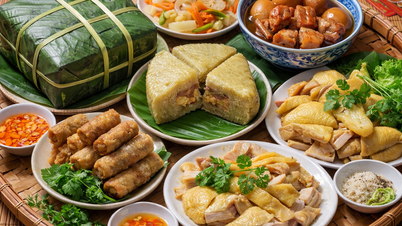
One day at the end of the year, far from home, I sip flower-scented tea, eat a few pieces of candied fruit, catch a whiff of sticky rice cake in the air, and in front of the inn, strings of sausages hang, their rich, savory aroma carried by the wind into the room. Just a whiff of this scent is enough to stimulate the imagination: a New Year's Eve dinner, the taste of traditional New Year's dishes tingling on my tongue.
In my memories, I try to find a restaurant, order a meal, and see the waiter place familiar dishes in front of me. I take a bite. It's tasty, but not... in the way I wanted.
Something still seems missing, a taste of childhood, of nostalgia, not of gourmet food, sometimes just an ordinary dish, a jumble of leftovers from a meal, a little bit of everything, and yet it becomes a "delicious" meal. Because that "delicious" meal can only be savored after a gnawing hunger, after a night of heavy drinking, in the backyard, in the small, smoky, grease-stained kitchen, prepared by the hands of our loved ones.
The taste of love
Do you remember the food critic from the cartoon Ratatouille? A cold, harsh character, whose scathing reviews caused countless restaurants to lose their ratings. The moment he tasted a dish made from ordinary vegetables, his pen fell from his hand; his critic's robe suddenly became too big for him, as he reverted to a snot-nosed child standing before his mother, savoring the vegetables she cooked.

Here, a question arises: Do we eat to enjoy ourselves, to be happy, or simply to judge, evaluate, and see what "status" we're at? Is it the status of five-star restaurants, those Michelin-starred eateries, that makes us forget that we eat (unless it's to satisfy hunger) for the joy – a joy that doesn't come from eating expensive food, but from eating something that brings us peace.
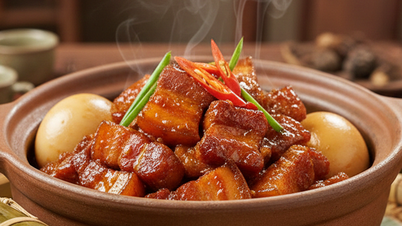
A sense of tranquility emanates from the jars of pickled cucumbers and onions, from the marinated pork drying in the sun in the yard. Sunlight lingers between the firm, spice-laden meat, waiting for the heat of the boiling coconut milk to release its warmth, coloring the meat a golden brown. Under that same sun, the jars of pickled onions and cucumbers cast thin shadows on the cement surface.
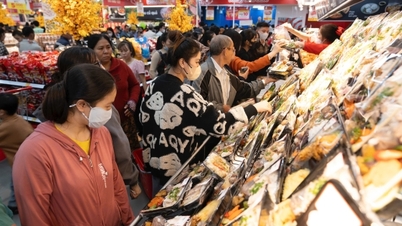
Familiar Tet dishes carry the warmth of the twelfth lunar month, waiting for the first lunar month to once again warm the hearts of children and those who have returned home after being away for a long time.
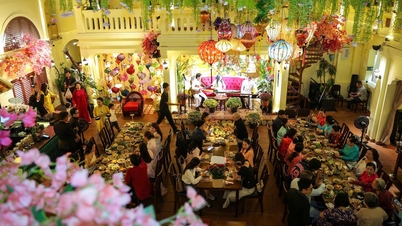
Returning home to "celebrate Tet," the most important occasion among all the celebrations, such as "mealtime gatherings/weddings/baby showers/birthdays." Mentioning the taste of the twelfth lunar month evokes the taste of love. A taste that even the most money can hardly recreate.
When I was a child, I watched a movie that featured a king who came from a beggar background, and his fellow beggars cooked him a soup called "pearl, jade, and white jade."
After ascending the throne, he tried to eat that delicacy again but couldn't. He searched far and wide to invite his former colleague to the palace to cook that soup for him. The beggar cooked a soup, to put it crudely... a pot of pig's slaw, so unappetizing that neither the king nor his courtiers could taste it, but he still tried to eat it, because it was the soup of pearls, jade, and alabaster in his heart.
Perhaps each of us is like that emperor, dwelling on the past, each with our own unique bowl of pearl, jade, and alabaster soup...
Source: https://baodanang.vn/mon-canh-tran-chau-phi-thuy-bach-ngoc-3323447.html



![[Photo] General Secretary and President To Lam receives Amazon's Senior Vice President David Zapolsky](https://vphoto.vietnam.vn/thumb/1200x675/vietnam/resource/IMAGE/2026/05/22/1779466547770_a1-bnd-3513-6601-jpg.webp)























































































Comment (0)