

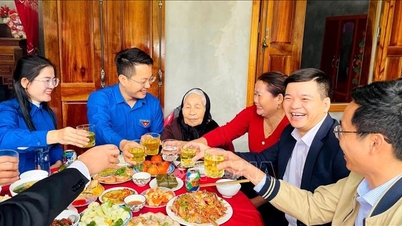
Every year, in the days leading up to Tet (Lunar New Year), the family of Mr. Nguyen Van Tiep in Hong Quang commune becomes lively and bustling. His two children both work far from home. However, the tradition of family reunion and New Year's Eve dinner has been maintained by his family for many years. Mr. Tiep said: "My children work far from home, and apart from important family events, we rarely have a large family gathering. However, on the 30th day of the Lunar New Year, despite their busy schedules, they always come back to visit the ancestral graves and have a New Year's Eve dinner with the family. Seeing my children and grandchildren happy and healthy makes the reunion dinner even more meaningful." Like Mr. Tiep's family, Mr. Tran Danh Tuyen in Hanoi has also returned to his hometown for many years to celebrate the New Year with his family. Mr. Tuyen shared: "My parents are no longer alive, and only the ancestral temple remains in my hometown. But besides the anniversary of their deaths, I always return home at the end of the year to organize a family New Year's Eve dinner." To ensure a decent meal, I had previously assigned the shopping to my children and grandchildren. This is not only a meal that strengthens family bonds, but also an opportunity to educate my children and grandchildren to always remember the traditions of their ancestors, so that they will always be conscious of promoting and preserving the beautiful traditions of our nation.
Beyond just a family meal, in recent years, year-end celebrations have become an indispensable activity in agencies, businesses, and residential areas at the end of the year. It's not just a time for gatherings and reunions; it's also a meal that strengthens camaraderie among colleagues and neighbors. Mr. Tran Van Hung, from An Thuong neighborhood, Pho Hien ward, said: "In the past few years, I've seen many neighborhoods organize year-end celebrations. In my neighborhood, at the beginning of December in the lunar calendar, we pooled money to buy flags, lanterns, and LED lights to decorate the whole neighborhood to welcome the new year. The year-end meal is usually held on a weekend near Tet (Lunar New Year). Around the table, stories are shared and reminisced. People share good deeds related to security and order, environmental hygiene, etc., and discuss and offer suggestions for the neighborhood's development." As someone who lives far from home in this neighborhood, the New Year's Eve dinner helps me feel closer to my neighbors, giving me a sense of familiarity as if I were in my own hometown. That's why I participate in the neighborhood's New Year's Eve celebration every year.
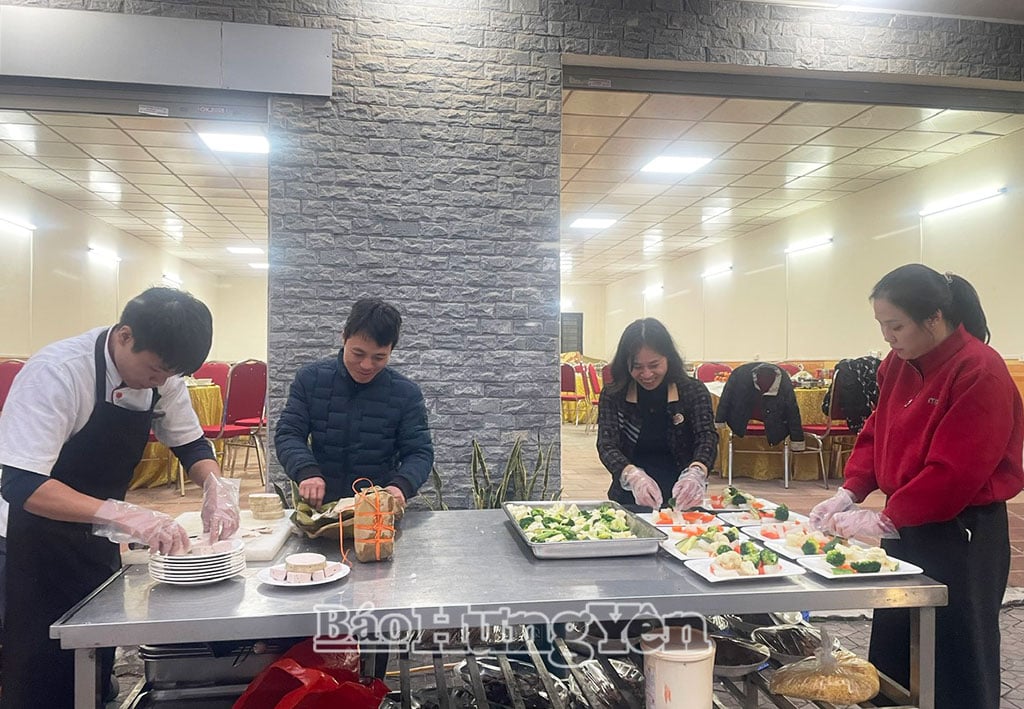
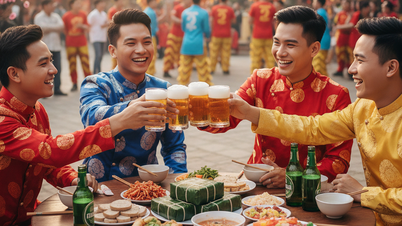
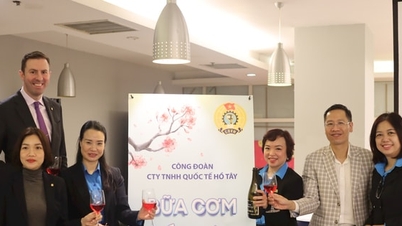
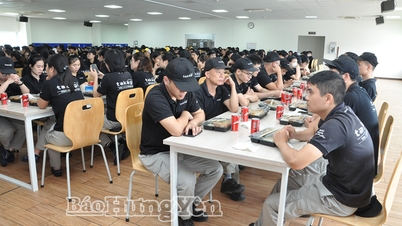
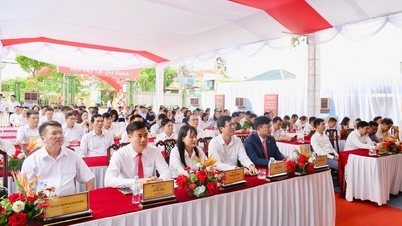
The year-end celebration truly becomes a festive occasion in every agency, business, and residential area. Depending on the conditions of each agency, business, or residential area, the year-end celebration is organized in different ways. In residential areas, each family contributes financially to the event. In agencies and businesses, the majority of the catering is arranged by the trade union or administrative department; some businesses even raise their own pigs and chickens for the New Year's feast and give sticky rice cakes (bánh chưng) to employees and workers. At the year-end party, although the feast may not be extravagant, it is filled with warmth and camaraderie. It's the meal with the most laughter and songs of the year.
Today's busy lives may have diminished many traditional values, but in the hearts of each person, the New Year's Eve dinner remains a sacred moment. It's not just the last meal of the year; more importantly, it's a meal of reunion, a meal that strengthens bonds and motivates everyone to strive for success in the new year.
Source: https://baohungyen.vn/bua-com-tat-nien-3191567.html
![[Photo] National Assembly Chairman Tran Thanh Man working with the Standing Committee of the Economic and Financial Committee](https://vphoto.vietnam.vn/thumb/1200x675/vietnam/resource/IMAGE/2026/05/20/1779249584387_ndo_br_1-jpg.webp)


![[Photo] General Secretary and President To Lam presides over a meeting on assessing national development resources.](https://vphoto.vietnam.vn/thumb/1200x675/vietnam/resource/IMAGE/2026/05/20/1779253785852_a1-bnd-2943-8519-jpg.webp)






























![[Workers' Month 2026] Spreading love on the Vinh - Dong Hoi frontline: Nearly 1 billion VND spent on caring for the lives of workers.](https://vphoto.vietnam.vn/thumb/402x226/vietnam/resource/IMAGE/2026/05/20/1779237885217_img_8650.jpeg)



















Comment (0)