


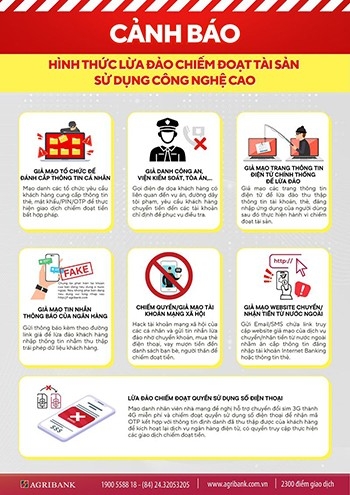
Agribank advises customers about various forms of online fraud.
Based on warnings from banks, it's clear that scams are becoming increasingly sophisticated and well-organized. Many forms of fraud have been exposed by banks, such as sending fake website login links, sending and requesting recipients to scan QR codes via Zalo, Facebook, Viber, or video calls, etc.
Many sophisticated scams
Recently, Vietnam Prosperity Commercial Bank ( VPBank ) issued a warning about a new scam tactic in which criminals impersonate bank employees, calling from landline numbers similar to the bank's hotline number, offering customers credit card limit increases, cash withdrawals, or other financial services. These individuals then send and request customers to scan a QR code.
When customers scan the QR code sent by the scammers, they will be redirected to a fake website link. On this website, the scammers will instruct customers to enter information such as their full name, citizen identification number, photos of both sides of their citizen identification card, card number, CVV security code, and card expiration date. Customers are also asked to share the OTP code sent to their phone number, login information for their bank account username and password…
Immediately after customers provide their information, fraudsters gain access to their internet banking accounts or credit cards, carrying out transactions to steal money.
Another sophisticated form of fraud that customers need to be highly vigilant about when transacting online is the sending of "successful transfer receipts." According to Mr. Ta Dinh (Hanoi), after posting an iPhone for sale on his Facebook page, he was contacted via Zalo by a buyer. The buyer then arranged to meet Mr. Dinh at a location to receive the phone. There, the buyer completed the bank transfer and showed Mr. Dinh a successful transaction receipt.
Although the money hadn't arrived in his account yet, Định, assuming it was a transfer between different banks and therefore delayed, handed over the phone and went home. The next day, upon checking his account and finding no money, Định realized he had been scammed and reported the incident to the police.
According to our research, the trick of forging bank transfer receipts is being used by many scammers. With just a few Photoshop edits, victims will receive receipts, invoices, or transaction documents with information (name, bank account, address, etc.) that is exactly as they provided. The recipient will be misled into thinking it's a real photo of the transfer or printed invoice/receipt, and will therefore trust and follow the instructions.
Notably, the Vietnam National Credit Information Center (CIC) reported that it recently recorded several cases of individuals impersonating CIC to commit fraud, "requesting borrowers to transfer money to personal accounts so that CIC can improve their credit scores and expedite loan disbursement."
Accordingly, the fraudsters, using their knowledge of finance in general and credit information in particular, employ specialized terminology such as "credit," "freezing," etc., to send borrowers "processing documents" complete with forged seals and signatures to inform them that their "credit file has errors, is locked, or does not have enough credit points to disburse the loan," and request that the borrowers transfer money to the fraudsters' personal accounts.
Preventing fraudulent schemes
According to many experts, scams have become much more systematic and sophisticated than before. The nature of online fraud will constantly change with the rapid development of technology. Therefore, preventing online fraud is a long and ongoing battle.
Experts advise customers to be extremely wary of requests to scan QR codes or access suspicious links; not to provide OTP/Smart OTP verification codes to anyone, including bank employees; and to be cautious when sharing personal information such as personal identification numbers, citizen identification cards, driver's licenses, passports, cards, etc., with service providers. In particular, absolutely do not provide card numbers, the three-digit security code on the back of credit cards, or any other confidential personal information via Zalo or unidentified phone numbers.
Furthermore, investigations reveal that while the sophistication of scams is increasing, a common thread among these cases is the use of "burner" bank accounts to receive money from victims. "No scammers use real phone numbers or bank accounts to commit crimes," affirmed Lieutenant Colonel, Dr. Dao Trung Hieu, a specialist in high-tech crime research.
Therefore, in recent years, the banking sector has been implementing many solutions to "deactivate" "junk" accounts. In particular, the State Bank of Vietnam is actively coordinating with the Ministry of Public Security to connect to the national population database with the goal of quickly completing the verification process to clean up over 51 million accounts, prioritizing the data cleanup for approximately 25 million customers with outstanding debts at the Credit Information Center (CIC).
According to Tran Cong Quynh Lan, Deputy General Director of Vietnam Joint Stock Commercial Bank for Industry and Trade (VietinBank), by utilizing national data resources, the banking sector can "clean up" "junk" accounts, thereby preventing crimes from being committed under the guise of acquired accounts. In addition, the introduction of chip-embedded citizen identity cards will also limit the opening of online accounts using forged documents. Currently, the banking system can read information from the chip very accurately, so there will no longer be issues with inaccurate data.
According to Pham Anh Tuan, Director of the Payment Department (State Bank of Vietnam), more decisive action is needed to address the issue of SIM cards registered under unregistered names, thereby facilitating the banking sector's efforts to thoroughly resolve the problem of renting and selling bank accounts. Another issue is the registration of multiple bank accounts with the same SIM card, which also requires thorough verification.
There is a need for more decisive action in addressing the issue of SIM cards not registered in the owner's name to facilitate the banking sector's efforts to thoroughly resolve the problem of renting and selling bank accounts. Another issue is that a single phone SIM card is being registered with multiple bank accounts, so this also needs to be clearly verified.
Pham Anh Tuan, Director of the Payment Department (State Bank of Vietnam)
Finally, as with the CIC case mentioned above, CIC leaders affirm that this is a form of fraud, impersonating CIC to steal money from customers. This action is illegal and seriously affects the legitimate rights and interests of customers; the image and reputation of the State Bank of Vietnam; and the credit granting activities of credit institutions.
"CIC only provides credit information reports directly to each borrower in accordance with the law, through the Borrower Connection Portal at: https://cic.gov.vn and "CIC Credit Connect" - a smartphone application, free of charge once a year. Customers pay for accessing the report from the second time onwards at a fee of VND 22,000 per report (including VAT)."
"CIC does not proactively notify or require customers to pay fees for credit granted by credit institutions," the CIC leader clarified. At the same time, CIC advises customers not to send OTP codes to anyone; not to follow instructions or transfer money to any individual/organization to have debt written off/hidden/credit score improved; and to regularly check and access personal credit reports on the Customer Connection Portal and the "CIC Credit Connect" smartphone application to ensure accurate credit information about themselves, and to proactively monitor their creditworthiness and credit status.
Source link





![[Photo] Prime Minister Pham Minh Chinh inspects the readiness of personnel to ensure order, safety, and security.](https://vphoto.vietnam.vn/thumb/1200x675/vietnam/resource/IMAGE/2026/02/16/1771254005385_ndo_br_dsc-3981-jpg.webp)






























































































Comment (0)