

That pungent yet warm scent lingered not only in the kitchen, but also seeped through the longan trees, brushed along the rows of betel nut trees, and wafted all the way to the end of the alley. Later, whenever I caught a glimpse of the kitchen smoke drifting through the bustling street, my heart would sink, filled with unease.
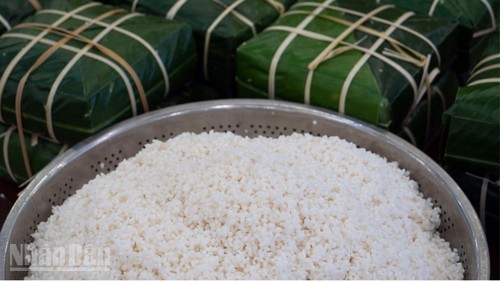
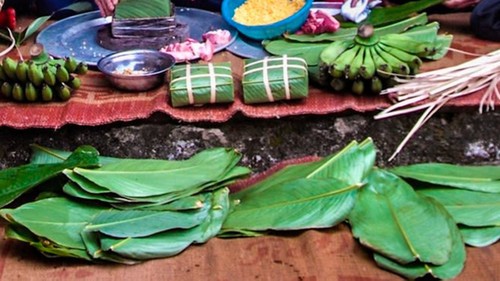
Wrapping banh chung (Vietnamese sticky rice cakes) has never been just a chore. It's a family reunion ritual. A mat is spread in the middle of the house. Stacks of lush green dong leaves are arranged. Grandparents, parents, siblings, and children sit together. Sticky rice mixed with water from the leaves of the Ophiopogon japonicus plant dyes it a soothing green. A layer of golden mung beans, a piece of fresh pink pork placed in the middle, and a sprinkle of fragrant ground pepper. Each layer is carefully wrapped, neatly square, as if encapsulating the savings of a long year. Adults don't forget to wrap a few small, pretty cakes for the children, as if giving them a New Year's gift perfectly sized for their tiny hands.
When the pot was full of rice cakes, clear well water poured in to cover them, and the fire began its all-night blaze. The firewood—longan, eucalyptus, pine—had been prepared by my father-in-law days earlier, neatly stacked in a corner of the garden. The fire gradually caught, blazed up, then quietly licked at the dry pieces of wood, crackling like a very soft laugh. Smoke rose, not too acrid, not too pungent, just enough to make eyes water and soften the heart.
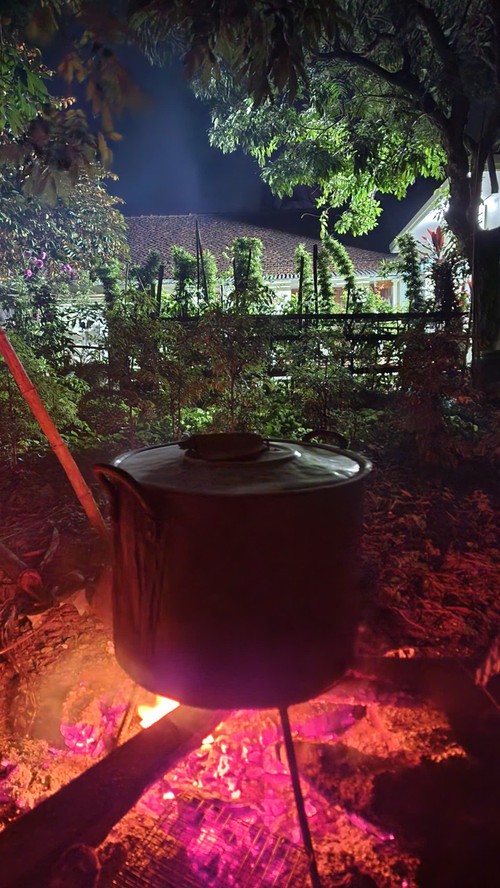
Boiling banh chung (Vietnamese sticky rice cakes) is a constant fire-watching activity; you can't just leave it unattended and sleep peacefully. The fire needs to be big enough to bring the water to a boil, but also just right to keep the pot simmering throughout the night. That's why, in the early evening, we would often sit by the stove, sometimes burying sweet potatoes or cassava in the glowing embers, other times roasting fragrant corn cobs, blowing on them to cool them down and savoring the moment we ate them right there.
The night before Tet (Lunar New Year) in Dai Bai used to be quite cold. The wind from the Chu River blew in, chilly and biting. The whole family gathered around the hearth, the adults chatting animatedly about old times, the children playing all sorts of mischievous games.
But late at night, when the grandchildren were fast asleep, the one quietly adding firewood, extinguishing the embers, his eyes following the fire as if following the breath of the house, was my father-in-law – the children's maternal grandfather. Every now and then, he would lift the lid, add more water, and steam would rise in thick plumes. The scent of banana leaves mingled with the fragrant aroma of sticky rice, a truly captivating fragrance. The smoke rose into the night sky, dissolving into the vast emptiness, as if carrying away countless wishes.
They say the smoke from burning wood can't penetrate because the rice cake is wrapped in so many layers of leaves. Perhaps that's true! But strangely, when you unwrap the cake and cut it with a thin string, you still feel a very different sensation. It's not exactly the smell of smoke, but the flavor of an entire night, of the crackling fire, of conversations, and the glowing embers. That flavor seems to be absent in a cake cooked on a gas or electric stove, even though they are still soft, still square, and still fragrant.
For me, sticky rice cakes (bánh chưng) cooked over a wood fire are still the best. Not only because of the "fragrant smoky aroma," but also because in each sticky grain of rice, each flavorful bean, each tender piece of meat, there's a rhythmic ebb and flow of the fire. Sometimes the fire blazes, the water boils vigorously, sometimes only embers smolder, the water simmering gently in the pot. This seemingly erratic fluctuation creates a unique level of doneness, as if the rice grains are "caressed" by waves of heat, sometimes strong, sometimes gentle, and the beans and meat also absorb the flavors of this uneven transition, ultimately blending into a perfectly balanced taste.
Nowadays, many families choose to buy pre-boiled banh chung (Vietnamese sticky rice cake). And rightly so! Urban life demands speed and efficiency. Gas and electric stoves provide stable, consistent heat, resulting in a perfectly cooked and beautiful cake. But that consistency is sometimes like a straight line. A wood-fired stove, however, is a curve, with ups and downs, highs and lows, just like life itself. I don't know if it's this unevenness that makes banh chung cooked over a wood fire more flavorful, or if it's because it holds memories of nights leading up to Tet (Vietnamese New Year).
Tet is a time when we slow down, sit closer together, and clearly hear the heartbeats of our loved ones, and of ourselves.
Returning to the village, sitting by the fire, listening to the crackling of the wood, breathing in the fragrant smoke of earth, mud, and straw, I truly felt Tet (Vietnamese New Year) touch me. Tet is somewhere in the moments when the whole family wraps cakes together, in the nights spent watching the fire, in the stories told year after year by the glowing embers. Tet is when we slow down, sit closer together, and clearly hear the heartbeat of our loved ones, and of ourselves.
And the pot of sticky rice cakes simmered silently over the wood fire. The smoke from the wood permeated my soul. And so, every spring, just thinking of the hearth in my hometown warms my heart as if I were gathered around the steaming pot of sticky rice cakes in the days leading up to Tet.
Source: https://baolaocai.vn/huong-banh-chung-bep-cui-post893865.html













































































Comment (0)