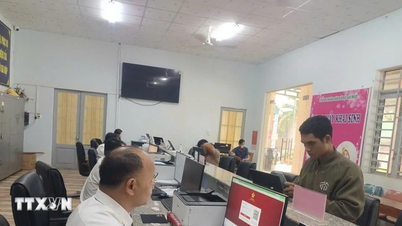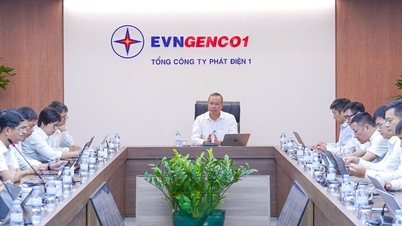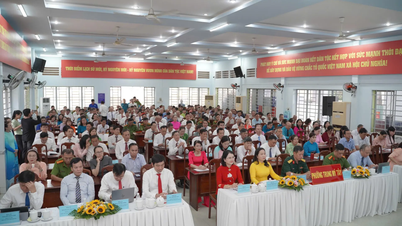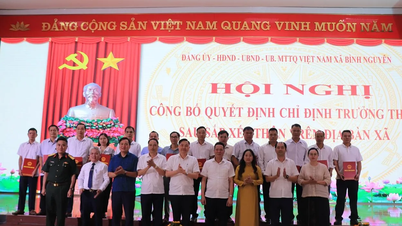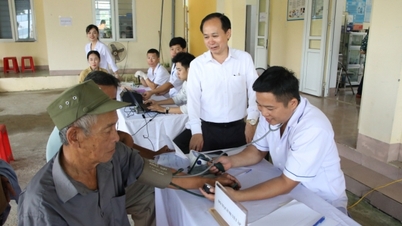
Experiencing digital platforms is one of the concrete steps to implement the resolution on digital transformation, bringing technology into practice to serve the people. Photo: Cao Bang Newspaper.
Digital transformation is reaching "villages and hamlets."
Thanks to the decisive leadership of the provincial government, many key digital platforms – including the Administrative Procedure Resolution Information System, the Document Management and Operation System, the Data Integration and Sharing Platform (LGSP), and the "Cao Bang Digital Citizen" platform – have been put into operation. These platforms are uniformly connected to the national database, ensuring a smooth flow of information to effectively support leadership and management.
After the province completed the reorganization of administrative units and the establishment of a two-tiered government model, 100% of communes and wards were equipped with fiber optic infrastructure, dedicated data transmission networks, and online meeting systems. Most localities also have computers, digital signatures for official use, and assigned staff to manage the one-stop service department.
Many digital transformation indicators show significant progress. All eligible administrative procedures are provided online. 85% of commune-level work files are processed online, and 91.1% of units implement the "4-in-1" mechanism. The level of citizen satisfaction exceeds 95%. Regarding infrastructure and the digital society, the province currently has 1,217 BTS stations and 33 5G stations; more than 90% of villages and hamlets have mobile coverage, and 63% of households own broadband internet. In the digital society sector, 97% of citizens have electronic health records, 95% of students have electronic school records, and 80% of people aged 15 and over have bank accounts. 100% of small and medium-sized enterprises apply QR codes in payments. Several communes have developed "market 4.0" models and OCOP product showrooms linked to cashless payments, with 171 OCOP products listed on the e-commerce platform buudien.vn.
Simultaneously, 1,349 community-based digital technology groups with over 11,300 members are operating in villages and hamlets, contributing to the dissemination of digital skills, supporting people in using public services, installing electronic identity systems, and making cashless payments. From this, the "Digital Literacy Movement" is gradually taking shape, helping people in remote areas access and utilize technological conveniences more easily.



Identifying the "bottlenecks" of digital transformation
The Culture and Social Affairs Committee of the Provincial People's Council conducted a thematic survey on the implementation of digital transformation in communes and wards during the 2021-2025 period and found that, in addition to the achievements, the digital transformation process in the province still faces some "bottlenecks".
The province still has 138 villages and hamlets without mobile phone coverage and 29 areas lacking electricity and internet access. The rate of people submitting applications online remains low. Most of the IT staff at the commune level are working on a part-time basis, leading to difficulties in transitioning from manual to digital work methods.
Vision 2026-2030: Towards quality and sustainability
During the period 2026-2030, the province's e-government initiative will shift its focus from expanding infrastructure and increasing the rate of online applications to emphasizing quality, efficiency, and sustainability.
The strategic tasks outlined include:



Completing the digital infrastructure , aiming to eliminate all "dead zones" for mobile and internet coverage, and ensuring 100% of villages and hamlets have stable broadband connections – an indispensable foundation for digital services such as education, healthcare, commerce, and public administration to reach the grassroots level.
The digital government at the commune level will continue to be standardized . The goal is to digitize 100% of administrative records, especially in the land sector; and to integrate and synchronously connect data from the Public Service Portal, the "Cao Bang Digital Citizen" platform, and the Intelligent Operations Center (IOC), forming a "one government - many services" model.
Digital workforce development is prioritized , aiming towards a team of "digital officials" at the commune level capable of operating, analyzing, and exploiting data. Community digital technology teams are oriented towards shifting from a "guidance" role to a "promotion" role, supporting people in applying technology to production, business, e-commerce, and digital tourism, placing people at the center of the transformation process.
The province will prioritize budget allocation and mobilize social resources for digital infrastructure, cybersecurity, and human resource training. At the same time, Cao Bang proposes that the central government develop a special mechanism for mountainous and border provinces in the comprehensive implementation of digital transformation. Monitoring and evaluation will be strengthened, linking digital transformation results to performance indicators, administrative rankings, and the accountability of leaders, ensuring that digital transformation is substantive, on the right track, and effective, rather than merely superficial.
Source: https://doanhnghiepvn.vn/chuyen-doi-so/cao-bang-tang-toc-chuyen-doi-so-o-cap-co-so/20251120012052496




![[Image] National conference summarizing one year of operation of the overall organizational model of the political system, the three-tiered government model.](https://vphoto.vietnam.vn/thumb/1200x675/vietnam/resource/IMAGE/2026/07/01/1782882811691_ndo_br_1-jpg.webp)