

According to Tran Dinh Uynh, Chairman of the Board of Directors and Director of Xuan Bo Agricultural Production, Business and Service Cooperative (Xuan Bo Cooperative) in Xuan Thuy commune, Xuan Bo Cooperative is a pioneer in Le Thuy district in implementing the "two-crop" rice farming model. This means that after completing the winter-spring rice crop, farmers will cultivate the summer-autumn rice crop. This is a new and different approach, because in most other localities in Le Thuy district, farmers are still accustomed to cultivating a ratoon rice crop.
It is known that for nearly five years, Xuan Bo Cooperative has implemented a model of abandoning the old rice crop and planting the summer-autumn crop instead. Initially, implementation faced many difficulties due to the mindset of the farmers, as well as rodent damage and high risks. However, with unity, solidarity, and a shared understanding, the farmers in Xuan Bo boldly carried out the project.
Because growing rice in the summer-autumn season helps increase the total food production for the whole society; at the same time, it promotes the development of related agricultural service industries, such as: seed services, land preparation, fertilizers, plant protection, harvesting, increasing profits from the service stages of cooperatives, creating jobs for farmers, and boosting the circulation of goods...
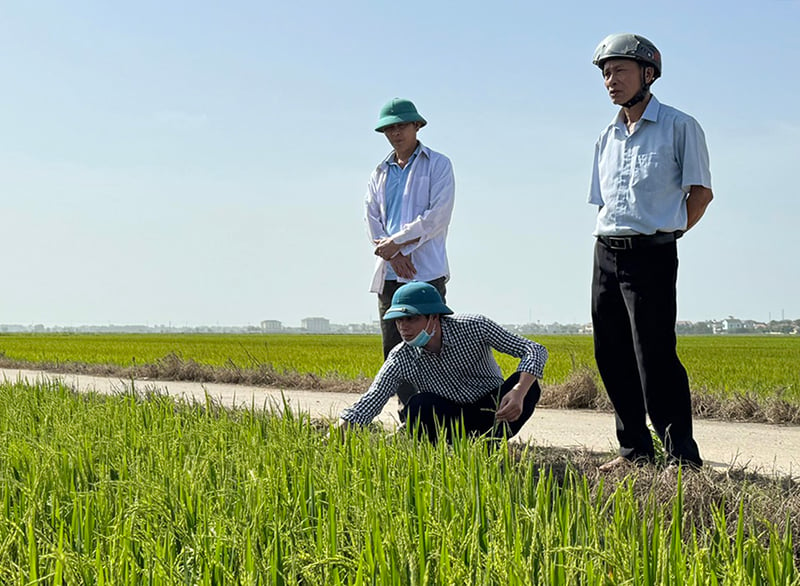 |
“This year's winter-spring crop saw the cooperative plant over 138 hectares of rice, primarily using varieties such as P6, VN20, Nhi Uu 838, Bac Thinh, and some hybrid rice varieties. Currently, the rice plants are developing well. However, due to unfavorable weather conditions, some rice fields in the cooperative have recently been affected by bacterial leaf blight and other harmful pests. To proactively prevent and control these issues, cooperative officials have regularly inspected the fields; actively disseminated information via loudspeakers to cooperative members on rice care and protection; and guided farmers on pest and disease control measures…”, said the Chairman of the Board of Directors and Director of Xuan Bo Cooperative.
An Thuy commune is implementing the 2024-2025 winter-spring rice crop production under challenging conditions. This area is frequently affected by natural disasters; the October 2024 flood alone damaged irrigation works, affecting transportation and hindering planting activities, such as the dike system in Zone 2 of the left bank of the Kien Giang River, the Hoi Quan dike, the Thuong My Trung dike, the Kenh Ca dike, and several sluice gates. In addition, a cold spell at the beginning of the season hampered pumping and drainage efforts; high prices of agricultural supplies also affected production, business, and agricultural development…
According to Vo Truong An, Vice Chairman of the People's Committee of An Thuy commune, despite the difficulties, the locality proactively implemented the winter-spring rice crop production on schedule, achieving results with a planted area of over 1,223 hectares; at the same time, it effectively implemented policies supporting rodenticides, seed support, and focused on applying scientific and technical advancements in seeds and intensive farming...
A new feature of the 2024-2025 winter-spring crop season in An Thuy commune is that the locality has focused on directing and guiding cooperatives to determine the structure and types of seeds suitable for each soil type and season; at the same time, promoting propaganda and mobilizing farmers to use certified seeds and new, technologically advanced seeds with high yield and quality in production.
“In fact, the entire commune has 20 basic rice varieties, including 4 main varieties: P6, Nhi Uu 838, MCH2, and HG12. Each unit usually produces 5-7 varieties, including experimental varieties. Currently, Loc Thuong unit has a contract to produce VN20 variety and conduct large-scale trials of HG12 variety; Loc Ha unit is implementing a production and consumption chain for Huong Binh rice varieties with Song Gianh Corporation…,” the Vice Chairman of An Thuy Commune People's Committee shared.
| “Looking ahead, rats, rice blast, leaf-rolling caterpillars, brown spot, and bacterial leaf blight are expected to continue to cause damage. To minimize losses caused by pests and diseases, the center has actively guided localities to instruct farmers to regularly inspect their fields, monitor the emergence and damage caused by pests and diseases on crops, and take timely control measures. Particular attention is being paid to controlling rats, rice blast, brown spot, brown planthopper, and bacterial leaf blight…” the Director of the Le Thuy District Agricultural Services Center added. |
Le Thuy District is considered the rice granary of the province. For the 2024-2025 winter-spring crop, the district planted nearly 10,100 hectares of rice, with an estimated total food production of approximately 96,000 tons. To ensure the winter-spring crop production meets the plan, the district has directed specialized units and localities to guide people in planting rice according to the planting schedule; renovate and repair the irrigation canal system; and promote the application of advanced techniques and high technology in production. They have also continued to expand the area of hybrid rice varieties and large-scale fields, implement improved rice cultivation methods, and proactively prevent and control pests and diseases.
According to Hoang Van Hai, Director of the Le Thuy District Agricultural Service Center, to ensure the favorable growth and development of the entire area of winter-spring rice crops in the district, the center has coordinated with communes and towns to strengthen propaganda and guidance on the process and techniques of caring for and controlling rice pests and diseases for farmers; especially focusing on rice blast, brown spot, bacterial leaf blight, and various pests such as brown planthopper, white-backed planthopper, stem borer, and leaf roller.
Currently, the winter-spring rice crop in Le Thuy district is in the tillering and heading stage; the early-sown crop is in the flowering stage. However, unfavorable weather conditions have recently led to pest and disease outbreaks. In the district, 132 hectares of rice have been damaged by rats, 78 hectares are infected with bacterial blight, 87 hectares with brown spot disease, 42 hectares with leaf blast, and 3 hectares with brown planthopper and white-backed planthopper…
N. Hai
Source: https://baoquangbinh.vn/kinh-te/202504/chu-dong-cham-care-lua-dong-xuan-2225727/
![[Image] Leaked images ahead of the 2025 Community Action Awards gala.](/_next/image?url=https%3A%2F%2Fvphoto.vietnam.vn%2Fthumb%2F1200x675%2Fvietnam%2Fresource%2FIMAGE%2F2025%2F12%2F16%2F1765882828720_ndo_br_thiet-ke-chua-co-ten-45-png.webp&w=3840&q=75)
![[Photo] Prime Minister Pham Minh Chinh receives Lao Minister of Education and Sports Thongsalith Mangnormek](/_next/image?url=https%3A%2F%2Fvphoto.vietnam.vn%2Fthumb%2F1200x675%2Fvietnam%2Fresource%2FIMAGE%2F2025%2F12%2F16%2F1765876834721_dsc-7519-jpg.webp&w=3840&q=75)
![[Image] The tenacious fighting spirit of Vietnamese women's football](/_next/image?url=https%3A%2F%2Fvphoto.vietnam.vn%2Fthumb%2F1200x675%2Fvietnam%2Fresource%2FIMAGE%2F2025%2F12%2F17%2F1765990260956_ndo_br_4224760955870434771-copy-jpg.webp&w=3840&q=75)

![[Photo] Prime Minister Pham Minh Chinh receives the Governor of Tochigi Province (Japan)](/_next/image?url=https%3A%2F%2Fvphoto.vietnam.vn%2Fthumb%2F1200x675%2Fvietnam%2Fresource%2FIMAGE%2F2025%2F12%2F16%2F1765892133176_dsc-8082-6425-jpg.webp&w=3840&q=75)
![[Live] 2025 Community Action Awards Gala](/_next/image?url=https%3A%2F%2Fvphoto.vietnam.vn%2Fthumb%2F1200x675%2Fvietnam%2Fresource%2FIMAGE%2F2025%2F12%2F16%2F1765899631650_ndo_tr_z7334013144784-9f9fe10a6d63584c85aff40f2957c250-jpg.webp&w=3840&q=75)
















































![[Live] Closing Ceremony and Award Presentation for the "Impressive Vietnam Tourism" Video/Clip Creation Contest 2025](https://vphoto.vietnam.vn/thumb/402x226/vietnam/resource/IMAGE/2025/12/17/1765974650260_z7273498850699-00d2fd6b0972cb39494cfa2559bf85ac-1765959338756946072104-627-0-1338-1138-crop-1765959347256801551121.jpeg)
















Comment (0)