

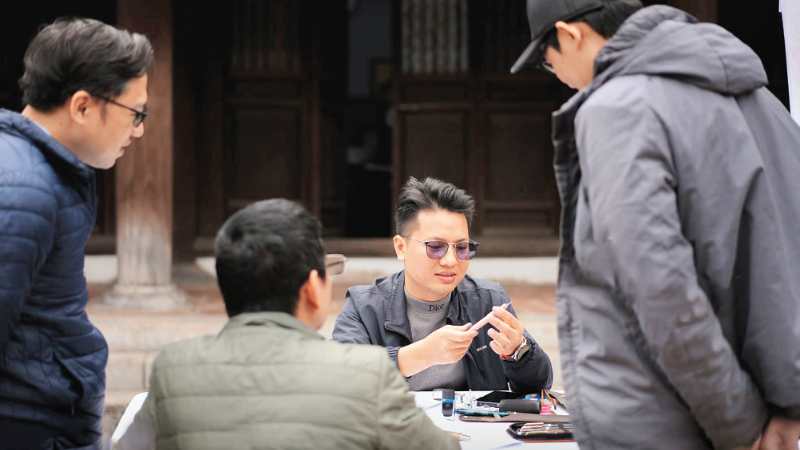
Therefore, when Ha Tuan Anh delivered pens to a collector in the Linh Dam area ( Hanoi ), the conversation between them was not just about pens from Pilot, Pelikan, Parker, Visconti, or Mont Blanc, but also about the journey of those who still believe that a carefully sharpened nib can preserve the slow rhythm of handwriting today.
The pens were kept.
From the outside, judging by the leather case Nguyen Van Ha was holding, I thought he was carrying an iPad for work. But when we sat down at the coffee table, Ha flipped open the magnetic closure of the case, and both Tuan Anh and I exclaimed in surprise. Inside were 12 fountain pens from world- renowned brands like Pilot, Pelikan, Parker, and Mont Blanc, which even I, an outsider, found truly beautiful and appealing. Even more surprising was Ha's explanation that he had only joined a fountain pen collecting and trading group on Facebook in March 2025, and that he had already found several pens he liked and was waiting to order more from abroad.
Because she uses fountain pens frequently, Ha asked Tuan Anh to sharpen her italic nib. According to Tuan Anh's explanation, an italic nib is a type of nib specially crafted to create a distinct difference between vertical and horizontal strokes when writing. Unlike a regular round nib, an italic nib has a flat, wide tip, allowing more ink to flow vertically and less horizontally – resulting in calligraphic writing with clear variations in thickness. This type of nib is more commonly used in calligraphy and for writing beautiful handwriting than for everyday writing.
The conversation between a collector like Ha and a nib sharpener like Tuan Anh revolved around different types of pens and nibs, helping me understand the community they belonged to. While Ha favored high-end pens from specific brands, some collectors only collect pens from a few brands, or collect based on materials (resin, ebonite, celluloid, wood), year of manufacture (especially important for vintage pens), limited editions, etc. However, what impressed me most was not only his relatively large collection, worth hundreds of millions of dong, but also the simple fact that he loved to write. According to Ha, maintaining a daily writing habit partly helps him relieve stress and relax, and partly allows him to teach his children patience and concentration.
Tuan Anh added that each pen brand has its own high-end lines, and the way they attract the attention of writers and collectors is not only through the actual value of each pen but also through the story behind it. At this point, the young man, born in 1992 in Quang Tri (he was born in Dong Hoi, formerly Quang Binh province), showed me a Visconti pen from the Van Gogh Collection, named after the Dutch painter Vincent Van Gogh.
Tuan Anh explained that each pen is a unique shade of color, distilled from famous paintings by the artist. Similarly, another interesting story related to pens is Visconti's Comedia Paradiso collection, named after Dante Alighieri's *Comedia*, written in Florence in 1265 and considered the greatest poet of Italy. Dante is also regarded as the father of the Italian language as we know it today. The Comedia pen collection thus reflects Visconti's love for Florence, the cradle of Renaissance culture and the embodiment of the exquisite craftsmanship that shaped the Italian pen company's creations in the writing instrument field.
However, those renowned fountain pens would only be display items, kept in collections, without professional nib sharpeners like Tuan Anh, who can be considered to create a unique handwriting style for the writer and help them write more beautifully and artistically.
Sit back with the pen.
I was fortunate to meet Tuan Anh at the Vietnam Pen Show in early December 2025, when the Vietnamese fountain pen community held an exhibition showcasing various pens, inks, and paper at the Temple of Literature - National University (Hanoi). There, I was truly impressed by the valuable collections of many collectors and also by the quiet work Tuan Anh has been doing over the past time.
At a small table in Thai Hoc courtyard, the young man born in 1992 from Quang Tri province intently performs the repetitive strokes of his pen on a white sheet of paper, leaving many wondering what he is doing. According to Tuan Anh, nib sharpening is a process of altering the nib's material to transform a smooth, even nib into one with a thicker, more delicate stroke, such as an Italic or oblique nib. The granular material at the tip (usually iridium or rhodium) acts as a wear-resistant material, ensuring smoothness. When sharpening, he only affects about one-third of this granule, or half (if the customer requests a thicker stroke), leaving as much of the granule as possible to ensure aesthetics, durability, wear resistance, and smoothness after sharpening.
Because he doesn't use a grinding machine, Tuan Anh grinds the nibs entirely by hand. Each nib takes at least two hours to complete. In return, users will have the most perfect, smoothest Italic nibs, and they can clearly see the smooth cuts and meticulously polished edges.
It was surprising to hear Tuan Anh share that he started sharpening pen nibs in 2011. The reason was that the fountain pen his grandfather gave him when he was in 7th grade broke. He bought another fountain pen, but the nib didn't produce the fine and bold strokes. So, he searched online forums and asked for advice before researching foreign methods of nib sharpening and learning how to repair pens himself.
According to Tuan Anh, there are many types of nib sharpening techniques in the world, but he usually uses three types: italic or cursive italic nibs (sharpened to write thick and thin strokes, thick vertical strokes, thin horizontal strokes, and two diagonal strokes of nearly equal length, suitable for everyday writing), oblique nibs (the nib tip is sharpened diagonally to the left or right, suitable for those who hold the pen at an angle. This is a classic sharpening style, once very popular in Europe), and architech nibs (thick horizontal, thin vertical, for sketching, note-taking, and decorative lettering).
To begin, Tuan Anh removes the nib, tapes up the unpolished part to prevent scratches, as many nibs are made from 14k, 18k, or 21k gold. Then, he performs rough polishing and shaping; uses sandpaper to remove roughness and round the corners; and finishes by polishing with buffalo hide, torn drumhead, or simply cardboard. Many people would be surprised to think that such a small nib takes two hours to complete. In reality, pen polishers (known as nibmeisters worldwide) like Tuan Anh cannot work quickly, partly because of the expensive nibs mentioned above, and more importantly, because if they ruin the nib, they will lose their reputation. Not to mention that although the fountain pen itself isn't expensive, it holds special sentimental value for many people.
There were times when Tuan Anh felt discouraged by the pressure of sharpening pens as a construction project manager, but the encouragement from fellow pen enthusiasts helped him maintain his rare nibmeister position in Vietnam over the years. Meanwhile, he has continued his habit of using fountain pens since the 7th grade, diligently copying a poem or song every morning using pens he has bought or received as gifts.
Source: https://nhandan.vn/chuyen-mai-ngoi-giu-chu-post936072.html
![[Photo] General Secretary and President To Lam presides over a meeting with the Central Organizing Committee.](https://vphoto.vietnam.vn/thumb/1200x675/vietnam/resource/IMAGE/2026/06/03/1780482764658_a1-bnd-4741-3342-jpg.webp)

![[Photo] Secretary of the National Assembly Party Committee, Chairman of the National Assembly presides over the meeting of the Standing Committee and Executive Committee of the National Assembly Party Committee.](https://vphoto.vietnam.vn/thumb/1200x675/vietnam/resource/IMAGE/2026/06/03/1780480353201_ndo_br_bnd-2585-jpg.webp)











![[Photo] General Secretary and President To Lam attends the 14th Congress of the Vietnam Trade Union](https://vphoto.vietnam.vn/thumb/402x226/vietnam/resource/IMAGE/2026/06/04/1780543339765_anh-man-hinh-2026-06-04-luc-10-22-07.png)




![[Photo] General Secretary and President To Lam attends the 14th Congress of the Vietnam Trade Union](https://vphoto.vietnam.vn/thumb/1200x675/vietnam/resource/IMAGE/2026/06/04/1780543339765_anh-man-hinh-2026-06-04-luc-10-22-07.png)






















![[Video] Sunset at Lap An Lagoon – Where the sun sets over the fishing nets](https://vphoto.vietnam.vn/thumb/1200x675/vietnam/resource/IMAGE/2026/05/31/1780192137701_beach-landscape-sea-water-nature-grass-745871-pxhere-com.jpeg)
































Comment (0)