

On October 10, 2023, the People's Committee of Da Nang City organized a workshop on "Developing human resources to serve the semiconductor industry; issues for Da Nang City".
Speaking at the event,FPT Chairman Truong Gia Binh shared: “20 years ago, Mr. Phan Dien, former member of the Politburo, raised the question of what kind of city Da Nang would become? I said we wanted Da Nang to become an intellectual city. At that time, no one believed it, businesses did not believe it. But I still believe that we can do it and have done it. The most basic thing is that we have aspiration.”
According to Mr. Truong Gia Binh, the story of developing the semiconductor industry in Da Nang this time also requires a strong aspiration. “By all means, we must build Da Nang has a name in the world's semiconductor ecosystem, and has overcome all difficulties and obstacles to do so. To do that, it is necessary to have human resources; attract investment and 'red carpet' - policy mechanisms for domestic and foreign enterprises to develop this industry", FPT Chairman affirmed.
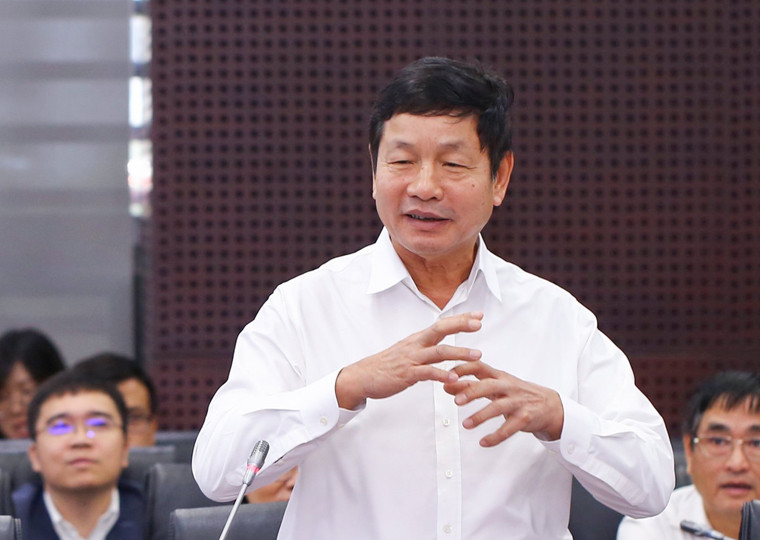
How to build a high-quality workforce is the first question Mr. Truong Gia Binh posed and answered. FPT graduates 6,000-7,000 IT students each year. To enable them to work in the semiconductor industry, FPT could partner with chip manufacturers like Synopsys to provide six months of distance learning. The corporation could also send students to Japan, South Korea, and Taiwan for work to quickly create a workforce. Afterward, these personnel could return to work in Da Nang. FPT initially planned to target 10,000 people, potentially reaching 20,000-30,000 annually to serve the semiconductor industry. In addition to training, Mr. Truong Gia Binh suggested that the city could bring in high-quality human resources from abroad, creating opportunities for them to stay and develop.
Besides human resources, attracting investment is an important thing to do. “My lesson is to stand on the shoulders of giants, cooperate with large companies in the world. Calling on the largest corporations to come to Da Nang like Intel before. This is an extremely important start because 'buffaloes eat in the herd' is the common mentality of foreign corporations,” Mr. Truong Gia Binh shared.
According to Mr. Binh, to attract investment, it is necessary to roll out the red carpet to welcome businesses. The red carpet of Da Nang is a favorable legal framework, mechanisms, training, international connections, and the dedication of the leaders and people of Da Nang. In addition, Da Nang needs to prove its strength through numbers: human resources, businesses, and famous figures of the industry in Da Nang.
In addition, Mr. Truong Gia Binh also emphasized two key words in the trend of building smart cities in the world: digital transformation and green transformation. Da Nang will follow this direction to create a difference and build the image of a smart city to the world.
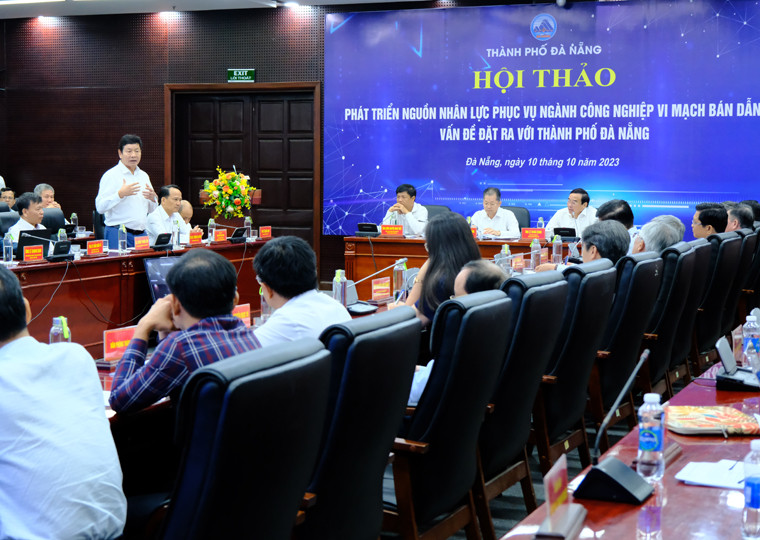
“Recently, the city leaders have organized many forums with students, leaders of businesses operating in the field of information technology, human resource training facilities, investors... to find solutions to promote digital transformation and green transformation. I believe that if we maintain that determination, Da Nang will become a new semiconductor center. The government, businesses and people must join hands to realize the aspiration, as on a chip there are hundreds of IPs of hundreds of companies, they cannot exist separately,” Mr. Truong Gia Binh concluded.
Sharing his views on the semiconductor industry, Mr. Nguyen Thien Nghia, Deputy Director in charge of the Information and Communication Technology Industry Department (Ministry of Information and Communications), said: Vietnam ranks 10th in exporting electronic products and sixth among countries involved in outsourcing, making a significant contribution to the ICT technology sector. Vietnam also has many talented people in this field. Vietnam is ready to do outsourcing for countries in the region and other countries, such as the US, Europe, and Japan. With the results achieved so far, along with the technological infrastructure, we can have a successful electronics industry.
“Vietnam also offers tax incentives such as: no income tax for the first four years, a 0% export tax rate, and VAT exemption for software products and information technology services. In addition, there are other incentives such as reduced land lease fees. These incentives are very helpful in attracting foreign investors,” said Mr. Nguyen Thien Nghia.
Mr. Nguyen Thanh Tuyen, Deputy Director of the Department of Information and Communications Technology (Ministry of Information and Communications) said that currently, Vietnamese enterprises participating in this field are Viettel and FPT Semiconductor with about 200 employees. The remaining 50 foreign companies from Japan, the US, China, and South Korea have invested in Vietnam with an estimated workforce of more than 5,000 engineers, who can undertake work in most areas of the design stage. In particular, the most concentrated human resource allocation is in Ho Chi Minh City (85%), followed by Hanoi (8%) and Da Nang (7%).
In the coming period, the semiconductor strategy will propose solutions to improve the quantity and quality of human resources, promoting Vietnam's potential in this field.
Source




![[Photo] Urgently help people soon have a place to live and stabilize their lives](/_next/image?url=https%3A%2F%2Fvphoto.vietnam.vn%2Fthumb%2F1200x675%2Fvietnam%2Fresource%2FIMAGE%2F2025%2F12%2F09%2F1765248230297_c-jpg.webp&w=3840&q=75)






















































![[Photo] General Secretary To Lam works with the Standing Committees of the 14th Party Congress Subcommittees](https://vphoto.vietnam.vn/thumb/402x226/vietnam/resource/IMAGE/2025/12/09/1765265023554_image.jpeg)
























Comment (0)