

Each ethnic group possesses unique traditional costumes, a "language" reflecting their rich aesthetic and artistic creativity, and expressing the value of their traditional cultural heritage. Through their distinctive costumes, with their unique characteristics, the Hmong community proudly contributes to the vibrant tapestry of ethnic groups in the province.
The Hmong ethnic community in Cao Bang accounts for nearly 12% of the province's total population, comprising three groups: White Hmong, Flower Hmong, and Black Hmong. Their traditional clothing is made primarily from cotton, silk, and linen, dyed entirely by hand with indigo, mainly by the skillful hands of women. Each Hmong group has its own unique culture, but the basic design of their clothing is quite similar. The decorative styles and color combinations demonstrate a refined aesthetic sense, reflecting a part of the people's spiritual life, their awareness of protecting and harmoniously connecting with the natural landscape.
Hmong women's traditional clothing is more elaborate and eye-catching than men's, consisting of a blouse, skirt, belt, front panel (a piece of cloth covering the front of the skirt), leggings, and headscarf/hat. Each part of the outfit is constructed and decorated differently, creating a whole that reflects their worldview and philosophy of life through the colors and patterns on the clothing. The blouse has three panels, with two decorative strips around the neckline, about 3-4 cm wide, which may be colored lace or floral fabric. The seams connecting the front and back panels create a slit about a handspan from the hem upwards, and the cuffs are also embroidered with beautiful patterns. When worn, the hem of the blouse is not tucked into the skirt but flares out. The blouse has no buttons but is draped diagonally, then secured with an embroidered belt to keep it from flaring out. Because it is a blouse with a V-neck, Hmong women often wear a bodice. The neckline is embroidered with floral patterns, and silver coins are attached to each side of the neckline. When worn, the patterns between the inner and outer garments create a harmonious look.
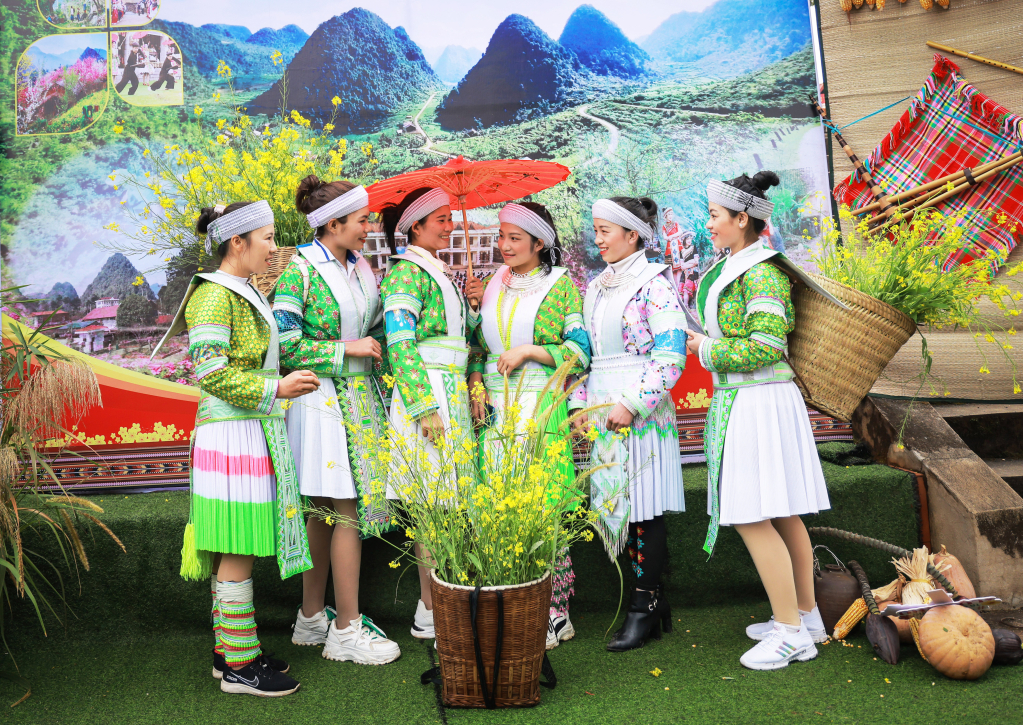
The skirts of Hmong women (called "tía") have a rounded waistband that hugs the waist, and a gently pleated, flowing skirt, creating a graceful and youthful look. The top and skirt are secured and decorated by a long belt, embroidered with flowers, which helps to keep the top and skirt in place and prevents them from shifting during movement. This also adds decoration, concealing the waistband and creating a harmonious look. Hmong women also wear a front panel of fabric over their skirts and wrap leggings around their legs, signifying modesty and discretion.
The patterns and motifs on Hmong clothing are predominantly colorful, a combination of warm colors creating a striking and impressive effect. The patterns on Hmong dresses and blouses feature a blend of colors and interwoven textures, varying between smooth areas (patchwork), raised areas (embroidery), or intricate details, making the decorative art on Hmong clothing unique and distinct from that of other ethnic groups. The Hmong believe that the more meticulous and skillful the embroidery on their clothing, the more it reflects their skill in cultivating happiness, wealth, and prosperity for their family. Hmong women often wear their long hair wrapped around their heads; some groups wrap a headscarf to create a voluminous mass. Along with their attire, women wear silver jewelry such as earrings, necklaces, bracelets, anklets, and rings to add charm.
The traditional men's clothing of all three branches of the Hmong ethnic group is simple, dyed indigo or black, with a distinct style that is not mixed with other ethnic groups. The shirt is short, reaching or below the waist, narrow in shape, with a round neckline, a split chest, slightly wide sleeves, and four pockets in the front. Shirts usually come in two types: five-panel and four-panel, sewn with two layers of fabric to suit the highland climate, keeping cool in summer and warm in winter. The trousers are tailored in a wide-leg style, with a wide waistband, low crotch, and wide legs, predominantly black, with unique cuts and designs, making them convenient for climbing hills and mountains and for playing the Hmong flute.
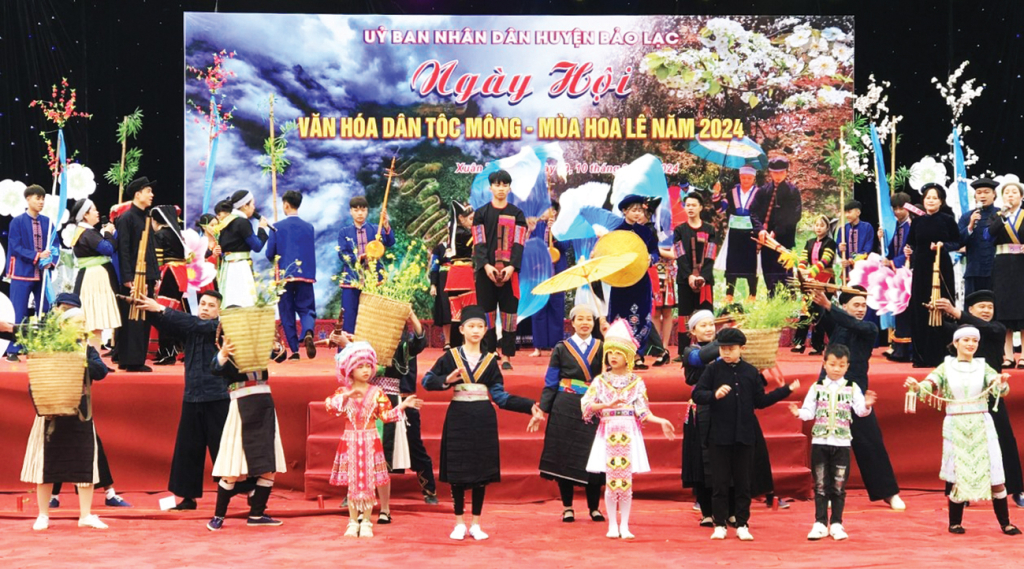
Hmong women's dresses and blouses are considered a measure of their talent; women skilled in embroidery are highly regarded and respected by the entire community. In the past, Hmong girls were taught by their grandmothers and mothers every stitch, thread, sewing, and embroidery technique; by the time they reached adulthood and knew how to dress elegantly, they had already mastered making traditional clothing for their families and themselves before getting married.
Today, in the trend of integration, the living standards of the people are increasingly improving, along with cultural exchange between ethnic groups, so the traditional clothing of the Hmong people has been improved compared to the traditional style. Most Hmong people now rarely grow cotton or weave their own fabric, but buy ready-made fabric and decorative accessories at markets. Besides details requiring hand-sewing, they mainly use sewing machines, but still preserve the original techniques of shaping and patterns on the clothing. In daily life, mainly elderly Hmong women wear traditional clothing, while younger generations and men wear clothing similar to that of the Kinh people. However, on market days, New Year's Day, and major ethnic festivals, the Hmong people still wear their vibrant, graceful, and elegant traditional costumes. In many localities in the province, the clothing not only serves the Hmong people but is also produced by some households and sold to tourists as souvenirs. Each ordinary outfit costs between 1 and 2 million VND, while elaborate traditional costumes, complete with intricate details and entirely hand-embroidered and woven by the ethnic people, can cost tens of millions of VND. These are encouraging signs, indicating that the Hmong people in particular, and ethnic minorities in the province in general, are increasingly raising their awareness in the self-preservation, promotion, and development of their traditional cultural identity, especially the cultural values embodied in their traditional clothing.
TK (According to baocaobang.vn)
Source: https://baophutho.vn/dac-sac-trang-phuc-dan-toc-mong-221416.htm


![[Photo] General Secretary To Lam working with Ambassadors and Heads of Vietnamese representative offices abroad attending the 14th National Congress of the Party](/_next/image?url=https%3A%2F%2Fvphoto.vietnam.vn%2Fthumb%2F1200x675%2Fvietnam%2Fresource%2FIMAGE%2F2026%2F01%2F25%2F1769334314499_image.jpeg&w=3840&q=75)




Comment (0)