

|
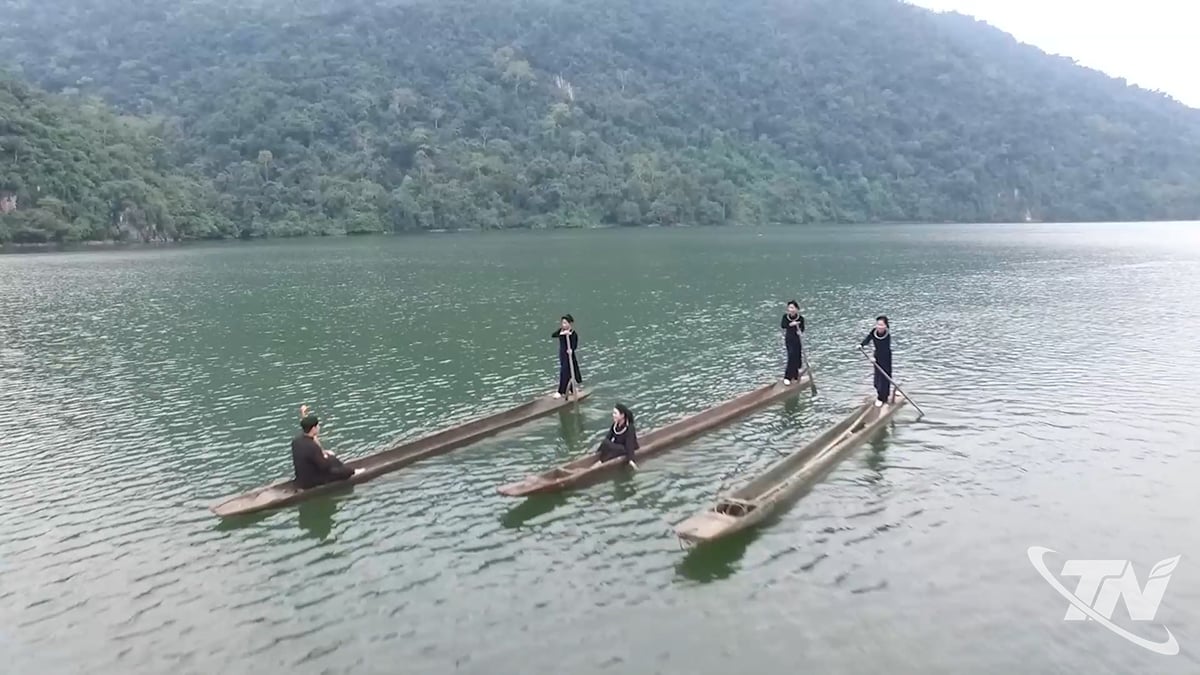
The Coc Toc village performing arts group sings Then songs to entertain tourists on Ba Be Lake. |
Potential from national identity
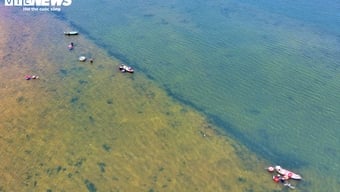
Amidst the vast expanse of Ba Be Lake, the sweet melodies of Then singing blend with the sounds of the Tinh lute played by the Coc Toc village art troupe in Ba Be commune, creating a scene that is both poetic and rich in cultural identity.
Born and raised in Coc Toc village, since the development of tourism , Ms. Trinh Thuy Quynh has boldly pursued further education and joined a tour guide group, establishing a Then singing club to provide entertainment for tourists.
Ba Be Lake is one of the world 's 20 most special freshwater lakes, boasting majestic natural beauty, rich vegetation, and many unique cultural features. The villages surrounding the lake are highly attractive due to their many unique scenic spots such as Dau Dang Waterfall, Tien Pond, Puong Cave, and Ba Goa Island...
In particular, this area still preserves the rich and unique cultural activities of the Tay, Nung, Mong, and Dao ethnic groups. In recent years, people in the core area of Ba Be National Park have invested in developing community tourism and experiential tourism.
A distinctive cultural feature of the Tay ethnic group is their stilt houses. Since developing tourism, these stilt houses have been converted into homestays, with investments in renovating the grounds and guest rooms. Those working in the tourism service have received training and guidance on how to exploit the potential of homestay services to meet the demands of tourists.
From small-scale, fragmented operations, households have joined forces, creating linkages between various service types such as accommodation, lake tours, food and beverage, and recreational activities… to create the most attractive experience for tourists.
|
The unique cultural characteristics of ethnic minority communities have become a highlight of community tourism. In the photo: The Ta Han village performing arts group, Nam Cuong commune. |

At Mr. Luc Huy Chung's Ba Be Hada homestay, the traditional stilt house has been extensively renovated by his family. Each area, from the large and small guest rooms to the restrooms, kitchen, and garden, is arranged scientifically . The staff at the homestay are all local villagers who have received training in professional tourism practices.
Ba Be commune currently has nearly 60 accommodation establishments, including more than 40 stilt houses and 2 homestays that meet OCOP 3-star standards; over 140 boats, and 10 performing arts groups serving tourists. Starting from just simple, rustic ethnic minority households, since tourism in Ba Be was explored and developed, the people have actively learned and participated in community tourism. Village roads and houses have been renovated, and accommodation, food, and cultural services have become increasingly professional.
Sustainable livelihoods from community tourism
Not only in the Ba Be Tourist Area, the community-based tourism model has developed in many other ethnic minority regions, preserving the unique characteristics of each ethnic group, linked to the strengths of agricultural and forestry production, and distinctive local products.
|
Khuân Bang village (Chợ Mới commune) has been selected as a model for community-based tourism. |

In Khuân Bang village, one of the villages selected as a model for community tourism in Chợ Mới commune, the people here are leveraging their strengths in natural landscapes and cultural identity to attract tourists.
Located about 3km from the center of Cho Moi commune, along a well-maintained concrete road leading into the village are traditional stilt houses with bright red tiled roofs. Khuan Bang village has over 60 households, mainly of the Tay ethnic group. The villagers still preserve the beauty of their traditional stilt houses. With guidance from the local government, the people are developing homestay and experiential tourism models to create additional livelihoods.
Introducing his newly built stilt house to us, Mr. Nguyen Van Hien, from Khuan Bang village, Cho Moi commune, said: "When the village was selected as a community tourism destination, I renovated the auxiliary facilities to suit the purpose, creating a green, clean, and beautiful landscape to welcome tourists."
In the northern communes, the potential for community-based tourism has begun to be explored, generating income for the people, especially ethnic minorities and those living in mountainous areas. Community-based tourism models are contributing to the socio-economic benefits of many localities and businesses.
Source: https://baothainguyen.vn/van-hoa/du-lich-thai-nguyen/202510/du-lich-cong-dong-sinh-ke-ben-vung-c116a68/
![[Photo] National Assembly Chairman Tran Thanh Man attends the opening session of IPU-152](https://vphoto.vietnam.vn/thumb/1200x675/vietnam/resource/IMAGE/2026/04/16/1776277863731_ctqh5-jpg.webp)
![[Photo] My Son at night: A thousand-year-old heritage site amidst the Milky Way](https://vphoto.vietnam.vn/thumb/1200x675/vietnam/resource/IMAGE/2026/04/15/1776261039184_ndo_br_chon6-jpg.webp)
![[Photo] Mrs. Ngo Phuong Ly meets and exchanges views with Mrs. Peng Li Yuan](https://vphoto.vietnam.vn/thumb/1200x675/vietnam/resource/IMAGE/2026/04/16/1776277858080_phu-nhan-1-jpg.webp)
![[Photo] The General Secretary, President and his wife meet with Vietnamese-Chinese friendship leaders.](https://vphoto.vietnam.vn/thumb/1200x675/vietnam/resource/IMAGE/2026/04/15/1776264829725_vna-potal-tong-bi-thu-chu-tich-nuoc-to-lam-gap-mat-nhan-sy-huu-nghi-viet-nam-trung-quoc-8703641-3130-jpg.webp)
























































Comment (0)