


Horses are very important to the Mongolians. They have a horse breeding industry, a horse culture, and a form of tourism closely associated with horses.
Horses and the Mongols
Mongolians don't keep horses in stables and feed them in the same way as in many other places. They let their horses live outdoors year-round, in harsh weather conditions, which can reach 45°C in summer and -45°C in winter. The horses find their own grass to eat and water to drink. This is a form of semi-wild farming.
A nomadic family might own hundreds of horses roaming freely on the steppe or in the desert. They would select only a few to be their main riding horses, leaving the rest to roam freely in the wilderness. When needed, the owner of the herd would search for and capture a few horses for various purposes.
Living in such a harsh environment, Mongolian horses are not large, but they are very sturdy. Their strong hooves and thick coat help them withstand the cold and they are very resistant to disease.
Horses are domesticated from a young age and are the primary means of transportation in rural areas and vast steppes where roads are underdeveloped. On steppes and deserts, horses help lead and gather other livestock such as sheep, goats, and cattle.
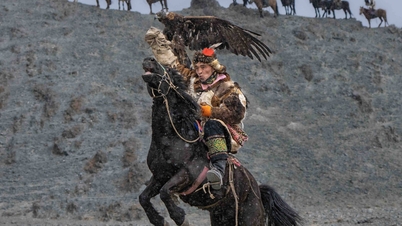
Horses are central to traditional games such as horse racing during the Naadam festival, a cultural symbol of Mongolia. Mongolians also hold their own festivals to honor horses, such as the Agtana Khureet festival, to promote equestrian culture. Mongolian children often learn to ride horses from a young age.
Horses are also a common and important food source for the Mongolians. Their hair, manes, and hooves are used to make strings, musical instruments such as the morin khuur (horse-headed harp), decorative items, and religious objects. Horses are symbols of freedom and strength, reflected in Mongolian poetry, music , beliefs, and nomadic culture. A Mongolian proverb says, "A Mongolian without a horse is like a bird without wings."

Horse riding tours in Mongolia
Each year, Mongolia welcomes approximately 700,000 to 800,000 tourists (data from eVisa Mongolia), mainly from China, Russia, South Korea, Japan, the United States, and some European countries (Germany, France, the United Kingdom, etc.).
Most tourists visiting Mongolia participate in horseback riding tours (trekking) across the steppes surrounding the capital Ulaanbaatar or in the Gobi Desert in the south. These tours can last a few hours, a few days, or even a week; they traverse steppes, cross hills and mountains, follow lakes, and cross the vast Gobi Desert.
I had the opportunity to experience two such horseback riding tours: one in the Khuvsgul Lake region of the Gobi Desert and another in Terelj National Park on the outskirts of Ulaanbaatar.
Early on the fourth morning of our 8-day Mongolian adventure, I and two Canadian companions left our nomadic tent camp (ger) in the Tsagaan Suvarga Reserve to venture deeper into the Gobi Desert.
After more than two hours of driving across a sparsely grassy desert, dozens of rolling hills, and a few dry streams, Kana (a Mongolian driver) stopped the car at the entrance to a long, narrow valley and told us: "From here, we'll ride horses through a narrow gorge, where a nomadic community has set up a grazing area for their livestock and offers horse trekking services, to reach a beautiful waterfall. The round trip will take about two hours."
We went to the pasture, hired four horses and a horse wrangler to guide us. The total cost was 100,000 MNT (Mongolian currency), equivalent to 750,000 VND. We mounted our horses, each on a horse, following closely behind the guide's horse as we entered the gorge. On the treacherous sections, the horses moved slowly, but on the flat stretches, they galloped, jolting first-time riders like me. I had to grip the reins tightly and stay firmly on the saddle to avoid being thrown off.
After nearly an hour of riding alongside our guide's horse, we arrived at a narrow gorge with sheer cliffs and a babbling stream… We dismounted and walked another kilometer to the end of the gorge, where we encountered a waterfall cascading from above. Many tourists were here filming and photographing the gorge and the waterfall. After admiring the scenery, we walked back, mounted our horses, and returned to the nomadic community's grazing area, leaving behind the mountain ranges bathed in the twilight.

On the eighth day of our trip, the three of us visited Terelj National Park on the outskirts of Ulaanbaatar, along with a newly acquainted Mongolian couple named Baja and Chimika.
Terelj is Mongolia's most famous national park, a UNESCO World Heritage Site. It is a complex of mountains, grasslands, and geological karst formations creating canyons and rock formations, including Turtle Rock, a famous natural landmark within the park.
After more than an hour's drive from the center of Ulaanbaatar, we stopped in front of the gate of a horse farm belonging to the Kazak community, an ethnic minority in Mongolia. This is where tourists can enjoy horseback riding to explore Terelj National Park, and where meals are served and souvenirs are sold.
In this horse camp, there was a large ger, nestled among smaller ones. From the outside, it looked like the other tents I had stayed in during my few days in the Gobi Desert, but once inside, I was surprised by its colorful interior. Baja told me, “This is a Kazakh tent, a Muslim tent. This tent encapsulates and displays the traditional culture and religion of the Kazakh people. Therefore, it is somewhat different from the Mongolian tents you have seen and stayed in over the past few days.”

After visiting and photographing the horse camp, we hired five horses and a Kazakh jockey to guide us into the heart of Terelj National Park. We urged our horses to stay close to the jockey ahead, galloping across the vast steppe, skillfully maneuvering them through narrow gorges and through forests overflowing with the golden hues of Mongolian autumn. We rode in Terelj for about three hours, then returned to the camp for dinner of steamed lamb, roasted potatoes, and hot mare's milk before heading back to Ulaanbaatar.
***
Horse riding tourism in Mongolia is very popular with tourists. Besides organizing horse rides, Mongolians also introduce tourists to horse culture, participate in horse festivals, explore nomadic horse pastures, meet local families, learn how to milk horses, cook traditional dishes, and learn about Mongolian horse riding history.
This is a way for tourists to "connect" with the traditional Mongolian way of life instead of just sightseeing. This not only helps preserve the "horse culture" but also supports the economy of Mongolian nomadic communities in developing local tourism and maintaining their livelihoods sustainably.
Source: https://baodanang.vn/du-lich-cuoi-ngua-o-mong-co-3324274.html
![[Photo] General Secretary and President To Lam works with the Party Committee of the Ministry of Health on the work of Vietnamese traditional medicine.](https://vphoto.vietnam.vn/thumb/1200x675/vietnam/resource/IMAGE/2026/05/20/1779294323718_a1-bnd-2978-3319-jpg.webp)
![[Image] "Journey of Hope" promotes the organ and tissue donation movement in Vietnam.](https://vphoto.vietnam.vn/thumb/1200x675/vietnam/resource/IMAGE/2026/05/20/1779294400833_1-8910-jpg.webp)































































Comment (0)