


As a predominantly agricultural province, Ha Giang has 86% of its population living and earning their livelihoods in rural areas. At the beginning of the term, the Provincial Party Committee recognized that the garden economy had not developed in proportion to its potential and strengths; people were not using garden land efficiently, not truly creating livelihoods, and not meeting the needs and annual income of households.
Stemming from this situation, on December 1, 2020, the Provincial Party Committee unanimously issued Resolution No. 05-NQ/TU on renovating neglected gardens, developing household garden economies to create livelihoods for people, and achieving sustainable poverty reduction in the 2021-2025 period. The resolution emphasizes that applying rational crop and livestock restructuring, along with scientific and technological advancements to household gardens, will bring stable income and sustainably meet the daily nutritional needs of families. The renovation of neglected gardens and the development of household garden economies are also identified by Ha Giang as a particularly important task to concretize one of the three breakthroughs of the Resolution of the 17th Provincial Party Congress: "Creating livelihoods and improving the material and spiritual lives of the people."
Selecting poor households as pilot models.
Traveling along National Highway 2 to the gateway to Ha Giang , we visited the family of Ms. Hoang Thi Dung, a poor household in Tan Hung village, Hung An commune, Bac Quang district. Beside her lush green garden, neatly planned with various crops and livestock, Ms. Dung shared: “My garden used to be very neglected, only growing a few types of vegetables enough for the family, with any surplus sold at the market, and much of it left fallow. When I heard from the officials at the district and commune about the program to improve neglected gardens, I was hesitant, not knowing where to start, what animals to raise, or what crops to grow effectively.”
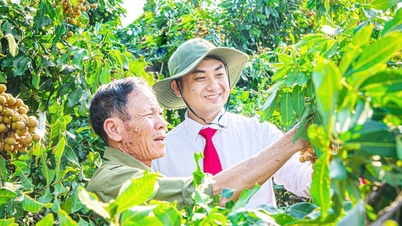
Starting the renovation of her neglected garden in August 2021, Ms. Dung's family received support from the Provincial Party Committee's Inspection Committee to implement the program. They also received direct support from the district, commune, and village authorities in terms of labor and partial funding. From the beginning, agricultural officials and members of the Women's Union in the commune directly guided her in repairing the pond, rearranging the garden, and building livestock shelters scientifically; they also helped her select suitable plant and animal breeds for the local climate and soil conditions. Along with the initial support of 24 million VND, Ms. Dung boldly borrowed an additional 30 million VND from the Policy Bank to purchase more plant seeds and raise more pigs, chickens, and ducks to improve her income. Just over a year later, her family's garden had a new look with a variety of vegetables and fruit trees such as dragon fruit, custard apple, sapodilla, guava, etc. She happily shared that life is now much less difficult than before, and she also has a stable income from gardening, earning about 6-7 million VND per month.
Seeing the positive results of Ms. Dung's family's method of renovating their neglected garden, many other households in Hung An commune have also learned from and followed suit. Moreover, people are gradually becoming more conscious of tidying up and replanning their gardens, ponds, and livestock pens, and their mindset about developing garden-based economic activities has also changed significantly...
Comrade Nguyen Xuan Cuong, Secretary of the Party Committee of Hung An commune, said: In addition to economic benefits, the renovation of neglected gardens also contributes to practical environmental benefits, and the appearance of the new rural area of the commune is more attractive because households regularly clean their yards, creating a green, clean, and beautiful environment. In 2023, Hung An commune will continue to maintain the model of renovating neglected gardens, while expanding the model according to the specific characteristics of each village, with the motto of exploiting short-term native plant and animal breeds, maximizing the labor of households, striving for poor and near-poor households to have stable income and jobs after implementing the model, gradually escaping poverty sustainably.
According to Comrade Nguyen Duc Ha, Head of the Propaganda Department of the District Party Committee, Bac Quang district has many advantages in agricultural production, especially in developing garden-based economy. Therefore, to ensure the program truly goes in-depth, the District Party Committee directed the effective dissemination of information about mechanisms, policies, and projects and plans of the province, district, and commune to cadres, Party members, and the people. The district also assigned working groups of the District Party Committee Standing Committee to directly select models and provide guidance at the grassroots level. Simultaneously, a scoring framework was developed to evaluate households improving their gardens, serving as a basis for assessing the effectiveness of guidance and implementation at the grassroots level; guiding households to keep records of income and expenditure accounting, helping to maximize the efficiency of loan utilization. Alongside this, the district focused on inspecting, monitoring, and guiding households to use loan capital for its intended purpose and maximize its effectiveness. Continue to promote, review, and assess the current state of household gardens in order to replicate the model garden model for average, well-off, and wealthy households.
To date, after two years of implementation, 160 poor and near-poor households in the district have renovated their neglected gardens, achieving 100% of the registered households. Bac Quang district has launched and implemented the renovation of neglected gardens for 350 households, covering a total area of over 251,000 m2. The average additional income increased by 21.1 million VND/household/year, 3-4 times higher than before the renovation; in addition, it has contributed to providing stable employment for 290 local laborers.
Expanding production linkages
In Xin Man, a remote and disadvantaged border district in Ha Giang province, one of the effective approaches adopted by the local government is to expand linkages with businesses, cooperatives, and traders to guarantee the purchase of products from households participating in the renovation of unproductive orchards. This helps local people feel secure in their work and production.
In early 2021, Vietnam - Misaki Co., Ltd. implemented a pilot project to cultivate 4 hectares of radishes in Xin Man commune. The company provided fertilizers and seeds, and also sent professional staff to support farmers in growing radishes for export. After two seasons of collaborative radish cultivation, farmers were very impressed with the income, which was four times higher than growing corn and rice previously. In 2022, Vietnam - Misaki Co., Ltd. continued to expand the area, coordinating with households to renovate their mixed orchards and cultivate 8.5 hectares of off-season cabbage, mustard greens, cauliflower, and carrots; as well as growing shallots, radishes, and ginger to create a raw material area for the company's exports to Japan. According to Mr. Hoang Van Moi, one of the households registered for the radish cultivation model in Xin Man commune, "Previously, my family mainly grew grass and corn for daily life and livestock farming. When we switched to growing radishes, I was quite surprised. However, after a while, we saw that the results were 4-5 times better than before, and the family has a stable source of income from growing radishes, so everyone in the family is very happy." He enthusiastically stated: "In 2022, after deducting expenses, the income from radishes reached 250 million VND/year. Although I haven't paid off all my bank debt yet, I am very happy because I have found a way to develop the economy for my family and myself."
To date, the district has seen the emergence of many models expanding production linkages with households renovating unproductive gardens, forming numerous raw material areas suitable to the natural and climatic conditions of each sub-region of Xín Mần district. Typical examples include: a linkage with Phu Tho Good Agriculture Joint Stock Company to expand the area for growing cabbage, cauliflower, Chinese cabbage, tomatoes, and carrots for households participating in the renovation of unproductive gardens in line with the New Rural Development program; a product buyback agreement for farmers to create a consumption chain in supermarkets in Hanoi; a cold-water fish farming model by Van Loc Cooperative linking with 10 households in Nam Dan and Quang Nguyen communes; a fish farming linkage model by Dai An Cooperative in Nam Dan commune with 12 tanks; a linkage model with Song Chay Cooperative for growing wild bitter melon; and a linkage model with Gia Long Corporation for growing and processing arrowroot in the three communes of Then Phang, Ban Ngo, and Ta Nhiu...
In particular, since 2022, Xin Man district has developed the model "From renovating neglected gardens to providing meals for boarding and semi-boarding students," which has been actively embraced by communes and schools in the area. Accordingly, the People's Committees of communes and towns, and schools in the area have signed commitments to supply and purchase food and vegetables from households renovating neglected gardens, with the goal of ensuring that students have access to clean food and vegetables grown and raised by their parents and local residents. To date, the model has not only brought practical benefits to households renovating neglected gardens but has also enhanced the supervisory role of the government, schools, and residents in food safety and hygiene, contributing to improving daily meals and enhancing the physical health and well-being of students.
In implementing the program to renovate neglected gardens, Xín Mần district focuses on disseminating information, providing training and transferring technical knowledge, issuing model planning diagrams for communes and towns; and reorganizing the space of household gardens and livestock pens in a rational and scientific manner, suitable to the practical conditions of each household, ensuring a green, clean, and beautiful rural ecological environment. To facilitate communication and implementation, the district has established a Zalo group for the Steering Committee for the renovation of neglected gardens at the district and commune levels; and formed household groups and interest groups for garden renovation in various fields such as integrated livestock farming, short-term crop cultivation, fruit tree cultivation; groups for fattening buffalo and cattle; groups for fish farming; and groups for growing medicinal plants… thereby maximizing the responsibility of group leaders and members.
Comrade Sin Van Duc, Deputy Secretary of the Xin Man District Party Committee, said: The program to renovate unproductive gardens has received attention and guidance from all levels and sectors, with the positive response of households and the joint support of organizations and individuals. Through this, many new scientific and technical advancements have been applied in production, helping people access suitable plant varieties, creating high-quality products, thereby opening up new avenues for livelihood creation and income improvement for households, making a significant contribution to poverty reduction in the district. By the end of 2023, Xin Man had 1,820 households participating in the program, of which 916 households registered to meet all 4 criteria. The total area of unproductive gardens implemented compared to the plan was nearly 917,000 m2, reaching 194.22%. According to the assessment, the total number of households that renovated their orchards and received loans under Resolution No. 58, resulting in economic efficiency, is 559 orchards with a total income of 927 million VND, averaging 19.7 million VND/household/year, or 1.64 million VND/household/month, which is 2-3 times higher than before the renovation of the orchards.
Greening the gray rocky landscape
Visiting Ha Giang these days, you'll hear local authorities and residents excitedly boasting about their garden renovation achievements. Hundreds of hectares of previously barren, neglected land have been revived with various crops and livestock that yield higher economic returns, giving people more confidence and peace of mind in their work and production. In a region facing many difficulties like Ha Giang, Resolution 05/NQ-TU has become a "breath of fresh air" in the local government's efforts to create livelihoods and achieve sustainable poverty reduction for the ethnic minorities here.
Through various flexible and creative approaches, the renovation of neglected gardens and the establishment of model gardens have truly created a vibrant emulation movement among households, villages, and communes. Throughout the implementation of the Resolution, following the guiding principles of the Provincial Party Standing Committee and the Steering Committee of the Program for Renovating Neglected Gardens in Ha Giang province, the renovation of neglected gardens must be implemented synchronously from all levels and sectors to the people, "without haste, without focusing on achievements, doing the easy things first, and the difficult things later." The core objective is to change the mindset and methods of farming and livestock raising on one's own garden land, change customs and habits, and shift cultivation from crops and livestock with low economic value to those with higher economic value.
The ultimate goal is to increase income and create sustainable livelihoods for over 80% of the population living in rural, remote, and mountainous areas of Ha Giang province, so that the people can confidently "firmly protect the national border, preserve the land, and protect the forests." Accordingly, Party committees and authorities from the provincial level down to the village and neighborhood levels are involved in taking responsibility for assisting poor and near-poor households in renovating their gardens, providing guidance, and transferring scientific and technological knowledge. The province is creating support mechanisms for poor and near-poor households, integrating resources from central government programs, objectives, and funding under the agricultural, forestry, and fisheries production support component to renovate gardens and develop household garden economies.
Following the directives of the Provincial Party Committee, the People's Committee of Ha Giang province issued Decisions, Guidelines, and Plans to launch and organize the pilot implementation of the Project; simultaneously, it established a working group to assist the Standing Committee of the provincial steering committee; subsequently, the Provincial People's Council also passed a Resolution creating a mechanism for poor and near-poor households in the province to borrow capital at 0% interest through the Provincial Social Policy Bank, and this can be extended to other households when poor and near-poor households do not need to borrow capital...
Acting as "extended arms" to bring Resolution 05-NQ/TU to every citizen, after three years of implementation, the entire province has 6,495 households participating in the Program, achieving 99.92% of the plan, including 3,030 households implementing Resolution 58 of the Provincial People's Council. The total area of gardens renovated is 262 hectares, with a total of over 90 billion VND disbursed by the Social Policy Bank to poor and near-poor households.
With the results achieved, Resolution 05-NQ/TU not only received the consensus of the people and the active participation of the entire political system, but more importantly, helped change the mindset and awareness about crop cultivation, livestock farming, and agricultural production; creating production resources and motivation for people to become richer for well-off households, and helping poor and near-poor households to have the will to rise out of poverty on their own land.
Source link

















































































Comment (0)