

Viewed from above, Bavljenac Island resembles a giant fingerprint, its contours formed by 1,000 stone walls dating back over 200 years.
Bavljenac is a small, uninhabited island in the Adriatic Sea, 10 km off the coast of Croatia. The island features a network of ancient stone walls dating back to the 1800s. Viewed from above, these walls resemble fingerprints, making the entire island look like a giant fingerprint or a labyrinth in the middle of the ocean.
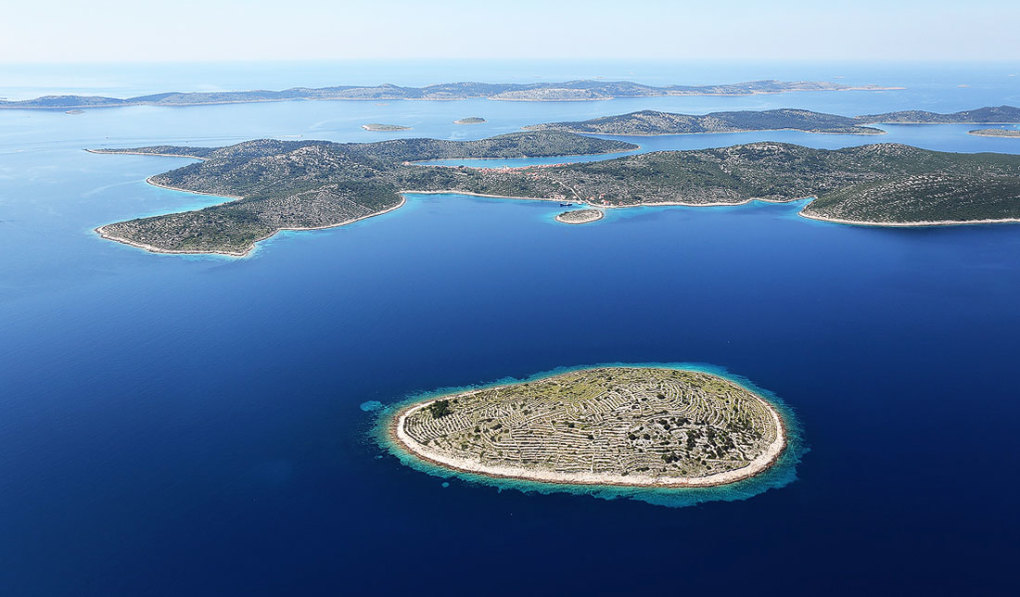
According to the Croatian National Tourism Board, the island has an area of 0.14 square kilometers. The stone walls are waist-high and, if connected, would be 23 kilometers long. This Croatian art of dry stone wall construction was included in UNESCO's list of intangible cultural heritage of humanity in 2018.
The locals created them using a technique called "drywall," stacking and nesting stones together. Most of the walls were built in the 19th century by people living on the neighboring island of Kaprije. They used Bavljenac Island to grow fruit trees and built drywall to protect the trees from the wind, as well as to demarcate land boundaries. Based on the remaining traces, scientists believe that the island's land was previously used for growing grapes. Grapevines in the Dalmatia region thrive in rocky soil, with plenty of sunshine and little rain. Therefore, Bavljenac is an ideal place to grow Dalmatia grapes.
Currently, over 100 people, mostly from Kaprije, are registered to use land on Bavljenac Island. There isn't much for tourists to explore on the island beyond rock walls, dry grass, and wild plants. Nevertheless, it remains a favorite destination for adventurous travelers due to its unique shape when viewed from above. There are no harbors or boats around the island. Visitors wishing to access the island can hire boats from local tour companies on nearby inhabited islands. Tours to the island are usually day trips.
[embed]https://www.youtube.com/watch?v=o_BrYb_b9_g[/embed]
Bavljenac is part of the Sibenik archipelago in the Dalmatia region, comprising nearly 250 small islands spread along the coast over an area of 160 km2. Six of these islands are permanently inhabited, with a total population of approximately 7,500 people: Kaprije, Krapanj, Murter, Prvic, Zirje, and Zlarin.
Of the islands, Kaprije (closest to Bavljenac) is a must-see destination for kayaking enthusiasts, and a perfect stop for those traveling between Split and Kornati. "Kaprije" means white flower, a Mediterranean plant with edible fruit and buds, often used as a garnish. There are virtually no cars on the island, only small paths for locals to walk to their farms. The famous Dalmatia wines are a must-try when visiting this region.
The sparsely populated Sibenik Islands are considered by Croatian travel companies "a destination for those who prefer privacy and immersion in unspoiled nature." The islands with permanent residents are connected to each other and to the mainland by ferries.
The inhabited islands all have rooms or apartments for rent. Hotel room prices in Sibenik start from around 41 euros. Each island has a local tourist office. Alternatively, visitors can contact the Sibenik County tourist office for assistance.
Tourists can choose direct flights to Split, one of Croatia's major cities, and then take a bus to the town of Sibenik, 60 km away. From there, you can take a daily ferry or hire a boat to the island.
The art of stone wall construction on Bavljenac Island has been recognized as an intangible cultural heritage of humanity. The Croatian government says it is "working seriously" with UNESCO to have Bavljenac recognized as a heritage site as soon as possible, helping the island become even more famous on the world tourism map.
According to vnexpress.net
Source


![[Photo] General Secretary and President To Lam presides over a meeting with the Central Organizing Committee.](https://vphoto.vietnam.vn/thumb/1200x675/vietnam/resource/IMAGE/2026/06/03/1780482764658_a1-bnd-4741-3342-jpg.webp)

![[Photo] Secretary of the National Assembly Party Committee, Chairman of the National Assembly presides over the meeting of the Standing Committee and Executive Committee of the National Assembly Party Committee.](https://vphoto.vietnam.vn/thumb/1200x675/vietnam/resource/IMAGE/2026/06/03/1780480353201_ndo_br_bnd-2585-jpg.webp)
![[Photo] First session of the 14th Congress of the Vietnam Trade Union](https://vphoto.vietnam.vn/thumb/1200x675/vietnam/resource/IMAGE/2026/06/03/1780465947883_ndo_br_img-3852-jpg.webp)



















































![[Video] Sunset at Lap An Lagoon – Where the sun sets over the fishing nets](https://vphoto.vietnam.vn/thumb/1200x675/vietnam/resource/IMAGE/2026/05/31/1780192137701_beach-landscape-sea-water-nature-grass-745871-pxhere-com.jpeg)








































Comment (0)