

Endemic rice variety
Currently, farmers in Tri Ton commune, especially the Khmer people, are entering the peak season for harvesting Nang Nhen rice. Although the yield is not high, averaging only about 450-500 kg per hectare, the selling price of 15,000-18,000 VND/kg, nearly three times higher than short-term rice varieties, still allows farmers to earn a profit of 3-4 million VND per hectare. Mr. Chau Am, a farmer in To Thuan hamlet, said that Nang Nhen rice produces very fragrant, beautiful white grains with slightly sticky rice. "Some years, people have already placed deposits even before the rice has bloomed. This year, my family only planted about 2 hectares to save for our own consumption. The yield is gradually decreasing, so I'm planting less," Mr. Chau Am shared.
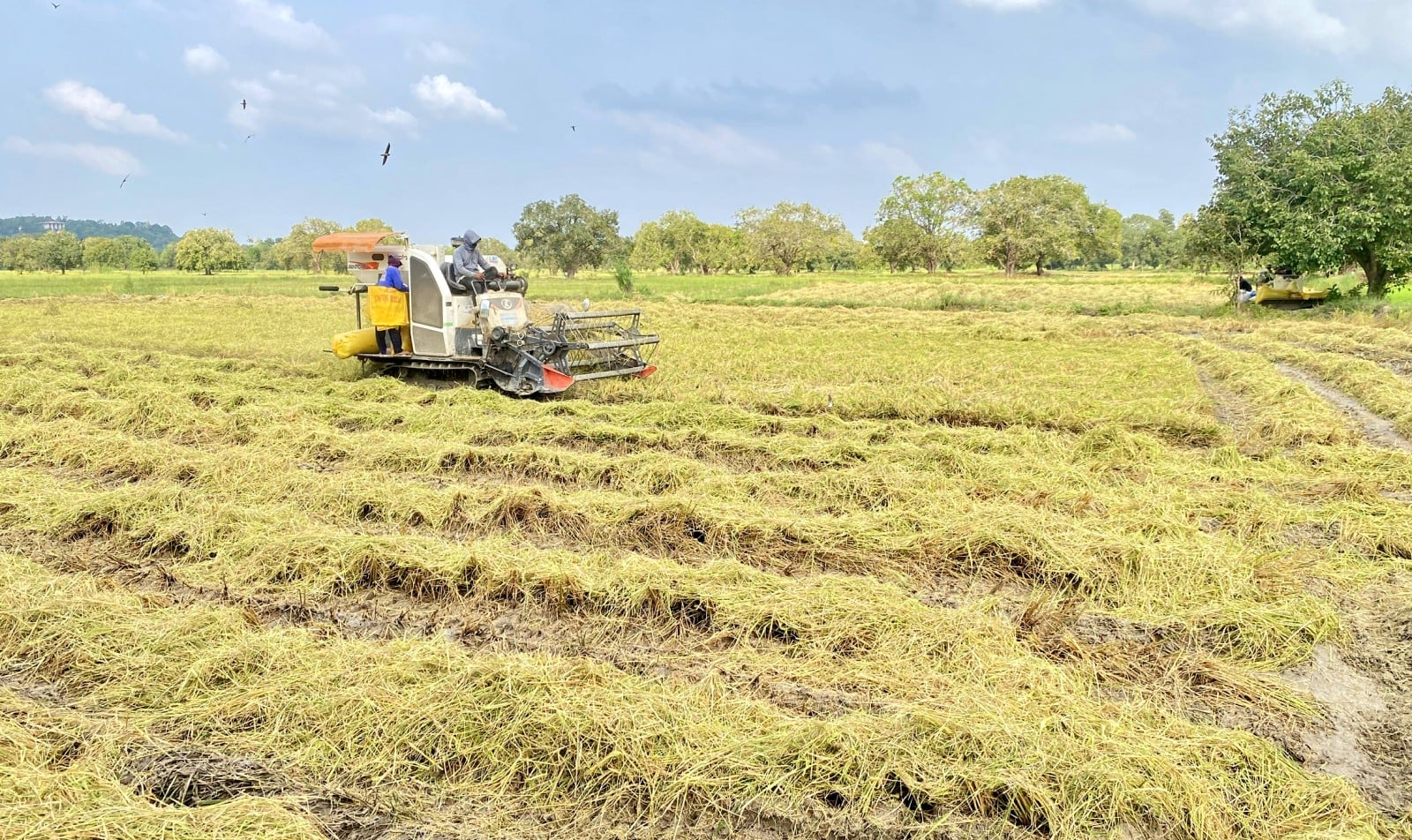
Farmers harvesting Nàng Nhen rice. Photo: DUC TOAN
Thanks to its semi-mountainous terrain, areas free from flooding, and sandy soil at the foot of the mountains, Tri Ton commune is well-suited for the Nang Nhen rice variety. According to many farmers, this rice variety is drought-resistant and less susceptible to pests and diseases. However, because it is entirely dependent on natural rainwater, only one crop can be produced per year. Following traditional farming practices, farmers sow seedlings around July, when the rainy season is stable; after 25-30 days, they transplant the seedlings. The growing period lasts about 6 months, with harvesting before the Lunar New Year.
Nang Nhen rice is considered a clean agricultural product because farmers limit the use of chemical fertilizers and pesticides, mainly using cow manure. The manure is mixed evenly into the soil after multiple plowing sessions, creating a thick "pond" on the surface of the field, which helps retain water and nutrients and reduces leaching during heavy rains. As a result, the rice plants grow steadily, producing naturally fragrant, clean, and safe rice grains.
Rich in cultural value
What makes Nàng Nhen rice special is that it retains its aroma for a long time, is resistant to insects, decay, and yellowing; the cooked rice is fragrant and not at all cloying. According to Mr. Chau Phi, a farmer in Tô Thuận hamlet, growing Nàng Nhen rice is labor-intensive in terms of land preparation and planting, but it requires less effort in terms of care. "When ripe, if the rice plants fall over, we cut them manually, dry them in bundles for a few days, and then thresh them. The straw is also used to feed cattle; nothing goes to waste," Mr. Chau Phi shared.
According to statistics, this year's crop season in Tri Ton commune saw only about 12 hectares of Nang Nhen rice planted, with each household cultivating an average of 0.5 to 2.5 acres. The majority of the yield was kept by farmers for family consumption, with very little sold on the market.
According to Lam Huu Hanh, Chairman of the Farmers' Association of Tri Ton commune: “Nang Nhen rice is not only a traditional crop but also carries cultural value for the Khmer people. The cultivated area is not large, mainly serving family needs. In the future, the locality will continue to promote and encourage people to preserve this precious rice variety, gradually increasing its value to associate it with characteristic products.”
According to Mr. Le Van Vu, a technician at the Tri Ton Agricultural Technical Station, to restore and develop Nang Nhen rice in the area, it is necessary to build a stable market through guaranteed purchase contracts with reasonable prices. At the same time, it is crucial to plan concentrated production areas to ensure consistent quality. When the market is stable and profits are increased, this specialty rice variety will have the opportunity for a sustainable revival.
Amidst the hustle and bustle of modern life, Nàng Nhen rice is still preserved by the Khmer people of Tri Tôn commune as a part of their cultural identity, contributing to the unique flavor of the Bảy Núi region.
DUC TOAN
Source: https://baoangiang.com.vn/huong-lua-nang-nhen-a471295.html



![[Photo] The General Secretary, President and his wife begin their state visit to the Philippines.](https://vphoto.vietnam.vn/thumb/1200x675/vietnam/resource/IMAGE/2026/05/31/1780230559452_anh-man-hinh-2026-05-31-luc-19-28-11.png)
![[Image] Hanoi Police officially crowned champions of V-League 2025/2026](https://vphoto.vietnam.vn/thumb/1200x675/vietnam/resource/IMAGE/2026/05/31/1780244769054_ndo_br_039d561b692be875b13a-jpg.webp)










































































Comment (0)