

Recently, Mr. NVĐ (63 years old, Hanoi ) experienced persistent headaches, without accompanying dizziness, nausea, or weakness in his limbs, and sought treatment at MEDLATEC Thanh Xuan Multi-Specialty Clinic.
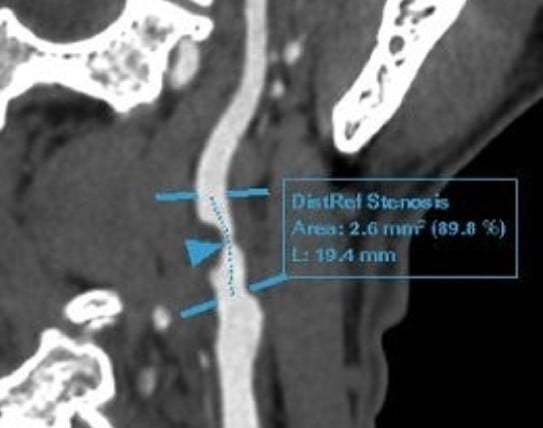 |
| X-ray images of the patient's lesions. |
Through examinations and specialized tests, he was found to have severe carotid artery stenosis due to atherosclerosis, one of the leading causes of stroke.
Mr. D. has a history of smoking for nearly 30 years, consuming 18-20 packs per month. This is a significant risk factor for atherosclerosis and cardiovascular diseases.
Although there was no family history of cardiovascular disease and he had never shown any suspicious signs of stroke before, the examination results showed his blood pressure was 140/85 mmHg and blood tests revealed a lipid disorder with elevated bad cholesterol (LDL-C) and decreased good cholesterol (HDL-C).
Ultrasound and cerebral angiography results showed that Mr. D. had severe 90% stenosis of the right internal carotid artery due to mixed atherosclerotic plaques, accompanied by a small dissection of the left internal carotid artery with a small aneurysm. The plaques also spread to several other segments of the arteries, such as the subclavian artery and cavernous sinus. Coronary CT angiography revealed mild calcification, causing 30-40% stenosis of the coronary artery branches.
Additionally, the CT scan revealed other lesions such as ground-glass opacities in the lungs, atherosclerosis of the aortic arch, calcified nodules in the liver, and a cyst in the right kidney. Based on this, the doctor diagnosed Mr. D. with atherosclerotic carotid artery disease with severe stenosis, chronic coronary artery disease, and dyslipidemia.
According to Dr. Tran Hai Nam, a specialist in Cardiology at MEDLATEC Thanh Xuan, severe carotid artery stenosis is the main cause of stroke because it reduces blood flow to the brain, causing blockage and permanent brain damage. Regular carotid artery screening is key to preventing this dangerous disease.
Atherosclerotic carotid artery disease is a condition in which the carotid arteries are narrowed or blocked by fatty plaques. It is common in older adults, especially those with risk factors such as smoking, dyslipidemia, and hypertension.
Statistics show that 33% of cases of carotid artery stenosis ranging from 80-99% can lead to transient ischemic attack (TIA) or stroke if not detected in time.
Early warning signs of stroke to watch out for include weakness or numbness on one side of the body, difficulty speaking, temporary loss of vision in one eye, loss of balance, or unusually severe headache. These symptoms may be fleeting but are a warning sign of a potential stroke in the near future.
The case of Mr. D., who smoked for nearly 30 years, illustrates the insidious and serious harm that tobacco causes to the cerebrovascular and cardiovascular systems. Even when symptoms are mild and unclear, the risk of stroke remains very high if not detected and treated promptly.
To prevent stroke, people should quit smoking, control their blood pressure, maintain stable blood lipid and blood sugar levels, eat a healthy diet, exercise regularly, and have regular health checkups. In particular, people over 40, those who have smoked for a long time, have hypertension, dyslipidemia, diabetes, obesity, or a family history of cardiovascular disease should undergo early stroke screening.
Necessary screening tests include blood lipid tests, carotid Doppler ultrasound to detect carotid artery stenosis, electrocardiogram, echocardiogram, and CT/MRI scans of the brain and cerebral blood vessels for a comprehensive risk assessment.
Carotid Doppler ultrasound is a simple, non-invasive, and cost-effective method that is highly effective in the early detection of atherosclerosis and carotid artery stenosis. Combined with other screening techniques, this helps doctors accurately assess cardiovascular and neurological conditions, enabling timely treatment and minimizing the risk of serious complications.
Source: https://baodautu.vn/hut-thuoc-la-30-nam-phat-hien-benh-ly-tim-mach-nguy-hiem-d402438.html

























































































Comment (0)