Unraveling the mystery of the long, dark streaks on the slopes of Martian mountains.
New research reveals that the dark, 'barcode-like' streaks on Mars are caused by dust avalanches from meteorite impacts and natural processes affecting the red planet's climate.
Báo Khoa học và Đời sống•19/11/2025
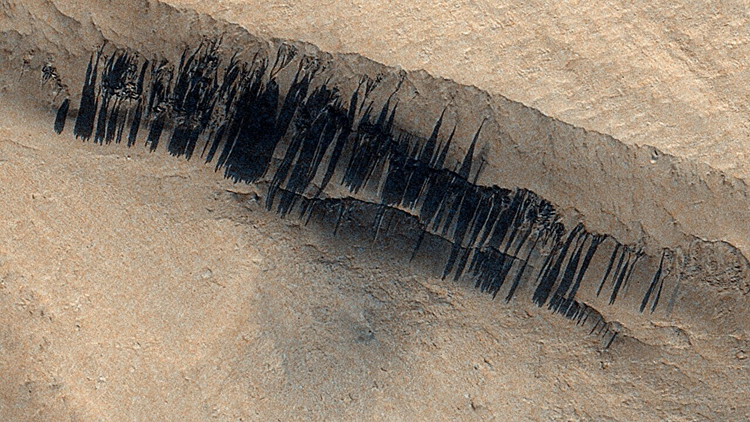
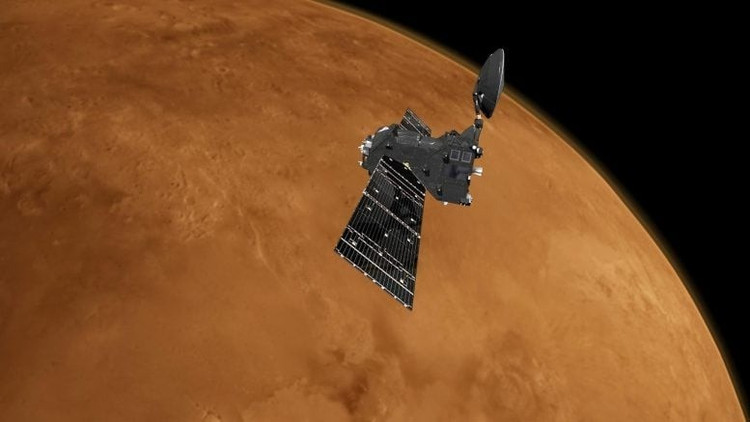
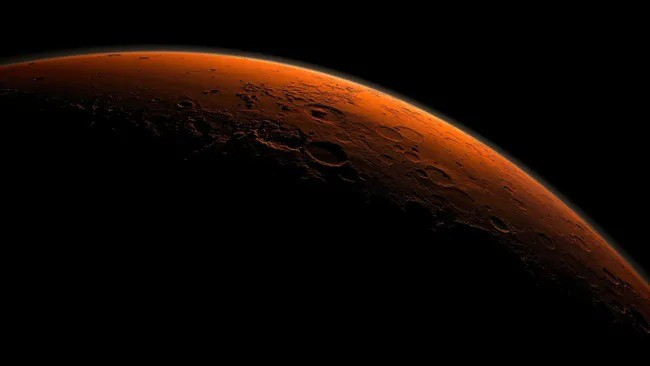
Recently, scientists published research results in the journal Nature Communications about long, dark streaks resembling "strange barcodes" on the slopes of Martian mountains, which were photographed in late 2023. Photo: European Space Agency. Images of "strange barcodes" captured by the European Space Agency's (ESA) Trace Gas Orbiter probe show narrow, dark streaks extending down the slopes of Apollinaris Mons – an extinct volcano near the Martian equator. Each streak marks the traces of a dust avalanche, triggered when a meteorite strikes the surface and shakes the fine dust covering the slopes. Photo: D. Ducros / ESA.
Despite covering less than 0.1% of the planet's surface, these "dust slips" play a crucial role in Mars' dust cycle. According to scientists, the amount of dust they release each year is equivalent to at least two global dust storms, significantly contributing to the red planet's climate. Photo: ESA/ATG medialab. A new study led by Valentin Bickel of the University of Bern (Switzerland) indicates that this is a rare phenomenon. Less than one-thousandth of these dust slides originate from meteorite impacts. The majority are due to seasonal changes in wind patterns and natural dust activity. Photo: NASA.
Expert Bickel and his colleagues analyzed more than 2 million dust slips across 90,000 images taken from Mars orbiters, primarily NASA's Mars Reconnaissance Orbiter (MRO). They used deep learning algorithms to scan the entire data and determine the time and location of each slip's formation, thereby uncovering seasonal patterns in Martian dust dynamics. (Image: jenoptik.com)
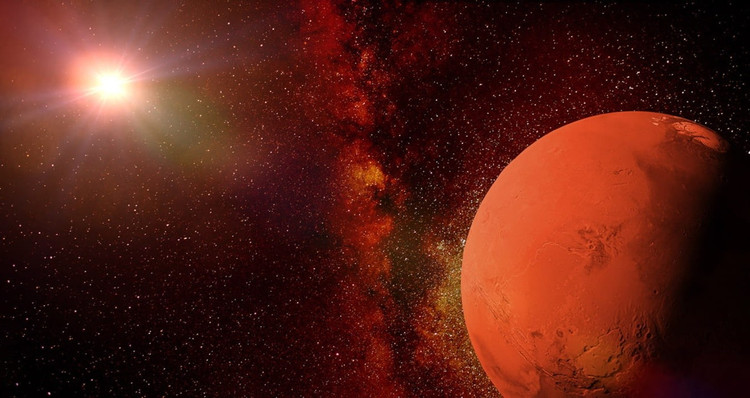
Research shows that this phenomenon is most prevalent in the summer and autumn in the southern hemisphere, when winds are strongest, powerful enough to blow tiny dust particles into the air. Photo: World Perspectives/Photographer's Choice/Getty Images. By comparing the amount of dust stirred up by these skid marks with data on atmospheric circulation, the research team found that they contribute to moving about one-quarter of the total amount of dust exchanged between the surface and the atmosphere each year, equivalent to the amount of dust generated by two global storms. Image: NASA/JPL-Caltech/UArizona. The most favorable conditions for the formation of these slip marks have been identified as occurring at dawn and dusk. However, no orbiter has yet directly recorded this process due to limited light during those times. Image: NASA/JPL-Caltech.
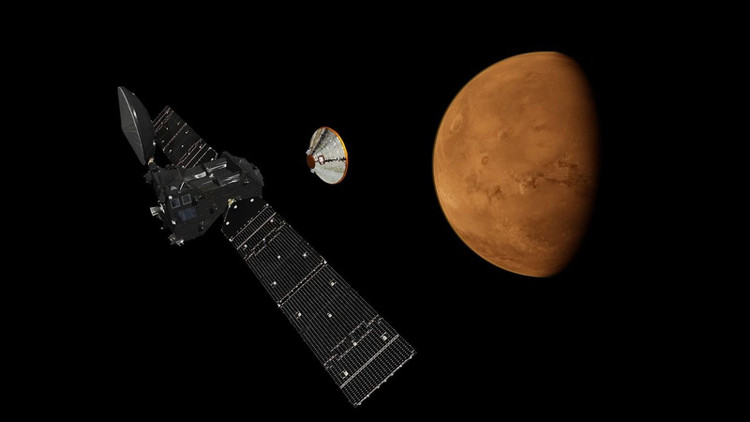
The study also identified five "hot spots" where this phenomenon is most common, including Amazonis, the area around Olympus Mons, Tharsis, Arabia, and Elysium—regions with steep terrain, loose dust, and winds strong enough to trigger surface movement. Photo: earth.com. Colin Wilson, the scientist in charge of the Trace Gas Orbiter mission, said these observations could help to better understand what is happening on Mars today. Collecting continuous, long-term, and global observations to explore the dynamics of Mars is a primary goal of current and future orbital probes. Photo: Universal History Archive/Universal Images Group via Getty Images.
Readers are invited to watch the video : A map of the universe with over 900,000 stars, galaxies, and black holes. Source: THĐT1.






 Báo Khoa học và Đời sống•19/11/2025


![[Image] Hanoi Police officially crowned champions of V-League 2025/2026](https://vphoto.vietnam.vn/thumb/1200x675/vietnam/resource/IMAGE/2026/05/31/1780244769054_ndo_br_039d561b692be875b13a-jpg.webp)
![[Photo] Admire the coral "masterpiece" amidst the million-year-old heritage of Dak Lak province.](https://vphoto.vietnam.vn/thumb/1200x675/vietnam/resource/IMAGE/2026/05/31/1780221235105_anh-man-hinh-2026-05-31-luc-16-53-27.png)

![[Photo] The General Secretary, President and his wife begin their state visit to the Philippines.](https://vphoto.vietnam.vn/thumb/1200x675/vietnam/resource/IMAGE/2026/05/31/1780230559452_anh-man-hinh-2026-05-31-luc-19-28-11.png)
![[Photo] Solemn bathing ceremony and Buddha procession in Hue](https://vphoto.vietnam.vn/thumb/1200x675/vietnam/resource/IMAGE/2026/05/31/1780228263543_1-jpg.webp)

![[GALLERY] Summer mistakes that cause phone batteries to drain extremely quickly](https://vphoto.vietnam.vn/thumb/402x226/vietnam/resource/IMAGE/2026/05/31/1780231867344_sac-4-png.webp)












![[Video] Sunset at Lap An Lagoon – Where the sun sets over the fishing nets](https://vphoto.vietnam.vn/thumb/340x192/vietnam/resource/IMAGE/2026/05/31/1780192137701_beach-landscape-sea-water-nature-grass-745871-pxhere-com.jpeg)



![[INFOGRAPHIC] PocketBook InkPad One](https://vphoto.vietnam.vn/thumb/402x226/vietnam/resource/IMAGE/2026/05/31/1780216562391_thumb-may-doc-sach-28-5-jpg.webp)






































![[Photo] Admire the coral "masterpiece" amidst the million-year-old heritage of Dak Lak province.](https://vphoto.vietnam.vn/thumb/402x226/vietnam/resource/IMAGE/2026/05/31/1780221235105_anh-man-hinh-2026-05-31-luc-16-53-27.png)
































Comment (0)