

From a remote, hilly area lacking electricity, roads, and water sources, the family of Ms. Le Thi Nga in Dong Toan village, Ha Long commune, has gradually transformed the land into a prosperous production area. Not only has it harnessed the potential of hilly land, but it has also become a model of agricultural economic development in Ha Trung district, creating jobs for 5 to 12 local workers.
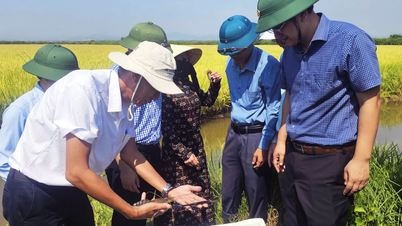
 Many delegations have visited to observe and learn from the experience of the hill garden economic model of Ms. Le Thi Nga's family in Dong Toan village, Ha Long commune (Ha Trung district).
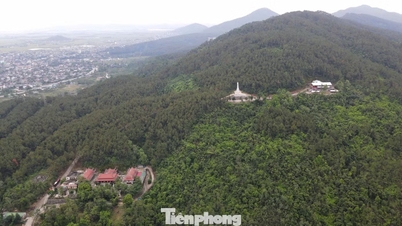
After winding our way for over a kilometer along the foothills and through dense forests, we finally reached the production land of Mrs. Le Thi Nga's family. Tucked away behind the hills and bordered by the Duong Lang mountain range, this area was once one of the most remote in Ha Long commune, as nearly a decade ago only a dirt path existed. From afar, we could see vast rows of guava trees planted in neat lines stretching as far as the eye could see on the slopes. Despite the hilly terrain, her family had paved the roads crisscrossing the area with concrete to allow easy access for vehicles and machinery within the production zone.
With a total area of 5 hectares of hilly land leased for 50 years, her family previously only grew sugarcane and pineapple. About 7 to 10 years ago, the prices of these two main crops were unstable, so the family decided to transform it into a fruit farm combined with livestock farming. 2015 is considered a new milestone, marking the beginning of her family's elaborate and arduous transformation journey.
With accumulated savings and borrowed money, she upgraded a kilometer-long trail into a main road, allowing easy access for trucks. The most crucial issue was the water supply for production; she hired drillers to explore six locations, finding three with water sources to build pumping wells. Then, electricity for production and temporary housing gradually took shape. Along with that, 1,000 Taiwanese pear guava trees, 800 Vinh orange trees, nearly 1,000 green-skinned and Dien pomelo trees, and 500 jackfruit trees were planted to green the hillsides. Throughout the development process, the family maintained pineapple cultivation in some remaining areas and intercropped them under the fruit trees that hadn't yet formed a canopy to generate short-term income to support long-term growth.
Since 2016, her family has expanded their livestock farming to include 1,500 broiler chickens per batch, increasing to 2,500 per batch in 2017. With successful chicken farming generating substantial income, the family continued to invest in three pig farms, capable of housing 120 pigs simultaneously. To ensure a reliable water supply for livestock and to install a drip irrigation system, the family constructed six large reservoirs on hilltops, investing hundreds of millions of dong in each project.
In recent years, the farm has continued to expand its area of avocado, sapodilla, and Hung Yen longan trees, all of which are now bearing fruit. With a variety of crops, the family has a year-round harvest depending on the season. This also helps avoid the "bumper harvest, low prices" situation that can arise from over-reliance on a single crop.
“My husband and I have traveled to many provinces such as Tuyen Quang, Hoa Binh, Phu Tho, Hung Yen, and even Dak Lak to learn about growing fruit trees for high income. The lesson learned is that we must apply scientific and technical advancements and safe production processes. Now we almost never use chemical fertilizers, but instead use livestock waste, ground corn, and crushed soybeans to fertilize the trees. That is also the factor that makes the fruit delicious, sweet, and refreshing, and is chosen by many traders,” Ms. Nga shared.
According to Ms. Nga, from 2020 to the present, fruit prices have remained stable at the orchard, such as oranges at around 18,000 VND/kg, green pomelos at around 35,000 VND/kg, avocados and sapodillas at around 20,000 VND/kg... In recent years, her family has earned a profit of 1-1.4 billion VND per year, providing employment for 5 permanent workers and 6-7 workers during peak harvesting seasons, with an income of 250,000 VND/day/person.
An efficient production zone, developing in a green, environmentally friendly direction, has been built thanks to the dynamism and diligence of its people. Recently, many visiting groups from within and outside the district have frequently been introduced to this place to learn from its experience.
Text and photos: Linh Truong
Source


![[Photo] National Assembly Chairman Tran Thanh Man working with the Standing Committee of the Economic and Financial Committee](https://vphoto.vietnam.vn/thumb/1200x675/vietnam/resource/IMAGE/2026/05/20/1779249584387_ndo_br_1-jpg.webp)

![[Photo] General Secretary and President To Lam presides over a meeting on assessing national development resources.](https://vphoto.vietnam.vn/thumb/1200x675/vietnam/resource/IMAGE/2026/05/20/1779253785852_a1-bnd-2943-8519-jpg.webp)






























































Comment (0)