

One particular element that adds emotional depth to the film is the song "A Region of Comrades," with lyrics by writer Nguyen Trong Luan and music by composer Quynh Hop. This song not only serves as background music throughout the film but also acts as a connecting thread between the past and present, transporting viewers back to the brutal yet humane years of war .
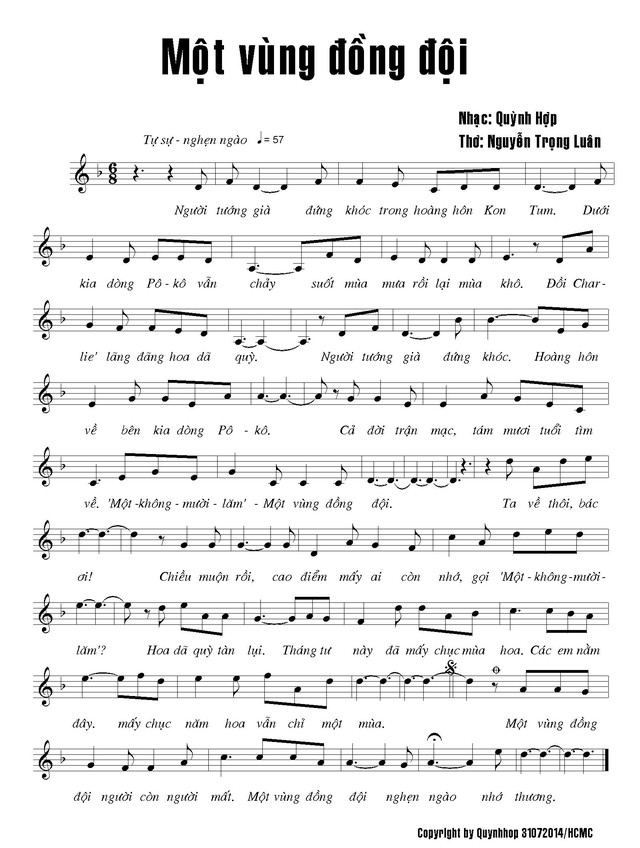
The song "A Region of Comrades" not only serves as the background music throughout the film but also acts as a connecting thread between the past and the present.
PHOTO: TGCC
The language of cinema recreates a glorious past .
The film opens with writer Nguyen Trong Luan sitting in front of his laptop, melodies and text appearing on the screen like a quiet stream of memories. Interspersed are aerial shots (taken by drone), overlooking high points 1015 and 1049 – once fierce battlefields . Scenes of the Po Ko River (Kon Tum) flowing gently, or the mist-covered hills of the Central Highlands, not only evoke a majestic and solemn atmosphere but also serve as silent witnesses to history. The film's emotional impact is felt right from the beginning with writer Nguyen Trong Luan's story as he witnesses his superior, Lieutenant General Khuat Duy Tien, standing on the summit of 1015 (Charlie Hill, or Sac Ly Hill) looking down at the Po Ko River and weeping. These are not just the tears of an old general returning to his old battlefield, but also the tears of a soldier, a comrade , mourning those who have fallen forever. This moment also served as the inspiration for the song "A Region of Comrades ."
Amidst the vast expanse of the Central Highlands, as the image of the martyrs' graves stretching across the Sa Thầy cemetery comes to mind, the melody of "A Region of Comrades" rises, making everything more haunting and moving than ever: "You have lain here for decades, the flowers still bloom for only one season…".
The lyrics are taken directly from the poems of writer Nguyen Trong Luan, recreating the choked cries of Lieutenant General Khuat Duy Tien upon returning to the old battlefield. These lyrics are not only an expression of sorrow but also a reminder that: the soldiers of yesteryear may have fallen, but the camaraderie remains forever intact.
Composer Quynh Hop used majestic melodies, infused with the poignant spirit of the Central Highlands, to draw listeners into a stream of memories. As the song resonates amidst the vast expanse of the old battlefield, viewers not only hear but also feel the deep sorrow of the surviving soldiers for their fallen comrades.
The 27-minute documentary film "Comrades' Zone," by a team of authors including Ho Nhat Thao, Tran Thanh Hung, Tran Vu Linh, and Huynh Thanh Huyen, participated in the 42nd National Television Festival in Binh Dinh. Screenwriter Tran Thanh Hung stated that the film is a tribute from the team to Lieutenant General Khuat Duy Tien, Hero of the People's Armed Forces; Dam Vu Hiep, Hero of the People's Armed Forces; and the martyrs and soldiers who fought and sacrificed their lives at the two high points 1049 and 1015 in 1972.
The bond of camaraderie is unbreakable.
One of the highlights of "Comradeship Zone" is that the film doesn't focus on battles, but instead explores the sacred bond of camaraderie. This bond exists not only during wartime but also extends into civilian life after the soldiers return to civilian life.
The moment writer Nguyen Trong Luan and veterans of the 64th Regiment lit incense at the tombstone of martyr Dam Vu Hiep in Sa Thay cemetery was a deeply emotional scene. As their trembling hands wiped away the inscription on the tombstone, memories of a time of bloodshed suddenly resurfaced. The soldiers of yesteryear now have gray hair, but their memories of their comrades remain as vivid as ever. This camaraderie is not only present among the soldiers but is also passed on to the next generation. The story of Colonel Dam To Giang, daughter of martyr Dam Vu Hiep (who was posthumously awarded the title of Hero of the People's Armed Forces by the President on January 23, 2025), is one of the most moving. Growing up without a father, she understood the pain of her mother and family. But instead of wallowing in grief, she decided to follow the military path to continue the ideals for which her father sacrificed himself. The extraordinary connection between Ms. Dam To Giang and Ms. Do Hoai Nam – the daughter of another fallen soldier who died at 1015 – further emphasizes the emotional bond between the children of the generation of soldiers. Notably, both were born in June 1972, sharing the same birth time and date. They never met their fathers and grew up together, sharing the same deep-seated sorrows. Their chance encounter at the annual reunions of veterans from Regiment 64 (Division 320) is proof that even though the war is over, the bonds between the children of the generation of soldiers still endure. And most importantly, the film touches the hearts of viewers through the images and words of the renowned writer Khuat Quang Thuy, spoken with his remaining strength.
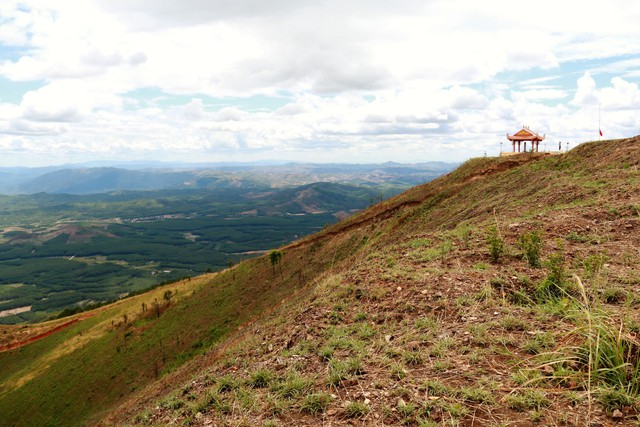
Historical monument at Hill 1015 (Sac Ly Hill), viewed from the white rock point.
PHOTO: MAI THANH HAI
Writer Khuất Quang Thụy was a close high school classmate of People's Armed Forces Hero Đàm Vũ Hiệp; both were from Phúc Thọ ( Hanoi ). Both talented, they had promised to study at Hanoi University of Literature, but both put aside their studies to take up arms and answer the sacred call of the Fatherland. "What is literature? Literature is this. It is this life. It is the struggle of this nation," writer Khuất Quang Thụy said, acknowledging that his literary career was indebted to his classmate and comrade Đàm Vũ Hiệp for that statement before he volunteered to go to the battlefield. It was also a declaration of the entire generation of young people in North Vietnam at that time.
Many viewers couldn't hide their emotions while watching this film. And tears flowed at the end with the verses by writer Khuất Quang Thụy dedicated to his close friend: " Please forgive those who are still alive / It's not easy making a living / Come back and be happy, Hiệp / Even if it's late, it's still fortunate / Your mother still has time to gather a handful of earth / To sew one last garment for you, my friend . "
Director Ho Nhat Thao was incredibly subtle in his use of silence to evoke emotions. Without excessive narration, the film lets the characters, images, and music tell their own story. Scenes of incense smoke mingling with the evening mist on the summit of Hill 1015, a veteran standing silently gazing into the distance, or simply a moss-covered tombstone… all create a tranquil atmosphere, compelling viewers to reflect. The slow, poignant melodies of "A Region of Comrades" resonate amidst the old battlefield, like a whisper from the past.
"A Comradeship Zone" is not just a documentary about war, but also an epic ballad about the undying bond of comradeship. Through realistic and artistic imagery, combined with the moving melody of "A Comradeship Zone ," the film revives memories of battles on Hill 1015 and Hill 1049 – where hundreds of soldiers perished. More importantly, the film affirms one thing: war may end, but the bonds of comradeship and humanity will endure.
Today, as memories of the war fade away, films like "Comrades in Arms " serve as a bridge for future generations to understand and appreciate the sacrifices of their ancestors. It's not just a cinematic work, but also a tribute to those who fell for the independence and freedom of the nation.
Source: https://archive.vietnam.vn/khuc-trang-ca-cua-tinh-dong-doi/


![[Photo] General Secretary and President To Lam presides over a meeting on preparations for the review of one year of operation of the three-tiered government system.](https://vphoto.vietnam.vn/thumb/1200x675/vietnam/resource/IMAGE/2026/06/02/1780391821195_a1-bnd-4595-9717-jpg.webp)




























































































Comment (0)