

 |
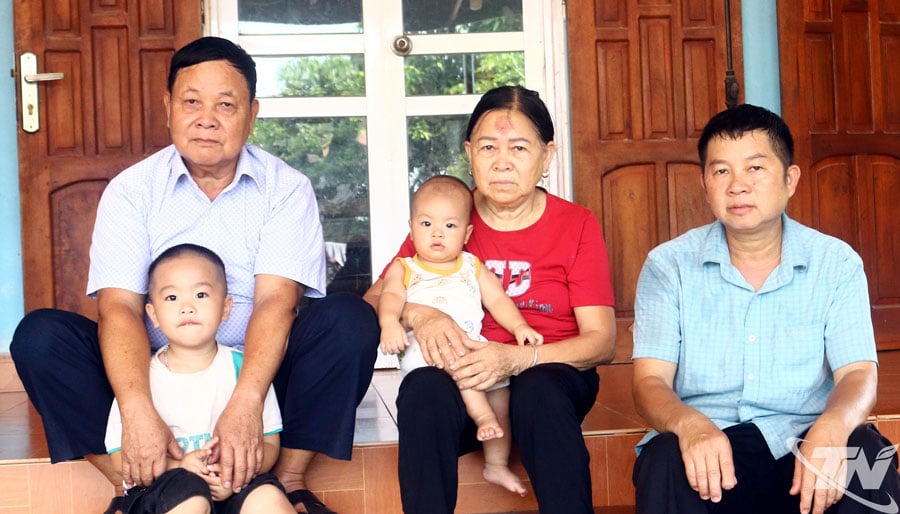
| Despite their busy household chores, Mr. and Mrs. Hoang Van Hoa and Tong Thi Vong, from Chi Son hamlet, Nam Hoa commune, always make time for their children and grandchildren. |
After more than three years of implementing the Code of Conduct for Families in Thai Nguyen province, its contents have become an important part of preserving family values. Many localities have effectively integrated the code into emulation movements and community activities, contributing to raising awareness of responsibility, love, and sharing among generations, and spreading positive cultural values in society.
Residential areas have proactively incorporated the contents of the set of criteria into their village regulations and conventions. Many aspects of the criteria have been concretized through models for building culturally exemplary families; culturally exemplary residential areas; and preventing and combating domestic violence. To date, the province has approximately 2,500 family clubs, 1,900 trusted addresses in the community, 1,200 domestic violence prevention and control groups, and nearly 800 hotlines to provide timely advice and support.
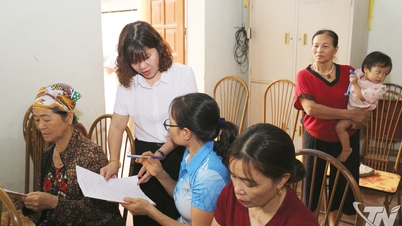
To ensure the criteria are widely disseminated among the people, in the last three years, thousands of officials and collaborators working in family affairs have participated in training courses organized by the Department of Culture, Sports and Tourism to enhance their knowledge and skills in counseling and disseminating information on preventing and combating violence and building happy families.
With its concise and easy-to-understand content, the set of criteria has conveyed a practical message: "Respect - Equality - Love - Sharing," becoming a guiding principle for every family. From this, positive behavioral norms are formed: Husbands and wives are faithful and affectionate; parents and grandparents are exemplary and loving towards their children and grandchildren; children and grandchildren are filial and respectful; siblings are united and considerate of each other. These simple things are the foundation for a happy family, contributing to the stability and prosperity of society as a whole.
The implementation process has shown that the content of the set of criteria has had a clear positive impact on each family. In most residential areas, the family atmosphere is warm and harmonious, and domestic violence is reduced. Family and clan members know how to be patient, listen, share, and adjust their behavior in a cultured way. Instead of imposing or blaming, people learn to dialogue and resolve disagreements with respect and empathy.
In the residential area, members of the Front Committee and exemplary cultural households always serve as leading examples in implementing the set of criteria. As a result, the effectiveness is evident, and the community is becoming increasingly close-knit and compassionate. Adults behaving kindly and exemplarily serve as living examples for children to look up to and follow. This fosters a generation of people who are humane and responsible towards themselves, their families, and society.
A highlight of the implementation of the set of criteria is its contribution to raising awareness of gender equality and the role of women in building happy families. Through training courses on parenting skills and conflict resolution within the family, many women have become more confident in communication, expressing their opinions, sharing household responsibilities with their husbands, and becoming the "keepers" of the flame of happiness. As a result, trust and a sense of peace are nurtured in each home, contributing to the spread of happiness throughout society.
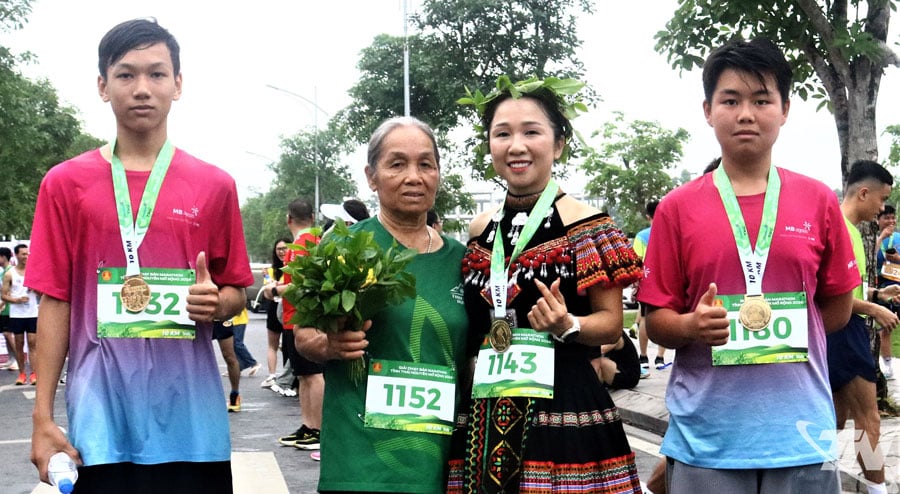 |
| The code of conduct within the family helps bring generations closer together. In the photo: Mrs. Tran Thi Thin, from An Khanh commune, with her grandchildren. |
When kindness, cultured behavior, and a responsible lifestyle originate within each family, a compassionate community and a harmonious and sustainable society will be formed. Therefore, the set of criteria, which has been and continues to be widely implemented among the people, has always received widespread support and active participation. Most families have considered it a "guiding principle" in their daily interactions, creating a "soft shield" against the intrusion of pragmatic, self-serving, and indifferent lifestyles.
A family or lineage with a hierarchical structure—exemplary grandparents, filial parents, obedient children, and siblings who are equal, united, and loving—will create a strong "fortress," capable of resisting social evils. And when each family truly becomes a place that nurtures love and cultural behavior, society will become increasingly peaceful, civilized, and sustainably developed.
Source: https://baothainguyen.vn/van-hoa/202507/kim-chi-nam-trong-moi-nep-nha-78d1454/

























































Comment (0)