

Is altitude sickness dangerous when climbing mountains, and how can it be minimized or managed?
I know a friend who recently went mountain climbing and suffered severe altitude sickness, requiring emergency treatment and at one point his life was in danger. So, I'd like to ask, what are the symptoms of altitude sickness when mountain climbing? Are there any ways to reduce or mitigate this?
Thank you.
Minh Anh
Reply:
Photographer Nguyen Viet Hung (Lekima Hung) often organizes group photo tours to many places both domestically and internationally, including many locations at high altitudes such as Tibet (4,900 m), Ladakh (5,200 m), and Pakistan (4,100 m). Hung says that one of the symptoms of altitude sickness is nosebleeds. This is because at high altitudes, the air is dry, and the capillaries are thin, making them more prone to bleeding.
Hung's group usually consists of people in good health, but when going to these places, everyone has to prepare beforehand with altitude sickness medication. Prescriptions are prepared at home, with consultations from many international mountaineering experts and specialist doctors. In addition, to boost health, Hung's group recommends using some dietary supplements, cordyceps, oxygen-boosting tablets, and many other types of supplements.
According to Mr. Hung, to minimize altitude sickness, it's necessary to design itineraries that ensure "altitude acclimatization time," meaning there needs to be time to adjust and avoid sudden changes in altitude. People with cardiovascular disease, high blood pressure, or asthma should consider carefully before participating in trips to these places. They should consult with or accompany a doctor if they still want to participate.
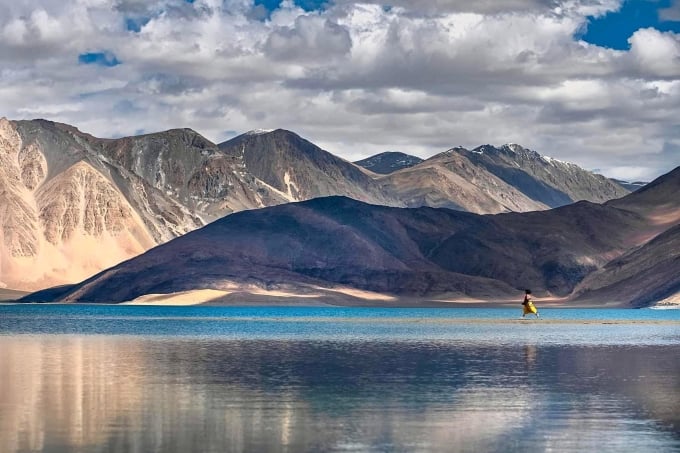
Pangong Tso Lake in Ladakh is located at an altitude of 4,300 meters. Photo: Tuan Dao
Tuan Dao , a tourist from Hanoi who has visited Ladakh (India) twice, said the most noticeable symptoms of altitude sickness are "severe headaches, nausea, and dizziness."
During his first trip to Ladakh a few years ago, he didn't encounter any problems, so on his second trip this past July, he was careless and didn't bring any medicine or prepare mentally. "A few months before that, I was trekking in the Fairy Meadows nature reserve (Pakistan), camping at a mountain base over 3,300 meters high without any health issues. But when I returned to Pangong Tso Lake in Ladakh, at 4,300 meters, I suffered from altitude sickness, chills, and malaria. I was delirious all night, with a throbbing headache, dizziness, and I fainted about 50 times," Tuan recounted.
Mr. Tuan advises preparing all necessary equipment, including altitude sickness medication (consult your doctor before you leave home), nasal spray (at high altitudes, dry noses are more prone to bleeding), heat patches, warm clothing, a hat, and gloves.
Mr. Pham Cuong , a representative of a travel company specializing in adventure tours, also shared some tips to minimize altitude sickness:
- You shouldn't shower immediately upon arriving at a place with a significant altitude difference.
- Avoid strenuous exercise and excessive physical activity, as it can be very tiring. Sometimes, walking 1 km feels like walking several km.
- Drink more water than usual (the normal standard is about 2 liters of water per day).
- Train physically before going to places where you might experience altitude sickness, and practice exercises to ensure even blood flow to the brain.
- Prepare medications to improve brain function, blood circulation, and altitude sickness (consult your doctor before use).
- Prepare necessary items such as warm clothing (clothes, shoes), nasal drops.
In many tourist destinations like Tibet, Ladakh, or Pakistan, some places have oxygen supply lines. If tourists experience mild symptoms, they can provide first aid on the spot. "Be careful because in many cases, just jumping on Yomost to take a photo can lead to emergency treatment due to altitude sickness," Hung added.
Tam Anh
Source link

![[Photo] National Assembly Chairman Tran Thanh Man successfully concludes his participation in IPU-152](https://vphoto.vietnam.vn/thumb/1200x675/vietnam/resource/IMAGE/2026/04/18/1776502638199_vna-potal-chu-tich-quoc-hoi-ket-thuc-tot-dep-chuong-trinh-tham-du-ipu-152-8709975-jpg.webp)













![[Infographic] Highlights of the Hung Temple Festival and the Ancestral Land Culture and Tourism Week 2026](https://vphoto.vietnam.vn/thumb/402x226/vietnam/resource/IMAGE/2026/04/18/1776502670666_le-hoi-vietnam-1-7877-jpg.webp)

































































Comment (0)