

To cultivate a culture of temple worship, it is necessary to practice moderation and restraint, as taught by the Buddha .
For most Buddhists or those who appreciate the serene atmosphere of temples, if they study or listen to lectures, they will likely understand the basic principles of the Middle Way. In theory, as well as in practice, Buddhism never takes extremes but emphasizes the principle of the Middle Way. The Middle Way is not only a relative way to balance present life but also a practice to achieve liberation.
The teachings of the Buddha emphasize moderation and balance. The Buddhist principle of the Middle Way is the foundation for moderation. Moderation means neither being excessive nor insufficient in attitude and behavior towards a particular issue. Any excess creates chaos. This is evident in many aspects of life.
Yet, every year during the festival season, stories heat up with incidents like the "obsessive burning of votive paper," the "overflowing scattering of small change," "stuffing money into the hands of Buddha," or the "obsession and jostling to snatch offerings"...
In this article, I share my thoughts on the relationship between the culture of visiting temples at the beginning of the year and moderation. Accordingly, a culture of visiting temples needs to be based on the practice of moderation and restraint as taught by the Buddha.
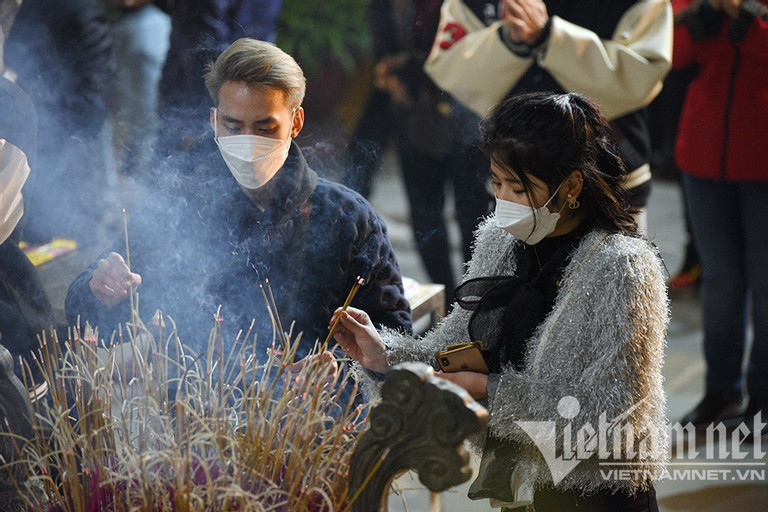 |
| Visiting temples at the beginning of the year is a beautiful Vietnamese cultural tradition that has existed for thousands of years. Photo: Pham Hai. |
Calmness, composure, and thoughtfulness are expressions of moderation. When visiting temples, people often remind each other and themselves not to be noisy, but also not to be indifferent or cold towards those around them. During the New Year, the number of people entering and leaving temples is usually very large, causing difficulties in parking and movement, and potentially leading to arguments, conflicts, and even clashes due to the crowds. A lack of moderation can lead to physical altercations and shouting. Those who practice moderation at temples can ask questions, offer reminders, show consideration for one another, and thus cultivate a culture of proper conduct.
Buddhist philosophy encourages people to live virtuously, emphasizing patience, self-confidence, and the principle of "you reap what you sow." By not exceeding the boundaries of moderation, people can overcome the burdens of daily life, accept life as it is, and find peace and comfort.
Moderation is key to living in harmony with nature and with others, fostering care and sharing. Buddhism is a religion of wisdom and compassion, but some people go to temples not for the teachings of Buddhism but to follow the crowd, leading to immoderate behavior such as breaking branches, picking leaves, littering in temples, or even stealing within the temple grounds.
Moderation also helps people know what is enough to maintain a stable and peaceful state of mind. It's not difficult to realize that this is the realm of Buddha, not the underworld, so why burn so much money and paper offerings? Or that the money donated to temples is for Buddhist activities, not for the Buddha himself, so why would people stuff money into the hands of Buddha statues? Therefore, a lack of understanding of the Dharma easily leads to superstition. A lack of moderation combined with a herd mentality easily leads to negative consequences.
In Buddhism, the only distinction between people is based on their potential for liberation, on their virtues. The Buddha saw that everyone possesses the same Buddha-nature, but each person's enlightenment is different. Hopefully, with moderate practice, each person visiting the temple at the beginning of the year will feel the compassion and kindness of others, and find solace for their soul. From there, each person will be able to reflect on the difficulties they have experienced over the past year and look forward to more good things in the new year.
According to vietnamnet.vn
.
Source




![[Image] Nearly 125,000 Hanoi students completed the Literature exam for the 10th grade entrance exam.](https://vphoto.vietnam.vn/thumb/1200x675/vietnam/resource/IMAGE/2026/05/30/1780117233041_ndo_br_thiet-ke-chua-co-ten-2-png.webp)




































































Comment (0)