

Despite recording growth in consumption in July, the Vietnamese automotive market entered a period of stagnation in August. This coincided with the seventh lunar month – a typical low season annually – and also coincided with news that the government had agreed to reduce registration fees by 50% for domestically produced vehicles.
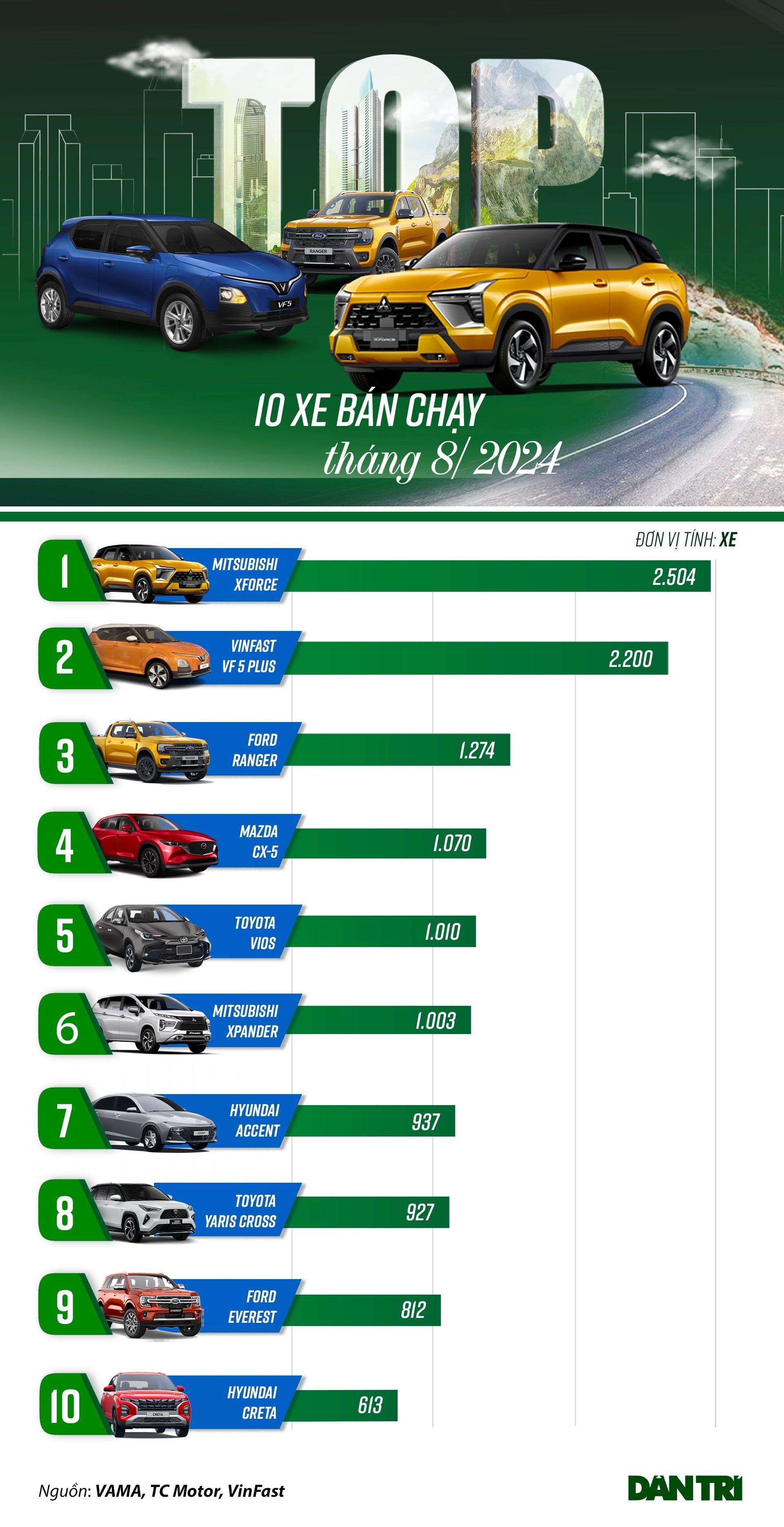
The downward trend in the market is clearly reflected in the list of the 10 most popular cars. Eight products recorded a decline in sales, with the last-ranked model selling only 613 units, yet still managing to make the top list.
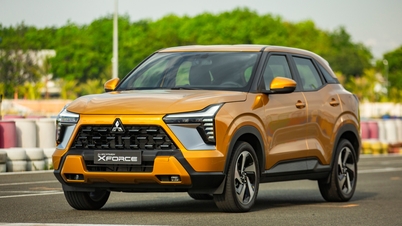
The best-selling vehicle was the Mitsubishi Xforce, with sales increasing by 43% compared to July. This position was previously held by the VinFast VF 5 Plus, but sales of this electric vehicle decreased by approximately 400 units in August.
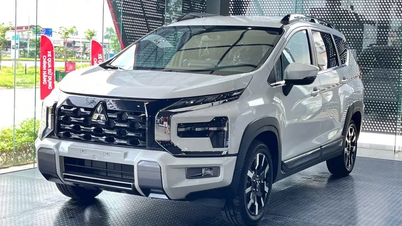
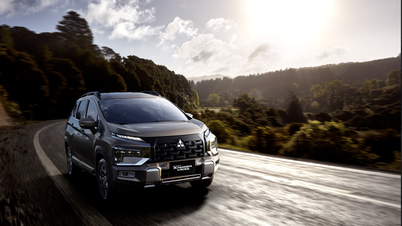
In contrast to the Xforce, another flagship product of Mitsubishi Vietnam, the Xpander, dropped to sixth place. Sales of this model reached 1,003 units, a decrease of nearly 33%, but it remains the best-selling model in the MPV segment.
Notably, when considering cumulative sales for the first seven months of 2024, the Ford Ranger surpassed the Mitsubishi Xpander with a total of 10,293 vehicles sold. The cumulative sales of the Xpander model were 10,268 units.
Besides the Xforce, the only model on the best-selling list to see sales growth was the Mazda CX-5. Compared to July, this product only sold 26 more units, but it was still enough to improve its ranking amidst the overall decline.
The remaining names are mostly quite familiar. Among them, Ford Ranger, Everest, and Toyota Vios continue to be the best-selling models in their respective segments (pickup trucks, D-SUVs, and B-segment sedans).
The Toyota Veloz Cross was the only name to disappear from the list of best-selling cars in August. Instead, the Hyundai Creta took its place at the bottom of the list.
Vietnamese consumers' preferences remain unchanged, still focusing on SUVs, with only two sedan models on the market. Japanese cars continue to be popular with five models, followed by American cars with two, while Korean and Vietnamese cars each have one representative.
The balance between domestically assembled and imported vehicles remains unchanged, with the respective numbers still at 6 and 4.
Source: https://dantri.com.vn/o-to-xe-may/loat-o-to-ban-chay-nhat-thang-8-ranger-giu-phong-do-xforce-but-pha-20240913142844279.htm
![[Live] 2025 Community Action Awards Gala](/_next/image?url=https%3A%2F%2Fvphoto.vietnam.vn%2Fthumb%2F1200x675%2Fvietnam%2Fresource%2FIMAGE%2F2025%2F12%2F16%2F1765899631650_ndo_tr_z7334013144784-9f9fe10a6d63584c85aff40f2957c250-jpg.webp&w=3840&q=75)
![[Photo] Prime Minister Pham Minh Chinh receives the Governor of Tochigi Province (Japan)](/_next/image?url=https%3A%2F%2Fvphoto.vietnam.vn%2Fthumb%2F1200x675%2Fvietnam%2Fresource%2FIMAGE%2F2025%2F12%2F16%2F1765892133176_dsc-8082-6425-jpg.webp&w=3840&q=75)

![[Image] The tenacious fighting spirit of Vietnamese women's football](/_next/image?url=https%3A%2F%2Fvphoto.vietnam.vn%2Fthumb%2F1200x675%2Fvietnam%2Fresource%2FIMAGE%2F2025%2F12%2F17%2F1765990260956_ndo_br_4224760955870434771-copy-jpg.webp&w=3840&q=75)
![[Photo] Prime Minister Pham Minh Chinh receives Lao Minister of Education and Sports Thongsalith Mangnormek](/_next/image?url=https%3A%2F%2Fvphoto.vietnam.vn%2Fthumb%2F1200x675%2Fvietnam%2Fresource%2FIMAGE%2F2025%2F12%2F16%2F1765876834721_dsc-7519-jpg.webp&w=3840&q=75)
![[Image] Leaked images ahead of the 2025 Community Action Awards gala.](/_next/image?url=https%3A%2F%2Fvphoto.vietnam.vn%2Fthumb%2F1200x675%2Fvietnam%2Fresource%2FIMAGE%2F2025%2F12%2F16%2F1765882828720_ndo_br_thiet-ke-chua-co-ten-45-png.webp&w=3840&q=75)




























































![[Live] Closing Ceremony and Award Presentation for the "Impressive Vietnam Tourism" Video/Clip Creation Contest 2025](https://vphoto.vietnam.vn/thumb/402x226/vietnam/resource/IMAGE/2025/12/17/1765974650260_z7273498850699-00d2fd6b0972cb39494cfa2559bf85ac-1765959338756946072104-627-0-1338-1138-crop-1765959347256801551121.jpeg)




















Comment (0)