

- Linking production to elevate the status of Ca Mau rice.
- Acceptance testing of an improved rice production model that reduces emissions in Ca Mau.
- Launching the Ca Mau Rice Museum and the proposed "three grains of rice" symbol.
 Vice Chairman of the Provincial People's Committee Le Van Su affirmed that Ca Mau will develop the rice industry in a modern, efficient, and sustainable direction.
Attending the workshop were Dr. Tran Minh Hai, Vice Rector of the School of Public Policy and Rural Development ( Ministry of Agriculture and Environment ); Mr. Huynh Huu Tri, Member of the Standing Committee of the Provincial Party Committee, Chairman of the Provincial Inspection Committee; and Mr. Phan Hoang Vu, Vice Chairman of the Provincial People's Council.
Ca Mau currently has over 185,000 hectares of rice fields, of which about 50% are rice-shrimp farming models, with an annual production of approximately 1.8 million tons. However, the rate of integrated consumption remains low, reaching only about 16.7% of the total production. Furthermore, the situation of unsustainable and breached contracts still occurs; infrastructure, logistics, and mechanization are not yet synchronized. The implementation of high-quality rice production models , organic rice, and low-emission rice production models under the Project for 1 million hectares of high-quality, low-emission rice in the Mekong Delta has only reached about 1,380 hectares, indicating limited scale.
At the workshop, delegates focused on analyzing the "bottlenecks" in the rice value chain, such as: production-consumption linkages, agricultural credit, market forecasting, cooperative capacity, the role of leading enterprises, and the carbon credit market. Based on this, several solutions were proposed, including: improving policy mechanisms for value chain linkages, strengthening the application of science and technology, digital transformation , developing concentrated raw material areas, and enhancing cooperative capacity.
 A view of the workshop connecting rice production and consumption.
Dr. Tran Minh Hai, Vice Rector of the School of Public Policy and Rural Development (Ministry of Agriculture and Environment), believes that the "four-party" linkage, comprising the State, scientists, businesses, and farmers, is an inevitable trend to solve the problem of fragmented agriculture, enhance value, and stabilize output for agricultural products.
 Dr. Tran Minh Hai, Vice Rector of the School of Public Policy and Rural Development (Ministry of Agriculture and Environment), emphasized that the "four-party" linkage model is an inevitable trend in sustainable agricultural development.
Labor Hero Ho Quang Cua, creator of the ST24 and ST25 rice varieties, believes that trademark registration is not just an administrative procedure but also a crucial "legal shield" for businesses, especially in agricultural sectors like rice, where product value is closely tied to reputation and origin. He emphasized that in the context of international integration and competition, failure to register for trademark protection in export markets could lead to the loss of the right to use one's brand abroad, causing economic losses and damaging the national image.
 Labor Hero Ho Quang Cua believes that trademark registration is an important "legal shield" for businesses.
Speaking at the workshop, Vice Chairman of the Ca Mau Provincial People's Committee Le Van Su affirmed that the workshop had comprehensively assessed the current state of rice production and consumption linkages in the province over the past period. This showed that linkage activities have made positive progress in both scale and effectiveness; the linked area has expanded, the number of participating businesses and cooperatives has increased, contributing to increased production value and gradually stabilizing output for farmers.
The Vice Chairman of the Provincial People's Committee stated that, in the coming period, Ca Mau aims to develop the rice industry in a sustainable, high-quality, low-emission direction that adapts to climate change; focusing on ecological production models, especially shrimp-rice farming; strengthening the application of science and technology and digital transformation; and building concentrated raw material areas with traceability.
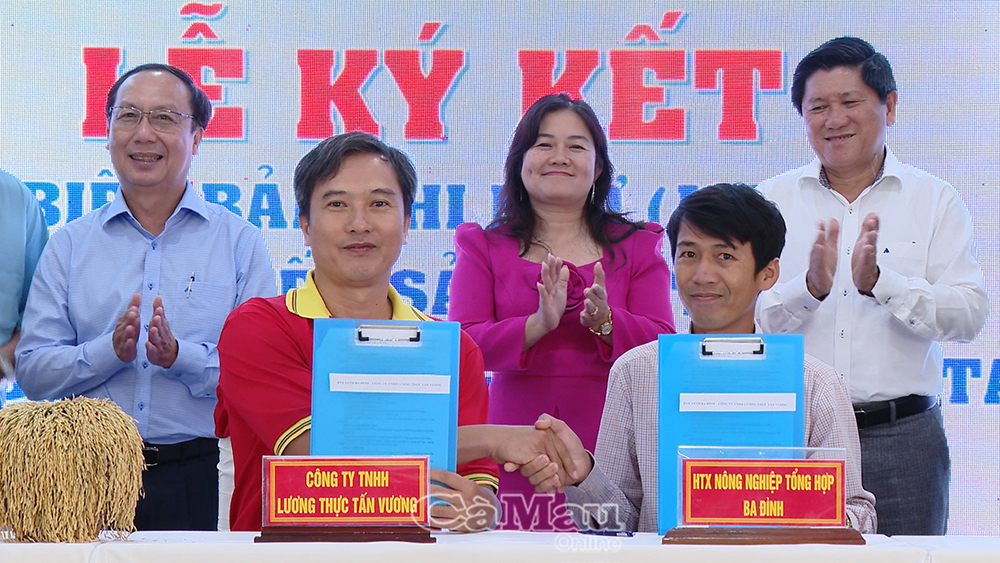 At the workshop, many businesses and cooperatives signed memoranda of understanding and contracts for linkage and guaranteed purchase of rice products.
Ca Mau will also promote value chain linkages according to the "four-party" model, in which cooperatives play the role of a bridge in organizing production, businesses lead the market, and farmers are the main producers. At the same time, it will strengthen trade promotion, support the signing of forward contracts, expand domestic and export markets; and continue to improve the investment environment, remove difficulties, and support mechanisms and policies to develop the rice industry in a modern, efficient, and sustainable direction.
Chuc Chi - Thanh Nhan
Source: https://baocamau.vn/lua-gao-ca-mau-huong-toi-giam-phat-thai-tang-gia-tri-a128262.html
![[Photo] Solemn bathing ceremony and Buddha procession in Hue](https://vphoto.vietnam.vn/thumb/1200x675/vietnam/resource/IMAGE/2026/05/31/1780228263543_1-jpg.webp)
![[Image] Hanoi Police officially crowned champions of V-League 2025/2026](https://vphoto.vietnam.vn/thumb/1200x675/vietnam/resource/IMAGE/2026/05/31/1780244769054_ndo_br_039d561b692be875b13a-jpg.webp)

![[Photo] The General Secretary, President and his wife begin their state visit to the Philippines.](https://vphoto.vietnam.vn/thumb/1200x675/vietnam/resource/IMAGE/2026/05/31/1780230559452_anh-man-hinh-2026-05-31-luc-19-28-11.png)
![[Photo] Admire the coral "masterpiece" amidst the million-year-old heritage of Dak Lak province.](https://vphoto.vietnam.vn/thumb/1200x675/vietnam/resource/IMAGE/2026/05/31/1780221235105_anh-man-hinh-2026-05-31-luc-16-53-27.png)













![[Video] Sunset at Lap An Lagoon – Where the sun sets over the fishing nets](https://vphoto.vietnam.vn/thumb/340x192/vietnam/resource/IMAGE/2026/05/31/1780192137701_beach-landscape-sea-water-nature-grass-745871-pxhere-com.jpeg)





























![[Photo] Admire the coral "masterpiece" amidst the million-year-old heritage of Dak Lak province.](https://vphoto.vietnam.vn/thumb/402x226/vietnam/resource/IMAGE/2026/05/31/1780221235105_anh-man-hinh-2026-05-31-luc-16-53-27.png)






























Comment (0)